Home Blog Page 784

A parking pass too far

0

Bromsgrove town centre is looking more and more shabby and neglected, ever more shops and businesses closing down, on-street parking reaching epidemic proportions, a very expensive but underused multi-storey car park – and the people who run our district council are trying to squeeze even more money out of car parking.

Is this madness or maybe the present administration writhing in its death throes before they are finally rejected by the electorate at next year’s full council elections.

While all of us in Bromsgrove suffer from burdensome parking charges, not levied as heavily by neighbouring towns, I sometimes wonder whether even Asda might reconsider its position in the town as it labours against unfair odds with other local supermarkets that can offer free car parking facilities.

As a Concession Parking Pass holder I feel I must add a few words on the subject. I use my pass on average probably about a dozen times a month; this includes taking my 91-year-old mother to do her shop at Asda once a fortnight.

Having lived in Bromsgrove for 40 years I do try and do as much of my shopping as I can in the town to support local traders, and I can only say that I was at least surprised, almost embarrassed to learn that my Pass is such a financial burden on the town’s monetary resources.

However, I suspect Councillor Sherrey’s report that it costs £15 to process a pass is in fact a good indicator of a far more fundamental and deep-rooted problem in the way our Council conducts its business.

In conclusion I would like to say that I suspect, like many others, should the £30 Concessionary Parking Pass become a reality I will not be renewing mine, which will, I fear, inevitably influence where I shop in the future.

However, at my own expense I will have my old pass framed, so that hopefully after next April’s elections Councillor Sherrey will be able to hang it on her wall as a memento of the time she spent serving the people of Bromsgrove.

David L Pardoe
Supporter Independent Group
Bromsgrove District Council

Police pledge speed crackdown

The police have promised to tackle speeding through Alvechurch village as part of a community partnership initiative.

Traffic problems topped a poll of villagers’ concerns along with anti-social behaviour by some teenagers and the lack of effective beat policing to tackle it. Police said they would be reporting back on their progress in two months.

The issues were raised at the first Partners and Communities Together (PACT) meeting in the village at Alvechurch Social Club.

Sgt Mark Ashford, of B Division, told villagers that crime had fallen every year since 1995, yet two thirds of people believe crime is rising.

“This lack of confidence and security is damaging local communitites, “ he added, explaining that PACT aimed to help to ease fears.

He introduced PC Lucy Thornton as the beat manager for Alvechurch, although he admitted that this role was in addition to also being the beat manager for Wythall. Budgetary constraints restricted the availability of beat officers.

When asked why the village couldn’t have an officer living there, as used to happen, Sgt Ashford said: “That isn’t going to happen.”

Villagers were then asked to highlight their main concerns, which were then listed and voted on.

Many of the complaints came under the banner of “problems with teenagers”, ranging from “general wanton destruction”, to “abuse of churchyards”, “vandalism at schools and library”, “under-age drinking” and “fires in Tanyard Lane car park”.

There was also the general view that effective, visible beat policing would solve this.

One resident asked: “Why is it not possible for a beat policing system to be reintroduced or at least a police-on-the-street presence be shown at times when officers would otherwise not be involved in active police work?”

There was also a wide consensus that traffic was still using the village as a rat run, despite the bypass. There were particular problems with speeding traffic on either side of the village traffic calming – Redditch Road and Swan Street, to the south, and Birmingham Road to the north.

Residents also complained about traffic speeding down Snake Lane, Tanyard Lane and Bear Hill.

There were also complaints of cars parking in village centre time-restricted spaces all day instead of the one hour allowed and also untaxed cars being “stored” in Tanyard Lane car park, taking up spaces for villagers.

The three issues voted top of “action” issues for the police to work on were: Beat policing, speeding traffic and teenagers late at night.

Teenager’s parents back village road safety move

The parents of Alvechurch teenager Andrew Perrygrove, who received severe brain injuries in a traffic accident 15 months ago, are backing community efforts to improve road safety.

Glenn and Andrea Perrygrove have supported public calls to limit the speed of traffic through the village and to improve road safety awareness among local children.

Andrew, now aged 14, was in collision with a van after stepping off the school bus in Birmingham Road, Alvechurch, in December 2004.

After months of intensive care he is currently being cared for at Tadworth Court in Surrey, one of the UK’s top rehabilitation centres for young people with acquired severe brain injury.

While his condition has stabilised enough for him to make regular trips back to Alvechurch in a specially-adapted vehicle loaned by the unit, his family hopes he will soon be able to be cared for at home permanently.

Along with concerned friends and neighbours, they have set up a trust fund to raise money for much-needed resources. They hope to buy an adapted vehicle of their own and carry out essential alterations to their house to make it suitable for someone with high dependency needs.

Road safety was high on the public agenda at a Partners and Communities Together (PACT) meeting organised by West Mercia Police at the Alvechurch Sports and Social Club last month.

Meanwhile, Andy’s former school, Alvechurch Middle School, is at the forefront of efforts to improve road safety among pupils and has organised a cycle safety programme as well as other awareness-raising events.

The Perrygrove family home is not far from the scene of Andy’s accident and his parents have often expressed their private concern over the dangers facing children crossing roads in the village, especially at peak times.

“We are very pleased to hear that improving road safety in Alvechurch is considered a priority by local people,”  said Glenn. “We don’t want any other family to have to go through our experience.”

Andy’s Fund, which was launched by family and friends of the Perrygroves last November, has so far raised £25,250.

At a second public meeting held on March 9 by the fundraising co-ordinating committee, chair Dawn Dearden said the efforts made by the community had so far exceeded all expectations. 

“Andrea and Glenn wish to express their enormous gratitude to everyone who has helped with the fundraising efforts so far.”

Many more events are planned for the coming months, including a concert at Alvechurch Middle School and a family fun day at the Golden Lion public house in Charford, both scheduled for May. Local volunteers from Redditch Lions are also busy with fundraising activities.

Further information about Andy’s Fund, contacts and details of forthcoming events are available at: https://www.andysfund.org

Fun and friendship

My First Friends

A children’s nursery rescued from closure by a Barnt Green mum has now been ranked amongst the top nurseries in the country.

My First Friends Day Nursery and Pre-School in Rubery, acquired by Caroline Lyle five minutes before it was closed by the administrators of its previous owners in August 2004, has been graded as “Outstanding” by Ofsted.

It is anticipated that only around 3 per cent of nurseries in England will receive this grade.

“We are absolutely delighted with the Ofsted report, as it reflects the huge effort that everyone has put into the nursery,” says Caroline. “My First Friends operates from one of the best childcare facilities in the Midlands.

“However, we are aware that the quality of childcare needs to match the quality of the facility, and the activities we offer are both educational and fun.“

The nursery, which operates from a purpose-built facility on the Great Park complex, is ideally located for parents from this area who work in Birmingham, as they are able to drop children off en route.

The building is set away from the main road and Caroline ensures that a safe, friendly childcare environment is maintained.

My First Friends has a restaurant-grade kitchen on site and a chef who prepares fresh food each day – the chef is also an experienced nursery assistant and spends time with the children teaching them to make biscuits and cakes.

Children can also take advantage of dance, music and French classes, as well as IT equipment. They often make trips to nearby attractions such as the safari park, zoo or bowling alley.

Twelve of the 14 full-time staff inherited in 2004 are still employed at the nursery, which Caroline says is a sign of a positive working environment in an industry where staff turnover is generally high.

“We strive to make My First Friends an outstanding place for children, parents and staff alike,” says Caroline. “However, things don’t stop there. We are still growing and looking to improve our offering.

“For example, we are trialling a holiday club at Easter and if this goes well we will be looking to roll it out later in the year.”

If you are interested in a personal tour of the nursery call Caroline Lyle on 0121 453 6206.

The nursery has vacancies for qualified nursery nurses – please contact Vicky on the above number or send your CV to My First Friends, Ashbrook Drive, Great Park, Rubery, B45 9FP.

Above: Helen McKeever, Jack Lyle, Caroline Lyle, Lori O’Brien, Viv Malone.

Bright ideas

0

Bandolera

. . . at Joolz of Barnt Green

ADVERTISEMENT FEATURE

LATIN LOOKS YOU’LL LOVE
Spanish label Bandolera, a favourite with Joolz customers, goes Latin this season with a fun and girlie collection including frothy skirts, cut-out patterns and tropical colours (right).

Elsewhere, there are colonial and prairie influences in brown and natural shades.

GOING DUTCH
New at Joolz is Dutch label Belissima, featuring a range of very unusual separates embellished with details like ribbons, patches and lace.

Well-cut, flattering fabrics like linen and soft denim predominate in the spring collection.

OVER THE RAINBOW
Passigatti’s new spring-summer collection has the usual blend of fun and sophistication, with bright exotic colours, shimmering threads and embroidered flowers to jazz up any outfit.

A selection of sarongs in complementary colours is in store.

FANCY FOOTWORK
You know summer is on its way when shoes start getting strappy, and Joolz stocks plenty of beautiful examples from labels like Esino and Valentina Russo, many featuring the ultra-trendy slim wedge heel.

Comfort is also a major factor, with soft leather uppers and soles meaning even toe-thongs can be comfy!

IN THE BAG
It’s always fun to mark the start of a new fashion season by splashing out on a new bag, whether it’s a small handbag or a holdall ready for the holidays.

Bulaggi offers tropical fish and floral designs, as well as colourful basket or woven styles and soft, squashy day bags.

Look out for the extremely popular Radley bags, coming soon to Joolz!

JEWELLERY QUARTER
Pilgrim jewellery follows the trend for bright colours this season, with pretty pinks and yellows sitting alongside seaside shades of turquoise and sand. Bag clips are still the accessory of choice.

Meanwhile, the Topaz Glow range also takes inspiration from the beach, with cute shell and starfish motifs. A selection of Mexican silver jewellery is expected soon!

CITY CHIC
In contrast to the bright colours seen in other collections, Antonelle offers a more monochrome palette perfect for chic city breaks – one shirt even features a sketchy cityscape design.

The incredibly soft fabrics make the garments even more pleasurable to wear.

Don’t forget – Joolz also stocks intricate hand-knitted pieces from Israeli label Double U, and stylish separates from Polish designers Imprevu.

45 Hewell Road
Barnt Green
0121 445 4657

Inspector directs highly unusual planning drama

The Village magazine attended all three days of the public inquiry into plans for a rendering plant at Mayfield Farm, Hopwood – and we could fill every free page for the next year with what was said.

Instead, and to use an appropriate expression in this case, we’ll boil it down to just four, while striving to be fair to all sides in what was at times an emotion-charged drama.

Simply put, we were told by those who want to process around 85 tonnes of lamb and chicken waste on the site each day that the proposed plant would be of such state-of-the-art quality it would cause no problems for anyone.

In fact, the smell-reducing thermal oxidiser, for which the chimney at the nub of this planning appeal is required, would make life better than it is at the moment.

On the other side, backed by around 1,000 letters of objection, were those people who say their lives and livelihoods have been affected by activities at Mayfield Farm in the past and who believe a new, expanded operation is undesirable.

Directing this drama was the Government-appointed planning inspector, Brian Sims, standing, as he put it, in the shoes of Deputy Prime Minister John Prescott.

From the opening scene, however, it was not to be straightforward action and was, as Mr Sims often reminded us, set within “highly unusual” circumstances.

This was because at the 11th hour, Worcestershire County Council had decided to withdraw its objections to the 17 metre chimney.

Even the leader of the council, Dr George Lord, said he was surprised by the move, in which the county planners said they believed “the potential very special circumstances” for allowing the chimney had now been shown, adding: “On this basis, it is appropriate for the county planning authority to withdraw their objections to the appeal process.”

The result was that the proceedings were left somewhat out of balance. On the one side was the team of the appellant, Mick Robbins, featuring barrister Jeremy Cahill QC, planning expert Peter Horridge and air pollution expert Darren Hall.

On the other was a barrister, Conrad Rumney, representing the county council. However, after outlining the county’s decision to discontinue its opposition, he maintained mainly a watching brief for most of the remaining three days.

The feeling from the large number of people who had forsaken their usual Tuesday activities to attend the first day – more than 100, and so many that the rear doors of the council chamber at Bromsgrove had to be opened to create sufficient space for them – was that democracy had deserted them.

But two men came, as best they could, to the rescue. The first was the inspector himself who, recognising the people felt unrepresented, bent over backwards for the whole inquiry to allow everyone to have their say, some over and again.

The second was in the form of Hopwood salesman Jeremy Roberts, representing HARM – Hopwood Against Rendering Movement. As he admitted, nervously, to The Village just as proceedings were about to begin, he’d rather have been “selling electrical things” than representing the hopes and fears of hundreds of people in such an adversarial setting.

Mr Roberts need not have worried, as he played his part in the inquiry with the appearance of someone with years of legal experience behind him.

The hearing began, however, with pleas for it to be halted there and then. Mr Roberts told the inspector: “We would like to submit an application for adjournment.”

The sudden change of mind by the county council meant objectors “had been holding on to false hopes”.

Coun Lord, who is also the county councillor for Alvechurch, said: “I speak on behalf of the people. I support the application for adjournment.

The planning committee of the county council has not heard the so-called recent evidence and I would agree that we adjourn this until the planning committee has heard the evidence.

“I have no idea what the officers have agreed behind my back, or indeed that of any other member. It seems to me that democracy is being undermined by this procedure and I ask you to abandon this inquiry for three months.”

Coun Lord’s words brought a round of applause from the public – the first and last of the entire hearing as Mr Sims warned he would not put up with such behaviour.

Bromsgrove District Councillor Brian Fuller added his voice to the plea for adjournment: “Whether we like it or not, we live in a democracy. There is new evidence of a very significant kind. I have not had time to consider this, nor has the district council, nor have the local people.

“The fact is, sir, that the county council planning committee and the elected members of that committee have not had an opportunity to examine the new evidence and make a determination on it. And that, in a democracy, must be wrong.

“These are local folk, ordinary people with ordinary jobs and ordinary incomes. They have already given support beyond their means, and it was with a sense of relief to hear that the county council was carrying the banner.

“Now they have been badly let down. Their natural right to be defended has been denied by the county council’s decision to pull the plug.”

But Mayfield Farm’s barrister, Mr Cahill, explained that this was an appeal against “non-determination” by the county council and that as the decision had now passed to the inspector, it was no longer up to them.

After deliberation over lunch, the inspector told the inquiry: “My duty is to ensure a fair hearing of this planning appeal. The county council evidence is still in the public domain for reference and I believe the best way forward is to make use of the time set down for the inquiry without delay.”

Mr Sims said he would leave open the decision whether to complete the inquiry until after he had heard the opening submissions.

The inquiry first heard from pollution expert Mr Hall, from Entec UK, consultants hired by Mayfield Farm. He said a thermal oxidiser – which costs around £400,000 to install – was the “best available technique” (BAT) for odour reduction and was what a lot of rendering plants aspired to.

“It is my experience that the thermal oxidiser can reduce the odour concentration by at least 98%.”

The inspector asked Mr Hall: “What is the likelihood that one day there is a dirty great pong over Hopwood, the chance of a great smell just as someone is celebrating a wedding in their garden?”

Mr Hall replied: “In my experience it is reasonably unlikely if the system is maintained properly.” He agreed it would be “probably” less than once a year.

The planning expert, Mr Horridge, then told the inquiry the Robbins family had been rendering catering and slaughterhouse by-products at Mayfield Farm since 1961 to produce swill for pigs on the farm and for sale to other farms, with the fats and oils produced by the process sold to the chemical industry.

Fumes from the cooking equipment were vented by a 15 metre chimney.

The enterprise was, however, badly hit by the foot and mouth outbreak of 2001. “The Robbins lost 3,500 pigs, which were slaughtered,” said Mr Horridge.

“Moreover, in the aftermath of foot and mouth, the Government banned the feeding of swill to pigs.

“Faced with the loss of two sources of income – pig farming on the site and the sale of much of the animal feed processed on the site – the Robbins decided to diversify by . . . selling to the next available market, the pet food industry.”

This entailed a different process and coincided with tightening of environmental regulations requiring a Pollution Prevention and Control (PPC) licence for such operations.

Following the issue of a “certificate of lawfulness” by Bromsgrove District Council in September 2001 for the “preparation and processing of animal feed” at the site, Mr Horridge said the Robbins ordered new rendering equipment and a thermal oxidiser – which would reduce smells so the operation could meet PPC regulations.

Before they could apply for a PPC licence, however, they were told by Bromsgrove’s environmental health department that a new certificate of lawfulness was required, covering “use for rendering animal by-products to produce animal feed”. This was granted in February 2003.

It was at this point that the chimney, required for the thermal oxidiser, became the focus, with a planning application for a 25 metre stack made to Bromsgrove in April 2003. After legal wrangling between the district and county councils over which one should make the decision, it was eventually accepted by the county and passed to their jurisdiction in December 2003.

Mr Horridge told the inquiry that after planning officers at both Bromsgrove and Worcester had indicated opposition to the chimney on planning grounds, the Robbins sought to establish if a lower chimney would be feasible.

The manufacturers advised that the 25 metre stack had used data “which gave a degree of comfort over expected emission values”. The appellant’s pollution experts then used new values to recommend a chimney height of 17 metres – the height on the application to be considered by the county council.

At this point, in April 2004, the county officer dealing with the application wrote to the agent of the appellants:

“If the confirmed height of 17 metres for the chimney in this application satisfies the requirements of the (PPC) regulations and is acceptable to the Environmental Health Officer, your clients’ planning application would receive a recommendation for approval because that would constitute the ‘very special circumstances’ necessary to justify granting planning permission for what would otherwise be ‘inappropriate development’ in the Green Belt.”

Mr Horridge told the inquiry: “We have, of course, now reached the stage that the Bromsgrove Environmental Health Officer accepts the 17m height and that it satisfies PPC regulations and consequently the pre-condition for the county council officers recommending approval has been met.”

He went on to give evidence that the visual impact of the new chimney would be “imperceptible” and that even if it was thought there would be “visual harm”, the need for the chimney to meet the PPC requirements to run a lawful, existing business would outweigh that harm.

“Allowing this chimney to be installed will enable the rendering activity at Mayfield Farm to continue. However unpalatable it may seem, it is an important and necessary part of an important industry,” said Mr Horridge.

“Additionally, the resumption of rendering on site at Mayfield Farm will reduce the volume of lorry traffic into and out of the site.”

Mr Horridge said this was because at the moment the farm was being used as an animal by-products sorting site and so the volume leaving the site was the same as that entering.

He admitted there had been a “huge” number of letters of objection, but the appellant believed much of this was based on a misunderstanding of what was involved.

“Some letters have alleged concerns over the conduct of the appellant. Mr Robbins has asked me to point out that he has always co-operated fully with the authorities,” he added.

The inquiry then heard from Barry Clarke, general manager of the Westmead Hotel – now part of the Corus group – at Hopwood.  “Over previous years the hotel has suffered from malodours which have been generated by the pig farm,” he said.

“There is a history of bad odours emanating from the farm not being managed so that they affect events at the hotel. We have had to deal with complaints and have lost business because of the odours.

“We have heard of four jobs that may be generated by Mayfield Farm; I am talking about 50 jobs that could be put in jeopardy by this application.”

Resident Gail Simpson then told the inquiry: “I live 69 metres from Mayfield Farm, in Waterside Orchard. Their business will affect us for the rest of our lives. The effects of rendering plants are noise and smell and they can cause great misery.

“Mayfield Farm has a bad track record on environmental issues. This will be the company in charge of the thermal oxidiser – you can understand the anxiety this causes us,” Mrs Simpson told the inquiry.

“I’m not denying the usefulness of rendering plants, but not in a residential area. This is one man, one family and one aim – profit – against the lives of hundreds of ordinary people.”

Mr Robbins’ barrister, Mr Cahill, asked Mrs Simpson: “If planning permission were to be granted and that were successful in suppressing odours, that would be something you would welcome?”

She replied: “There is the matter of trust, and we do not trust these people.”

Mr Cahill pointed out that if Mr Robbins went against the tough new pollution controls, he would be in trouble with the authorities.

But Mrs Simpson said: “We phone up the council, we complain, they come and yet nothing seems to be done. At the end of the day, it is too near a residential area. I don’t want to move because I like where I live, apart from this. Who wants to live near this?”

To which Mr Cahill replied: “If I had a rendering plant over the road, with a lawfulness certificate, I would rather have it controlled than not.”

Retired Barn Green GP Dr Tony Armond told the inquiry that St Andrew’s School, Barnt Green, was only 1.5 miles from Mayfield Farm. “They know fumes have arrived there from the pig farm and they fear emissions form the rendering plant would also affect the school.”

He also said there was a real risk of “thermal inversion” in this area, which could lead to the emissions not escaping into the atmosphere. “We should not use the population of Barnt Green, Hopwood and Alvechurch as an experiment, an experiment for which we shall not know the results for 50 years.”

Bromsgrove Conservative Party secretary Rita Dent read out a statement from MP Julie Kirkbride, who said: “The increased scale of the rendering processes at Mayfield Farm is wholly unacceptable in an area so close to housing. The site has a long history of noxious fumes, causing blight for residents living locally.

“The issues are not – and should not be – purely technical, based on planning law. There are question marks about the safety of the chemical processes and we remain convinced that industrial scale rendering such as this should on public safety grounds be located in areas well away from major population centres.”

At this point, the inspector decided he would not adjourn the inquiry – in spite of hearing from Coun Fuller that the mis-match of legal abilities was “a bit like Hopwood Boys Football Club taking on Real Madrid”.

Mr Sims said: “I must balance the rights of you as interested persons with those of the appellant.”

The objectors were then taken aback by an announcement by Coun Frank Molloy, who said he was acting as the representative of Alvechurch Parish Council, which had previously objected to the plan.

“Alvechurch Parish Council has withdrawn their objection in line with Bromsgrove and Worcester County Council,” he told the inquiry.

This led to much to-ing and fro-ing the following day as attempts were made to establish what had happened.

Coun Molloy first said: “I would like to clear the situation of my remark yesterday. The [parish council] chairman has been in contact every evening regarding this and that was the line I was instructed with.”

He was asked by Mr Roberts for further clarification, asking if this decision had been “taken democratically or by one or two individuals”.

Then a letter dated that day was brought before the inquiry from Alvechurch Parish Council stating: “The objections of the Parish Council have not been withdrawn.”

Coun Molloy asked: “Who signed that letter?” and was told by the inspector it was properly addressed and signed by the parish clerk, Yvonne Goode.

Despite Coun Molloy saying: “I wish to differ”, Mr Sims said that as the letter appeared to be the official statement of the council’s position, it was the one he would take into account.

Meanwhile, Mr Roberts outlined HARM’s objections to the plans. Central to these were public concern over the “possible adverse impacts from emissions from the chimney on the surrounding area”.

He said: “We are worried that the site has not been properly managed in the past and environmental laws have been flouted. There has been persistent bungling by the district council over this site and they have patently shown they are incapable of controlling the site and its operations or the owner.

“There has also been no public consultation or consultation with elected representatives to allow the site to be developed to its current state.

“The plan to allow the site to use its certificates of lawful use to change the use from pig farming to an industrial incineration factory are a cynical perversion of the planning laws which continue to frighten residents in the area.

“The visibility of the stack will be a constant reminder to the residents of the pollution, which they are being asked to suffer at the hands of the few benefiting.

“The Kidderminster planning inspector on July 10 2002 concluded that public perception was a negative factor of some significance in that case. It was also concluded that concern about development proposals is a material consideration in planning decisions. The people of this area would ask you to do the same.”

The second day ended with the inspector being told that the plan was for the site to run five days a week, from Tuesday to Saturday, and it would be open from 6am to 6pm, with the machinery operating for eight hours a day.

The quantities involved in the present operation involved 600 tonnes of poultry and fat and bone coming in and out of the site to be sorted – requiring around 96 12-tonne lorry loads.

The planned rendering operation would see 725 tonnes of poultry, fat and bone and lamb coming into the plant, but, after processing around 512 tonnes leaving. It was believed the present operation would continue in some form alongside the new rendering processing.

At the start of the final day Mr Roberts chose not to be cross-examined by Mr Cahill, saying he feared he may prejudice himself. The inspector then allowed Gordon Britton, the immediate past chairman of Barnt Green Waters, to make a statement on behalf of Barnt Green fishing and sailing clubs.

He told the inquiry: “Our members have no confidence that, if the chimney is erected and the rendering plant is in continuous operation, that malodorous emissions will be controllable.

“The crux, as stated by the Health Protection Agency is ‘if regulated and managed well’. In an academic perfect world this would be the case, but in view of past experience in the context of Mayfield Farm, we have no confidence that this is achievable.”

The next witness was Independent Bromsgrove District Councillor Jean Luck, who told the inquiry she had been an elected member for the Alvechurch ward since 1987. “I speak from the point of view of the real fear based on bitter experience over many years.

“It got to the point where the environmental health officer said the best equipment was in there and he couldn’t understand why it was breaking down.

“There were many promises made and broken about the environment and there were several prosecutions. In my opinion the prosecutions were nothing to do with the state-of-the-art equipment, but everything to do with the appellant being unable or unwilling to act responsibly either as a good farmer or as a good neighbour.

“There is a very real fear that nothing is going to change and the people will be left with a very, very bleak future.”

Mr Cahill asked Coun Luck if she wished to stand by the statement about the appellant not being prepared to be a good farmer or good neighbour. She replied: “I am saying that I don’t know whether all this misery is because he is unable to do anything about it or unwilling.”

Mr Cahill pointed out that in a letter of 2001 another Alvechurch ward councillor, Conservative June Griffiths, had paid tribute to Mr Robbins for implementing odour control methods at the plant.

In his closing submissions, Coun Fuller said: “The letter written at the county council in April 2004 was a shot in the foot and, I feel, that’s why the county had to withdraw their objections.”

He went on: “The certificate of lawfulness was granted in respect of 10 years of swill boiling. What we are now looking at is a considerable change to a very substantial industrial process with a chimney that has five times the capacity of the present one.

“If the appellant continues with the waste transfer process, there would be more than 1,000 tonnes of material a week going on to the site and more than 800 tonnes coming out of it. That’s a massive change in intensity of use.”

Then Mr Roberts, in his closing submission, said: “We are told the emissions fall within the limits set by the Air Quality Directive. When we pressed for further information about the source data we were told it was in our district, and pressed further, not our district, but in fact Birmingham Airport.

“It was in another county on a flat open piece of land and did not take into account the problem of our motorway, main road, complicated by a canal and being surrounded by hills.”

Mr Roberts continued: “The applicant is infamous in the area with regard to complying with environmental and planning law . . . and this must be a consideration when making a decision about this chimney.

“The PPC application will not permit Mr Robbins to operate the plant, but he will be signing the cheques with regards to the plant. I implore you to make sure he can’t write the cheques with regard to the health and fear of this community.

“I urge you to refuse planning permission on the grounds of public fear, which is a material consideration.”

Summing up for Mr Robbins, Mr Cahill said: “The matters that have been raised are important and I don’t want people in this room to think anything other than that air pollution is very important.”

But he added: “Any anxiety that is brought about by misinformation does not constitute risk. Perception of risk is a self-fulfilling prophecy.”

Mr Cahill said the “planning bible” put the issue as follows: “Public concern must be justified, for if it were not, no industrial development would be permitted.”

He added: “I would say that the public concerns are completely and entirely covered by the pollution control regime.”

Mr Cahill said the “very special circumstances” required for development in the Green Belt was a balance, with harm on one side and benefit on the other – “the concatenation of the beneficial effects”.

In this case the benefits were that the site would meet planning rules, it would bring better environmental control, allow diversification, increase employment and create a valuable product.

Turning to Mr Roberts’ use of the word “incinerator” for the thermal oxidiser, Mr Cahill said: “This is not an incineration plant, it is a rendering process where animal parts are boiled. This will have alarmed people unnecessarily.”

On claims of concerns over noise, Mr Cahill said that the county council had been “silent” and equally there had been no objection by the highways authorities over the movement of lorries to and from the site.

Mr Cahill said there had been “deliberate alarmism” over the plan. “It does no service to spread unnecessary and alarming rumour. There is no evidence at this inquiry that pregnant women or children will be harmed.”

On Coun Fuller’s complaints about the certificates of lawfulness, Mr Cahill said they were “entirely without merit” as the certificates included the “proposed use” intended by Mayfield Farm.

Finally, Mr Cahill told the inspector: “This is a development which should be granted planning permission subject to appropriate controls.”

The inspector, Mr Sims, closing the inquiry, said: “I believe I have enough information to make a fair and proper decision.”

This would be within four weeks and a day.


Easter invitation

Six months into her new job as Baptist minister in Alvechurch, Fiona Lee is extending an Easter Invitation to the people of the village.

Impressed by the way she has been made welcome here, thirty-something “thoroughly-modern” Fiona is keen to meet more of the Alvechurch folk.

“We have lots going on in the week up to Easter, but I would like to concentrate on three events,” she explains. “On Friday April 7, there is to be a special Mums & Toddlers Service.

“On Easter Sunday, from 9-10.15am, we have an Easter Breakfast and we hope that some of the people who come for breakfast will stay for the Easter Celebration Service at 10.30am in the chapel itself.”

For more information call Fiona on 0121 447 7369 or visit https://www.alvechurchbaptist.org.uk 

Lift that left a lot to be desired

0

Perpendicular lift

In our March issue, we told you about the Rev Alan White’s new book, The Worcester and Birmingham Canal: Chronicles of the Cut, which details the canal’s complete history.

One of the most interesting chapters, at least for people in the nearby area, concerns the story of how the locks that make up the famous Tardebigge Flight were almost never built – and with thanks to Rev White, we have abridged part of the tale here.

In 1809, when the Worcester and Birmingham Canal Company was about to start the last stage of the canal’s construction from Tardebigge to the River Severn at Diglis, it planned to incorporate a series of locks.

In order to supply the water, it would be necessary to use steam pumping engines and storage reservoirs so that water could be pumped from the river in stages to the summit level at Tardebigge.

It would be a costly method, but the Birmingham Canal Company had refused to supply water, despite assertations that it did have enough to spare – plus the Canal Act of 1791 had decreed that no reservoirs supplying the canal were to be built north of the Parish of Tardebigge.

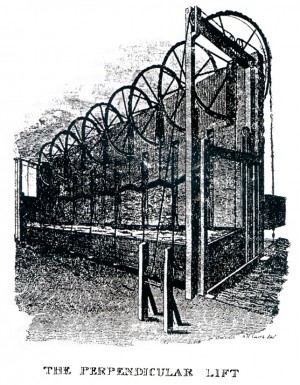
However, there was another way in which both money and water could potentially be saved. For several years, engineers had been experimenting with boat lifts, whereby a boat could be winched up in a “cradle” and then “floated” into the next section of canal.

This method avoided a substantial loss of water and was said to cost far less.

The Worcester and Birmingham Canal Company was approached by John Woodhouse, an engineer on the Grand Junction Canal who had obtained a patent for a vertical boat lift. He offered to construct this design, at his own expense, for a trial, and this took place in February 1810. 

The lift proved capable of raising a boat by 12 feet in less than three minutes, impressing everyone present, and the company paid Woodhouse £1,000 for the machine.

When a longer section of the canal had been completed, another trial took place in June – but this time the event was not so successful. While the “cradle” containing the boat and several members of the Canal Committee – plus civil engineer John Rennie – was being winched upwards, the machinery that maintained the correct water pressure was not properly deployed.

The cradle shot up to the higher level, the speed of its arrival causing injury to one of the men operating the winding equipment and breaking one of the wheels.

Unsurprisingly, the accident raised concerns about the safety and reliability of the Woodhouse Lift, particularly after another inspection when Committee members witnessed more problems with leakage.

On July 3, an Assembly of Shareholders met to decide how to proceed. Most were in favour of abandoning the lift project, but in the end it was resolved to hold more trials in January 1811 when more of the canal had been built.

As it turned out, the Tardebigge Tunnel was still not in use by that date, but at a New Year meeting the shareholders voted unanimously to use locks rather than lifts.

Crucially, even Woodhouse now advised the adoption of the lock system. But the lift still had its supporters, namely a group of proprietors of the canal who wanted further trials. At their own expense they organised a month’s trial, to be followed by a Special Assembly at which the final decision could be made.

The trials were not officially endorsed by the Committee, who were annoyed that some of the Company’s own employees were being used to operate the lift.

When William Ward Eagle, a staunch lift supporter despite actually being a Committee member himself, arrived to supervise the start of the trial, he found that the machinery had mysteriously been screwed so tightly that it could not be used…however, a complaint to the press soon brought about an agreement with the rest of the Committee, and the trial could begin.

But more machinations were to come. When Eagle’s report on the trials was posted to all shareholders, dated March 22, he did not realise that on February 16 – before the trials had even begun – the Committee had already taken the final decision to proceed with locks, fully intending to keep this decision secret from the opposition until the Assembly on March 26.

The meeting nevertheless generated much debate, and it was finally agreed that although locks were to be built (using three supply reservoirs and surplus flood water from the River Rea), the lift could also continue to work while the canal was finished.

On May 27, the lift was struck by lightning and damaged. The Committee said it should not be repaired, but was overruled at an Assembly in July – Woodhouse was given £60 with which to carry out repairs.

In August that year, Woodhouse moved to a different stretch of the canal, but his replacement, William Crosley, continued to use the Tardebigge lift for moving construction materials.

Sadly, in 1813 it was damaged further through the neglect of an employee appointed by Woodhouse, with the result that serious flooding occurred.

This was the final nail in the lift’s coffin, and the Committee ordered it to be dismantled. The machinery was finally disposed of a few days before the canal’s official opening in November 1815.

*  To read the full story, you can buy Chronicles of the Cut from Ottakars on Bromsgrove High Street, from https://www.brewinbooks.co.uk, or from Rev White – call 01527 877955.

English country gardens

Verbena bonariensis

Hannah Genders’ tips for creating a cottage garden.

March is a great month for gardeners – after the long winter we feel as if we are coming alive again along with our beloved plants. Jobs in the garden start in earnest now and many of the vegetables can be planted later this month.

March is also a great time to look at flowering plants especially if, like me, you love the perennial plants. Perennial, as its name suggests, is any plant which flowers year after year – traditionally they die down each winter, as opposed to a shrub which will keep a structure in the winter months even if it loses its leaves.

These perennial flowers are the backbone of our traditional cottage gardens and we are fortunate in this country to have a massive choice (maybe too much choice for those of you new to gardening); they are such versatile plants and can be used in a number of ways.

A herbaceous border, as seen in many of our great country houses, would be almost entirely made up of perennials, usually planted in drifts for maximum effect.

So it’s well worth a visit to Sissinghurst or Packwood House in early summer to gain some inspiration for you own garden – but do take note: the reason this style works well from a design point of view is that the soft planting is set off by the very strong structure around it, either yew hedging or old brick walls. This rule needs to be followed in the domestic garden, too.

For an up-to-date look, try planting these perennials in drifts with different grasses, sometimes referred to as matrix planting. I really like this effect and in this instance the grasses provide the added structure and also some interest when they flower in late summer after the perennials have finished.

The other tried and tested idea is to mix perennials with shrubs, and I do this a lot in planting schemes. The shrubs provide structure throughout the year and the perennials come up as an under-layer of planting, providing added interest and flower colour.

The only drawback to these wonderful plants is the length of their flowering season – traditionally the cottage garden would always be at its best in April, May and June as flowers we know and love, like foxgloves, delphiniums and perennial geraniums,  are all at their best in these months.

If you visit some of those country houses in August you might well be disappointed to find that the flowers have all finished, so what can we do to extend this flowering season?

As I’ve alluded to before, using shrubs or grasses will give interest in other months, and you should choose carefully which plants you put in as there are some perennials that flower later in the year.

I would recommend Verbena bonariensis (pictured), as I love this flower with its flat, purple heads in late summer. It grows quite tall but has a lovely airy feel and looks especially good in a matrix planting with grasses.

For a splash of bright yellow or orange try the Rudbeckias with its daisy-like flowers and dark centre – you can see where it got its common name of “Black-eyed Susan”.

Another trick is to plant annuals in with the perennials to keep the flowers coming through July and August; they can just be sprinkled on the bare soil in March and left to come up.

Grow something hardy like cosmos or cornflower from seed or plant out some of your spare annuals when you have finished filling your pots.

Finally, don’t forget bulbs – they don’t take up much room and they do such a good job of extending the flowering season.

The lovely little Iris reticulata will pop its head through in February along with the early daffodils, and autumn flowering bulbs like Nerine bowdenii will keep your garden cheerful into the winter months.

* In February’s gardening piece we labelled the main picture incorrectly – it should read: “Seed heads of the common English ivy, Hedera helix.“

Yelena gives facelift to The Mill

0

Yelena

ADVERTISEMENT FEATURE

This popular old building in Alvechurch is now home to a leading cosmetic treatment clinic.

The Mill, one of the most attractive and distinctive buildings in this area, has been putting Alvechurch on the map for years.

It was well known for more than a decade as a highly regarded restaurant, receiving accolades ahead of most of the Midlands in national good food guides.

Now it is being recognised as the place to go for an entirely different form of pampering – the sort that leaves you feel better about yourself and makes others wonder at how well you’re looking.

Many people may not have realised it, but for the past year The Mill has been home to the cosmetic treatment clinic of Dr Yelena Watkins.

Yelena featured in The Village around four years ago when she was running her clinic from her home in the countryside near Barnt Green.

Since then, her business has grown as more and more people decide they can benefit from, and afford, the relatively simple cosmetic treatments she offers.

“The previous clinic became too small and I needed somewhere bigger, but it was very difficult to find a building with business planning permission in a residential area and also with car parking, which is very important,” says Yelena.

“Because this type of treatment is so discreet and private – and also because I see a lot of celebrities – I never wanted my clinic to be somewhere on the high street.”

Then she heard through a friend that The Mill might be for sale and started making inquiries.

“I was very, very lucky to be able to buy it,” she says, gesturing around her clinic reception, which used to be part of the dining area. “It is just perfect; there is car parking, loads of space and it is in a perfect location so close to the motorway access.”

It has meant she has been quickly able to expand the treatments on offer. “I had wanted for a long time to have a dentist to do teeth whitening, and now we have a dentist. We also have another doctor helping me.”

As for putting Alvechurch on the map, The Sunday Times carried a piece on cosmetic treatments and at the end of the article said that for non-surgical cosmetic procedures, readers should contact Dr Watkins at The Mill in Alvechurch.

“I don’t know who wrote it, but these were people in London saying to come here to Alvechurch!” she adds, clearly delighted at the recognition.

Yelena, who is a qualified GP after six years’ training and practice in the Ukraine and medical conversion training and qualification in the UK, is able to offer a wide range of treatments.

These include skin fillers such as Restylane, Perlane and collagen, natural substances which are injected to smooth lines and wrinkles and can be used to augment features such as lips.

Then there is sclerotherapy, which is used to clear broken veins; and SubQ, a natural gel implanted in the cheeks.

Another popular and well-known treatment is the use of a muscle relaxant, such as Botox, which can reduce or even remove worry or frown lines or crow’s feet around the eyes. Botox can also be used to treat excessive perspiration.

All of the treatments are temporary. “I could do permanent treatments, but I wouldn’t want to because to make it permanent, manufacturers have to put some kind of foreign body into the filler; it may be plastic or silicon and that’s what makes it stay forever.

“But it can cause problems, straight away or even years later, and because it is an injection it is impossible to remove,” says Yelena.

“For me, safety is more important than anything because people come here to feel better, not worse.

“It is subtle and you look younger and other people wonder why you look much younger.

“Our approach is very much a natural one. I don’t want people to say, ‘Oh, she’s had her lips done.’ I want my clients to look in the mirror and go, ‘Wow! I look good!”

And don’t think all the clinic’s clients are women. “In six years, it has gone from about 0.5 per cent of my clients being male, to 10 per cent,” says Yelena. “I think it has become much more acceptable in society and men have started to look after themselves more.”

Other very popular treatments at the clinic are laser-based, with the plasma light laser being used for hair removal and for “photo-rejuvenation” of the skin, which stimulates natural collagen production and closes open pores.

Therapist Sara Bennett says it gives the skin a “healthy glow” and makes people say, ‘Oh, you look well’.”

Sara said the laser can also be used to target age spots, thread veins and also works well on acne.

The clinic can now also boast what is thought to be only the third Fraxel laser treatment machine in the country, and the only one in the Midlands. This is billed as the next big thing in cosmetic treatments and aims to repair aging and sun-damaged skin “pixel by pixel”, just as you might digitally repair a picture.

Rachel Baldwin, business development manager at the clinic, explained: “It is the new generation in skin resurfacing; it doesn’t break the surface of the skin. Clients can get up, put on their make-up and go back to work.

“You can use Fraxel, Botox and fillers for a non-surgical facelift, if you like. And the beauty of it is that it can be used to treat all skin colours up to light Afro-Caribbean.”

The Fraxel laser was arriving during February with a queue of people already booking sessions in March – yet another attraction to put The Mill on the map!

Dr Yelena Watkins
The Mill, Alvechurch
0121 445 6644
.(JavaScript must be enabled to view this email address)