Home Blog Page 785

Remembering Big Bertha

0

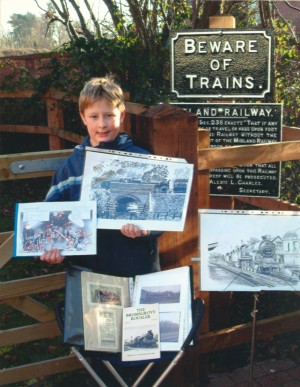
James Wood with memorabilia

Neville Billington pays tribute to a famous locomotive and appeals for memorabilia.

It was just 50 years ago that the Fowler’s 0–10–0 Lickey Banker, built by the Midland Railway Company in 1919, ended her days on the Lickey Incline.

Big Bertha, as she was known to all local people, gave Trojan service for 37 years, assisting trains up the Lickey Incline through peace and war and through times of greatly changing fortunes for the railway industry.

During her working life she covered a total of 838,856 miles. She was a one-off, designed and built to assist goods and passenger trains over the two-mile, one in 37 climb from Bromsgrove station to Blackwell and she fulfilled the aims of Fowler and his team with flying colours.

In May 1956 a Bromsgrove man, Les Rudge, accompanied by fireman Barry Troth, recovered Bertha from the ash pit at Bromsgrove and drove her to Derby and so to her grave.

Local railwaymen and legions of enthusiasts around the country were horrified.

In May this year the Bromsgrove Society’s Local History Group aims to mark this somewhat sad anniversary by presenting Bromsgrove Library with an archive of papers, sketches and press cuttings about Bromsgrove’s famous lady.

Above all the archive will contain many personal recollections of “Bertha” by men who worked and maintained her and by people who witnessed her snorting her way up the gradient with noise louder and columns of smoke higher than anything else on wheels.

And all that is to overlook her totally individualistic whistle! If you have any reminiscences of BB, please write them down; likewise if you have any memorabilia that we could photocopy for the archive, please contact Alastair Moseley on 07734 847960 or via email: .(JavaScript must be enabled to view this email address)

Pictured: Nine-year-old James Wood with some images from the Big Bertha archive.

James is holding a unique footplate photograph taken by his grandfather Les Wood, who was a teenage fireman on the locomotive in the early 1950s.

Relying on pin-sharp memory, Les has annotated all of BB’s controls and this item is perhaps the most interesting in the entire archive.

Let down by litter

0

How beautiful the front cover of the February issue of The Village looked, but just a short walk away, by the school, there runs a pathway up to Swans Walk where the ditch and other areas is a disgrace with litter, bottles and fish and chip containers just thrown down.

Leaves from the trees are still all over the paths, making them very dangerous to walk on in damp weather.

It’s a let-down to the village of Alvechurch. Let’s have these off-road areas cleaned up, then we can be proud of our village, hopefully by the spring.

Mrs N Ravenhill, Alvechurch

Cycle challenge cash

A presentation night was held at Blackwell Club to give the money raised from the 2005 Blackwell Challenge to three charities – The Edwards Trust, CLIC Sargent Cancer Care for Children and the County Air Ambulance.

The challenge consisted of a two-day cycle ride by the Blackwell Wheelers to Bath and back, covering 223 miles.

A total of £16,512 has been raised from the event through sponsorship and also several fundraising events throughout the year.

Cheques for £5,504 were presented to each of the three charities. This was the fifth staging of the Blackwell Challenge, and to date the total money raised stands at over £65,000.

Top pub after just four years

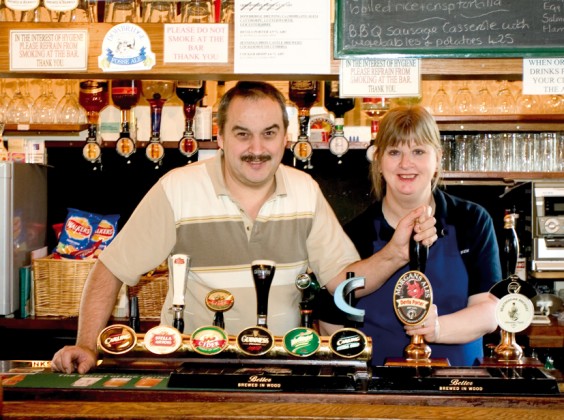
John & Jayne

John and Jayne Humphries, licencees of the Weighbridge, Alvechurch, are celebrating being named Pub of the Year by Redditch and Bromsgrove Campaign for Real Ale.

They have achieved this accolade in just four years as a pub, since the Alvechurch Marina venue was converted from a private club.

CAMRA praised the real ales, which include the regular Tillerman’s Tipple, brewed by Weatheroak Ales, and the character of the rooms “each with their own character . . . that has been lost in so many pubs.”

John told The Village: “Our regulars say it is a proper, old-fashioned pub even though it’s only been one for four years.”

County abandoned us, say rendering plan objectors

Villagers were left stunned when Worcestershire County Council decided not to oppose plans for a rendering plant in this area just days before a public inquiry was to begin.

It meant people who fear the effects on their lives of a plant processing up to 100 tonnes of animal parts each day were unlikely to be represented by an official authority before the Government inspector.

Instead, it was expected to be down to the pressure group HARM, led by Hopwood salesman Jeremy Roberts, to put their case, with little legal back-up.

This magazine went to press just before the inquiry was to be held, at which point the county council’s principal solicitor, Alan Moore, confirmed the council would be telling the inspector it no longer objected to the plans for a 17 metre chimney for a rendering plant in the green belt at Mayfield Farm, Hopwood.

“The county council must now accept that there are very special circumstances for the approval of the chimney within the green belt and therefore the objections to it can no longer be sustained,” he said.

Mr Moore explained that this decision had been made because the council had been given legal advice that if it continued to object, it could face having to pay substantial costs.

The reason for the change was that the county now believed Bromsgrove District Council would have no technical objections to a 17 metre stack in an application for a pollution control certificate.

This would mean there was a “very special” need for the chimney in the green belt.

However, Bromsgrove made it clear to The Village that no decision had yet been made. Corporate director for service Phil Street said: “Simply by removing the technical reasons for not erecting the stack does not mean the rendering plant will get the permit.”

Jeremy Roberts told The Village: “With six days to go, our last friend, the county council, left us. Now I am going to have to represent HARM and its members before the Government inspector. I am a salesman, not a lawyer.

“This has got nothing to do with planning, it has got nothing to do with the environment, it is purely to do with law and money.”

In spring 2004, the leader of the county council, George Lord, told worried villagers at a public meeting that costs were not an issue in fighting the plans.

Because of personal circumstances, it was not possible to contact Coun Lord, who is the councillor for Alvechurch, for his reaction to the county’s decision to withdraw its objection at the public inquiry.

The inquiry had been expected to last three days from February 21-23. We will bring you a full report from the inquiry in our next issue.

Know your future in pensions shake-up

0

Terry

Terry Read of AFH says ‘simplification’ serves only to muddy the waters for many people.

From April 6 new pensions rules will come into force, supposedly devised to bring clarity and simplification to the industry.

However, for many, the new legislation will serve to muddy the water even further, with new convoluted rules introduced to increase retirement options presenting both opportunities and pitfalls.

Historically, pension funds have offered the benefits of tax relief on contributions and largely tax-free growth. Under current rules, however, to take pension benefits the owner of the fund is required to retire and ultimately use the fund to buy an annuity.

A key component to the new rules is that you no longer need to “retire” to take pension benefits and can freely keep on working. You will be able to draw all or part of your pension, or take tax-free cash and defer the pension.

The tax-free cash can be up to 25 per cent of the accrued fund and for some this will be an increase on what they can take now. For others the level will reduce, unless they take advice on actions to preserve benefits at the previous level.

“Unsecured Income” (currently known as “Drawdown”) has also been introduced so that instead of purchasing an annuity, you may retain control of the accrued fund and draw an income from it.

Under current laws an annuity must be purchased by the age of 75, but after April income can continue until death with the remaining fund passing to the children for use in their own pensions.

This strategy will be attractive to many, but entails a degree of risk. It also presents various inheritance tax planning issues.

Perhaps the most crucial difference is the change to limits placed on the amount that can be invested or on the benefits that can be drawn.

From April these will be replaced with an Annual Allowance and maximum accrued fund (Lifetime Limit), and anyone can pay in up to 100 per cent of earnings to the limit of £215,000 in a year with the maximum Lifetime Limit starting at £1.5million. A penalty of 55 per cent applies where the lifetime limit is exceeded.

Final Salary schemes offer fixed benefits so to test these against the lifetime allowance the expected pension is multiplied by 20.

For example, a doctor expecting an NHS pension of £75,000 would have reached the limit, and any private funds would be taxed at 55 per cent.

Anyone who already has, or expects to have a fund exceeding the Lifetime Limit should immediately take advice to evaluate his or her options.

The legislation changes are ongoing, and will continue to raise numerous other questions for those planning retirement; there has already been a Government U-turn on the use of a fund to purchase residential property, and we expect tinkering in many other areas.

Terry Read is Technical Director at AFH Independent Financial Services, Bromsgrove. You can contact AFH on 01527 577775 for advice on your pension – initial consultation without charge or obligation.

Village hall facing crisis

Alvechurch Village Hall is facing an uncertain future unless new people are found to take over key roles in running the venue.

Three stalwarts of the hall’s management committee have died over the past two years and now the treasurer is leaving the area and the secretary is leaving in July.

There are real fears that the hall, which celebrated its 75th anniversary in 2004 and is a proud feature of village life, could drift into disuse.

A spokeswoman told The Village: “Over the past few years, a great deal has been accomplished by members of the Village Hall Management Committee.

“The next project, for the summer, is the kitchen refurbishment. It’s all expensive, but all necessary if we’re going to keep this much-loved heart of the community up and running.

“But keeping it going is not just about money – people are more important.”

She added: “It’s an ideal opportunity for community minded people to play a part in village life. These two posts urgently need filling – neither are particularly demanding, requiring attendance at six meetings a year and a small amount of paperwork.”

Anyone interested in getting involved should call the committee chairman David Noakes on 0121 445 4903.

The local connection

0

Lee

ADVERTISEMENT FEATURE

There are many wonders that come with new technology – receiving emails from children or grandchildren on their travels around the world, for example, and being able to reply.

Or, even easier, being able to talk to them by mobile phone in some of the most surprising places.

The only problem is that it is all still a little complicated. While they have become more reliable and user-friendly in recent years, home computers still require the kind of knowledge and technical ability that kept the drivers of a Model T Ford on the road.

And if you’ve ever wandered into a mainstream mobile phone shop, the chances of understanding what all of the various deals and tariffs actually mean are slim.

So where does that leave you? This is the knowledge and experience vacuum a new Barnt Green business aims to fill.

Connectivity opened in Hewell Road shortly before Christmas, with Barnt Green chosen because its owners live in the village, as does salesman Lee Kelly (above), who says the aim is to make the latest technology available to everyone.

“We want to do anything that helps people who don’t feel totally at ease with technology,” he explains.

Connectivity offers all you might need for PCs, from making one to the customer’s specification, to maintenance, repair and upgrades. They also stock “peripherals” such as printers and will install networks, both wired and wireless in your home.

“We are about to introduce a PC home maintenance agreement where you can have three home visits a year,” says Lee. The price is still to be decided, but he says it would be under £100.

“We have this shop here, but we want people to get used to picking up the phone and us coming out to see them in their homes.”

As for mobile phones, Lee says they aim to cut through the jargon to get the best deal for their customers. “It is a really confusing industry. I have to study it every day to keep on top of it myself.

“But it can take 20 minutes to sort it out for a customer and we can save them perhaps £100 or £200 a year, and all in the comfort of their own homes.”

Lee says Connectivity has many other plans for making the most of technology, such as a service for selling people’s used computer equipment on eBay.

Already there are seven people working there, all from this area, and they hope to expand further.

43 Hewell Road, Barnt Green
Tel: 0121 445 6609
www.igbltd.co.uk

Centre of excellence

0

Plants

Sally Oldaker visits a garden centre offering expert advice and top customer service.

The concept of the garden centre has changed dramatically over the past 20 years, with many centres expanding to include a vast range of other products quite apart from plants and shrubs.

Little Heath Aquatics, Garden Centre and Restaurant at Lickey End is a case in point, having grown to such an extent that it is hard to imagine how it must have looked 20 years ago when the premises consisted of a single greenhouse.

“You wouldn’t believe how it looked before!” says owner Barry Hall, who bought Little Heath in 1985, having originally rented greenhouse space from the previous owner to set up an aquarium.

“Since taking over, we have made improvements year by year, taking one area at a time,” Barry continues. “There have also been huge changes in retail over that time, and Little Heath has adapted accordingly.”

That said, the values of customer service and genuinely helpful advice have not changed – Barry is proud of Little Heath’s ability to offer a more personal touch. Many of the centre’s customers have been coming to Little Heath for 20 years, no doubt appreciative of Barry’s ethos:

“We aim to sell customers exactly the right product, saving them time and money,” he says. “All the staff – many of whom have been with the company for a long time – are geared up to be straight with people and to sort out any problems as quickly as possible.”

Little Heath also scores highly with customers where product choice is concerned, with a vast array of different types of plants from decorative to structural.

Every year, Barry travels to Italy to source top quality plants, bringing them back to Little Heath in a container lorry. He says that he will try to locate a specific plant should a customer request it.

Another aspect that makes Little Heath stand out from the crowd is the aquarium, which has been developed to become a major feature of the centre. Tropical fish and pets are on display in the specially lit and heated pet department, with staff able to give expert advice.

“People buying this type of pet need to be advised on all aspects of maintenance and care,” Barry explains.

Cold water fish are also sold during the summer months, as well as everything you could possibly require in the way of garden ponds and accessories.

Bridges, waterfalls and lighting are all on offer, displayed so that customers can visualise the pond in their own garden.

During summer, a larger range of garden furniture is available alongside gazebos, arches, decking and fencing, plus unusual water features, statues and pots in all shapes and sizes. Indoors, conservatory furniture and more decorative items offer plenty of ideas for improving the garden and home, while the large giftware section includes toys and keepsakes for children.

With so much to see, it’s hardly surprising to learn that customers often spend several hours or even half a day at Little Heath, particularly in summer.

The centre’s extremely popular restaurant, featuring a patio area for warmer days, ensures that refreshments are always available, from a quick coffee and a home-made cake to a full breakfast or lunch.

“All the food is home-produced,” Barry points out, nodding towards a glass counter packed with tempting cakes and pastries. “We try to keep it quite traditional, bearing in mind that our main customer base is the over-45s.”

Does Barry have any plans to attract younger customers? “The aquatics department brings in younger people, but I would like to attract what I call ‘the IKEA generation’ – those who would usually go somewhere like B&Q instead of a garden centre,” he comments.

“We can spend time with customers and advise them to ensure they buy the right thing.”

To celebrate 20 years in business (the official birthday was in December), Little Heath will be organising special promotions – drop in to see what’s happening, and to browse this friendly centre jam-packed with garden ideas.

Littleheath Lane, Lickey End, Bromsgrove
Tel: 01527 878174 or 832728

Different strokes

0

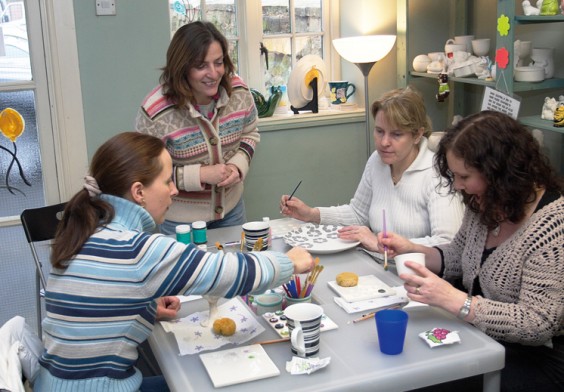
Julie with clients

Ceramic painting gives adults and kids a chance to unleash their creativity, says Sally Oldaker.

At the risk of sounding like a recruitment poster for journalism, the job really does give you the opportunity to try some diverse experiences – my latest activity was ceramic painting, which I had never come across even in the course of GCSE and A-level Art classes.

Julie Finn-McDonald runs the Brushstrokes ceramic painting studio at Tardebigge Court, offering both adults and children the chance to produce an original piece of ceramic artwork.

Children’s parties, family sessions and painting courses are all available at the studio, or Julie will bring the equipment to a school or home.

She took over the business in June 2005, after its original founder was forced to give up through ill health.

“My own daughter came to a birthday party at Brushstrokes, and that’s when I found out the business was for sale,” Julie recalls. “It seemed like such a great idea that before I knew it, I had agreed to buy it!”

Already working as a Technology teacher at St Bede’s middle school in Redditch, Julie had the necessary credentials to continue the success of a creative venture like Brushstrokes.

Her artistic background also included a degree in Silversmithing and Jewellery Design at the Birmingham Institute of Art and Design (now part of the University of Central England) and her PGCE (specialising in CDT) from the then Wolverhampton Polytechnic.

“At first I continued to teach and ran Brushstrokes on the side, but there wasn’t enough time for both,” says Julie. “I thought it was time I did something different, so I gave up teaching to concentrate on Brushstrokes.”

Her teaching skills make her an ideal person to coach others, particularly children, in the technique of ceramic painting. It’s not as difficult or as messy as you might expect, and makes a novel theme for a party.

“It’s not just for children, though!” Julie stresses. “Kids’ parties are my main activity, but lots of adults come too, from retired people to hen parties or social groups – there’s one group made up of mothers who have autistic children, and coming here gives them a chance to have a break and do something for themselves.”

Another misconception is that painting a plate or mug is all that’s on offer. I had rather expected to be given a plate or a tile, and as if to prove the point, Julie had arranged for me to paint a “tea for one” set consisting of a stacking mug and mini-teapot.

An example designed by Julie was on the table to provide inspiration, painted in turquoise with a design of yellow squares and black spirals.

In order to demonstrate the technique, Julie wanted me to do a similar design, although I could choose my own colours. Because the paints change colour when they are fired in the kiln, Julie has displayed “finished” examples of each shade on the wall to help you decide.

I picked a lavender purple for the exterior of the cup, teapot and lid, deep blue for the visible interior of the wide teacup, and turquoise for the extra detailing.

The first step was to create a design of irregular squares on the exterior surfaces, achieved by sticking down pieces of masking tape cut to the required shapes.

When this was done, the inside of the cup could be painted, using a large brush to give a thick coverage for a deep colour. This part would need three coats, to be completed later.

To achieve the mottled effect of Julie’s “one-I-made-earlier” tea set, a smaller brush was to be used – since my lavender choice was a paler colour, I was advised to use a lot of paint and, to use a technical term, “splodge” it on rather than paint in strokes.

Once I had painted over the whole surface, the masking tape would be removed, leaving the square-shaped areas clear.

It’s a fun process, especially if, like me, you haven’t used paints for a while. The only difficulty is working out how to hold the pieces while you paint them, and Julie is on hand to offer tips on this and other aspects of the technique, such as how to hold the brush – sounds simple, but I’ve learned there’s a certain way to paint the rim of a teacup!

After adding another coat of the deep blue inside the cup, it was time to peel off the masking tape and fill in the gaps. The paints are incredibly fast-drying, so there are no worries about smudging the main colour by this stage.

Painting in the squares with turquoise was the more daunting bit, but Julie selected a very thin brush for precision, and we were even able to carry on a conversation as I painted.

One final coat on the cup’s interior, and then the final touch – drawing spirals on the now-dry turquoise squares with a squeezy bottle of black paint.

A background in cake-decorating will serve you well here – shaky hands are a no-no – but Julie points out that potential mistakes can be corrected when the paint dries.

However, the great thing about creative activity is that even when you are essentially making a copy of an original, there is room for individuality, and the hand-made aspect always ensures that every piece is unique.

I was pretty pleased with the final look of my tea set, although this was by no means the finished article – Julie would now leave it to dry for a day, then glaze it, leave it another day, and finally fire it in the kiln where the true colours would appear.

“I usually tell people to allow a week before they pick up their work, so that I don’t have to rush things,” Julie explains. “Younger children sometimes don’t understand that they will have to wait, so I give them each a balloon animal to take home in the meantime!”

It’s touches like this that make Brushstrokes such an appealing concept, along with the fact that it offers everyone an opportunity to be truly creative.

“In this day and age we like things to be instant – it makes a nice change to do something that takes a little bit more time and care,” says Julie. “Plus, people are keeping up a traditional craft that’s been done for hundreds of years.”

As well as tea sets, you can also choose to paint a plate, mug, bowl, vase or panel, while children often paint figurines such as teddies, pigs or fairies. One nursery group decorated plates with their own handprints to give as Christmas presents.

Julie buys the ceramic pieces from a mould maker, and each has a “shelf price” to which a set fee is added to cover use of equipment. She can provide a template or stencil for an existing design, though some people prefer to create their own.

“Most people need to have a starting point, especially if they’ve never done anything like this before,” she says.

Above: Julie (second from left) supervises a group of artists at the studio.

Brushstrokes
Tardebigge Court
(opposite the pub at Tardebigge)
01527 540500 / 07950 955793