
In our March issue, we told you about the Rev Alan White’s new book, The Worcester and Birmingham Canal: Chronicles of the Cut, which details the canal’s complete history.
One of the most interesting chapters, at least for people in the nearby area, concerns the story of how the locks that make up the famous Tardebigge Flight were almost never built – and with thanks to Rev White, we have abridged part of the tale here.
In 1809, when the Worcester and Birmingham Canal Company was about to start the last stage of the canal’s construction from Tardebigge to the River Severn at Diglis, it planned to incorporate a series of locks.
In order to supply the water, it would be necessary to use steam pumping engines and storage reservoirs so that water could be pumped from the river in stages to the summit level at Tardebigge.
It would be a costly method, but the Birmingham Canal Company had refused to supply water, despite assertations that it did have enough to spare – plus the Canal Act of 1791 had decreed that no reservoirs supplying the canal were to be built north of the Parish of Tardebigge.
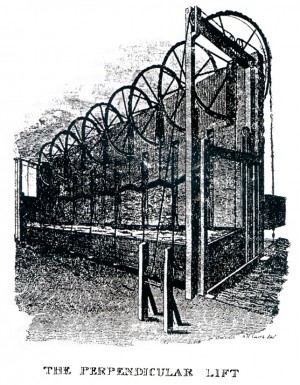
However, there was another way in which both money and water could potentially be saved. For several years, engineers had been experimenting with boat lifts, whereby a boat could be winched up in a “cradle” and then “floated” into the next section of canal.
This method avoided a substantial loss of water and was said to cost far less.
The Worcester and Birmingham Canal Company was approached by John Woodhouse, an engineer on the Grand Junction Canal who had obtained a patent for a vertical boat lift. He offered to construct this design, at his own expense, for a trial, and this took place in February 1810.
The lift proved capable of raising a boat by 12 feet in less than three minutes, impressing everyone present, and the company paid Woodhouse £1,000 for the machine.
When a longer section of the canal had been completed, another trial took place in June – but this time the event was not so successful. While the “cradle” containing the boat and several members of the Canal Committee – plus civil engineer John Rennie – was being winched upwards, the machinery that maintained the correct water pressure was not properly deployed.
The cradle shot up to the higher level, the speed of its arrival causing injury to one of the men operating the winding equipment and breaking one of the wheels.
Unsurprisingly, the accident raised concerns about the safety and reliability of the Woodhouse Lift, particularly after another inspection when Committee members witnessed more problems with leakage.
On July 3, an Assembly of Shareholders met to decide how to proceed. Most were in favour of abandoning the lift project, but in the end it was resolved to hold more trials in January 1811 when more of the canal had been built.
As it turned out, the Tardebigge Tunnel was still not in use by that date, but at a New Year meeting the shareholders voted unanimously to use locks rather than lifts.
Crucially, even Woodhouse now advised the adoption of the lock system. But the lift still had its supporters, namely a group of proprietors of the canal who wanted further trials. At their own expense they organised a month’s trial, to be followed by a Special Assembly at which the final decision could be made.
The trials were not officially endorsed by the Committee, who were annoyed that some of the Company’s own employees were being used to operate the lift.
When William Ward Eagle, a staunch lift supporter despite actually being a Committee member himself, arrived to supervise the start of the trial, he found that the machinery had mysteriously been screwed so tightly that it could not be used…however, a complaint to the press soon brought about an agreement with the rest of the Committee, and the trial could begin.
But more machinations were to come. When Eagle’s report on the trials was posted to all shareholders, dated March 22, he did not realise that on February 16 – before the trials had even begun – the Committee had already taken the final decision to proceed with locks, fully intending to keep this decision secret from the opposition until the Assembly on March 26.
The meeting nevertheless generated much debate, and it was finally agreed that although locks were to be built (using three supply reservoirs and surplus flood water from the River Rea), the lift could also continue to work while the canal was finished.
On May 27, the lift was struck by lightning and damaged. The Committee said it should not be repaired, but was overruled at an Assembly in July – Woodhouse was given £60 with which to carry out repairs.
In August that year, Woodhouse moved to a different stretch of the canal, but his replacement, William Crosley, continued to use the Tardebigge lift for moving construction materials.
Sadly, in 1813 it was damaged further through the neglect of an employee appointed by Woodhouse, with the result that serious flooding occurred.
This was the final nail in the lift’s coffin, and the Committee ordered it to be dismantled. The machinery was finally disposed of a few days before the canal’s official opening in November 1815.
* To read the full story, you can buy Chronicles of the Cut from Ottakars on Bromsgrove High Street, from https://www.brewinbooks.co.uk, or from Rev White – call 01527 877955.
