Home Blog Page 59

Warming up after chill

lambs

Phil

Alvechurch amateur weatherman Phil Thomas records the changes.

April reversed the warming trend of the past couple of months. Both daytime and overnight temperatures were well below what is expected at this time of year.

Rainfall was also slightly below average, the one exception being the 4th with 12.5mm of rain over a short period – nearly half the rainfall for the month thus far. Temperatures were climbing as we headed towards Easter, but were then due to turn changeable.

April 2019 (to the 17th)
Mean Max  10.6C  2.2 below average
Mean Min   2.2C   1.4 below average
Mean        6.4C    1.8 below average
Rainfall   27.5mm   41% of average
Sunshine  66.2 hrs  56% of average

March was a month of two halves. The first 18 days were very wet with the entire month’s rainfall of 68.5mm. This was then followed by 13 days with no rainfall. This same period gave about 70% of the month’s sunshine. Again, the mean temperature was warmer than the local mean by 1.8 C.

March 2019
Mean Max  11.8C  1.8 above average
Mean Min   4.2C   1.8 above average
Mean       8.0C   1.8 above average
Rainfall     68.5mm  152% of average
Sunshine 116.2 hrs  122% of average

Outlook

During the first half of May, there is a slightly greater chance of some longer dry spells, but also brief, more changeable interludes. Temperatures will probably be near or slightly above average. However, as is usual at this time of year, there will be some marked variations through the period.

More information at https://www.alvechurchweather.metsite.com  
You can see an improved HD weather-cam, updated at one-minute intervals, at: https://www.alvechurchweather.metsite.com/webcam_alvechurch.php

Play-offs beckon for AFC

action
Celebrating the win at Kettering (Photo/ Ian Macvie)

Alvechurch FC keep their eyes on the promotion prize.

Alvechurch kept themselves in the play-off spots and managed to spoil the party for Kettering Town with a 2–1 win; Mitch Botfield’s late winner denying the runaway league leaders the chance to secure the title there and then.

Both sides came into the game determined to take the three points, but ’Church were superb throughout and got off to a dream start just three minutes in when Tom Turton’s corner found Jamie Willets, who headed home brilliantly.

Kettering created two good chances of their own, but AFC continued to impress and twice should have doubled their lead. The second half proved exciting and it was Kettering who scored soon after the re-start.

’Church, however, continued to match their hosts right up to the dramatic end, when Andre Landell pulled the ball back for Botfield whose strike squirmed through the Kettering keeper’s hands, sparking a great celebration for the visitors.

Earlier, Alvechurch had bounced back from defeat at Kings Lynn with a commanding 2–0 victory at St Ives but this was followed by a shock 5–1 home defeat to Barwell with 10 men. Things picked up back with home wins against Hitchin and Leiston – and a fantastic 5–0 demolition of Coalville Town.

’Church were sitting in fourth position as we went to press, with a crucial away game against second-placed Stourbridge FC about to take place.

The league champions gain automatic promotion and the next four clubs compete in the play-offs on Wednesday May 1. The team who finish second will host the team in fifth (currently Stratford Town) and the club in third (currently King’s Lynn) would host fourth place. The winners of these two matches then play each other in the final on Saturday May 4, hosted by the club finishing highest in the league.

However, the winner is still not guaranteed promotion. As there is an imbalance between promotions and relegations, there will be two “super play-offs” on Saturday May 11 between the play-off winners of the four feeder leagues to step 2, with the two victors gaining promotion. These fixtures and venues will be decided after the play-offs, based on points-per-game average over the season.

* Meanwhile, officials from the FA visited Lye Meadow to check on the upgrades required to continue playing at step 3. The club was instructed that extra seats, an extra turnstile and larger changing rooms were the major projects required to maintain its status.

Under the leadership of chairman Richard Thorndike and secretary Steve Denny, all the work was completed and the FA gave its approval. Special thanks must go to the contractors who worked so hard under such tight time constraints and to the supporters who volunteered their time prior to the inspection, tidying up the ground ensuring it looked immaculate.

* Top scorer Josh March won the Goal of the Month award for March for his first goal in the win against Lowestoft, where he smashed the ball into the top right-hand corner.

Player of the Month was recent signing Tom Tonks. Since joining from Stourbridge, his influential play in midfield and long throw-ins causing havoc in the opposition’s defence have made him a worthy winner.

Centre forward James Roberts has signed for Alvechurch on loan until the end of the season from Hereford. The deal went right up to the 5pm transfer deadline as the club waited for FA approval. Since his arrival ’Church have won the three games he has played – he scored the winner against Leiston and is a constant threat.

Former Alvechurch forward Luke Yates has joined local rivals Redditch United. Luke played an integral part of AFC’s promotion last season, and this season has been out on loan to Highgate United and Wolverhampton Casuals.

*  On Friday September 6, Lye Meadow hosts a luncheon with former Arsenal, Middlesbrough and England footballer Ray Parlour as guest speaker. Comedian Jed Stone will also entertain the audience. Tickets, priced £65 per head or £600 for a table of 10 (to include a three-course Indian meal), are available via chairman Richard Thorndike and directors Simon Redhead and Paul Weaver.

*  For more info or sponsorship enquiries, please contact Trevor Ball at saintsarehot2@btinternet.com or visit https://www.pitchero.com/clubs/alvechurch   Follow the club on Twitter @Alvechurch1st

U9s triumph in league cup

kids

Alvechurch FC U9s are celebrating after they secured victory in the Central Warwickshire Youth Football League Winter Cup Winter Cup.

The boys scored two goals in the first half, while the opposition’s shots on target were successfully blocked by Alvechurch keeper Harry. During a nail-biting second half, the team stayed strong and netted a further two goals, finishing with a well-deserved 4–0 win.

Part of the Alvechurch FC Youth section, the squad was formed just under two years ago with seven boys, signing three new players last season.

Managers Rob Southall and Shaun Hayes were delighted with the results from a fantastic season: “We are looking forward to seeing what next season has in store and hopefully winning more cups.”

Girls end season on a high

kids

Kings Norton Girls’ rugby team finished the season on a high, winning the final tournament of the West Midlands Girls’ Tag League. Sixteen teams competed at the finals held in Rugby, and this was Kings Norton’s fourth tournament victory of a tremendous season. The squad of 19 girls, aged between 8 and 18, have improved throughout the season and have had a great team spirit throughout the year.

Earlier, the Kings Norton Rhinos’ festival season kicked off with the Under 12s, U10s and U8s inviting guests to Hopwood Park, including teams from Bournville, Camp Hill, Bromsgrove, and Sutton Coldfield– plus an U12 squad who came all the way from Abergavenny.

Kings Norton RFC would especially like to thank volunteers Tony and Marion Heafield and their team who cooked hot dogs and burgers for the children, as they have done every week for several years. At the end of this season Marion and Tony will retire for a well-earned rest.

Under the spreading chestnut tree

tree

Mary

Mary Green identifies ‘useful’ trees to look out for in May.

May is a lovely time to visit woodland, before the trees close out the light and while the trees and the plants that grow underneath them are flowering. After a good spring, this first month of traditional summer should be full of leaf and flower, insects and birds.

There has been some interesting research on trees, which have a positive impact on our lives. Among other things, they absorb and use carbon, thus helping slow down global warming.

It was always assumed the ancient rainforests were the most important for this. Research from the University of Birmingham has shown this not to be so. The newer woodlands of the northern areas, those less than 150 years old, actually absorb more carbon, especially naturally regrown woodland.

This is because when they are in their earlier stages of growth, they can use up more carbon and convert it into sugars to help them grow. It points up the importance of our looking after all our woodlands, not just the ancient ones.

When I wrote about trees last year, I missed out some of our common and useful trees, because they are not part of the Celtic calendar. They aren’t common in the Celtic parts of the British Isles, but are in England. And you will notice them at this time of year.

The first is beech. It has beautiful lime-green leaves in late April and early May, and later in the year wonderful autumn colour. Its shape is graceful, and it can grow to be big and a great age, like oak. Unlike the oak it is always portrayed as rather female, sometimes called the Queen of the woods. Its bark is much smoother than oak. In winter the leaf buds are long and pointed.

The spring leaves are delicate and let the sun shine through, but in summer they become thick and glossy green and form a very dense shade. The autumn leaves are red-gold, and sometimes stay on well into the winter. Its seeds are called “mast” and grow in wrinkly brown cases.

Mast is an old word for food. The tree has a “mast year” every few tears and doesn’t produce in other years – a bit like the oak. Beech mast used to feed pigs which grazed in woodlands, and it can be used to make oil.

Beeches were often planted in clumps on hillsides, a good local example being Frankley Beeches. They also provide roadside avenues in some places – there is a row between Cofton Hackett and Barnt Green. There are good ones in some of our best woods, like Peck Wood in Rowney Green. Try to catch the open weeks there – early this year but there are some dates at the beginning of May.

Shortwood also has wonderful beeches, visible from the canal. There are good single trees, like the one just past the village end of St Laurence Churchyard, and some striking ones at the top of the footpath up Foxhill.

Beech makes good hedging, especially as smaller bushes keep their leaves into winter and even the next spring. There are some huge ancient beech hedges in other parts of the country. We have a nice smaller one in Birches Lane, Withybed Green. Birds love these for cover in early spring. Beeches are truly native in the South of England but were planted further north.

Sweet chestnut, my next tree, was introduced by the Romans and is now considered an honorary native. There are some really ancient and huge ones in England. They are well known for their edible fruit, which form well in a good summer. Their flowers are not noticeable, being strings of small green flowers coming out in July, which doesn’t give a very long ripening season if the late summer isn’t warm. The flowers have an interesting musky smell.

When the trees grow to a good size, a noticeable feature is the way their trunks grow in twisted shapes. There are some beautiful ancient ones in Piper’s Hill Wood between Hanbury and Bromsgrove. Smaller ones can be found locally on Wheeley Road, and at Hopwood. Some lovely young ones are established in the little linear wood going out of Barnt Green on the Blackwell Road alongside the railway.

We associate the nuts with roasted chestnuts, especially at Christmas. In other European countries, where they produce a more reliable crop, they were traditionally used for flour and made into many staple foods. The trees don’t seem to be especially known for much else here, and haven’t attracted customs or legends.

Our other chestnut, the horse chestnut, comes from a completely differently family from beech and sweet chestnut, which are related. There are similarities, though: both chestnuts have shiny brown nuts, prickly seedcases and twisty trunks.

The horse chestnut came into this country in the 16th century, from the area round Turkey. It was established first in big parks and estates, becoming especially popular in the 18th century with the kind of landscaping fashionable then. Later it was planted in streets and then in public parks, after which it spread into the countryside. By the late 19th century, it was a common feature of village greens, “under the spreading chestnut tree.”

About that time, the game of conkers began to use horse chestnuts. The game came first, with children hitting other nuts on strings. It was called “conquerors”, shortened to conkers. This name then became attached to the fruit of the horse chestnut when it was found to be a far superior nut for the game during the 19th century. It took a long time for conkers to become conkers as the trees were in wealthy people’s estates for so long where local boys couldn’t reach them.

Horse chestnuts have sticky leaf buds in winter, coming out in spring to folded five-lobed leaves. When these open out, the flower buds start to rise. These become big, beautiful candle-shaped flowers in May, with a lovely perfume. The leaves are later quite thick and dark and it was known as a good shade tree.

You can see them all over the place around here. There is a lovely avenue in The Meadows in Alvechurch, many roadside trees, some alongside the beeches at the top of Foxhill, along the canal and in fields near Alvechurch station (where many were cut down when the station was redeveloped). The trunks sometimes become twisty like the other chestnut.

In Turkey horse chestnuts were traditionally fed to horses and used to treat their sprains and bruises. Now modern science has found they contain something which will treat human bruises and sprains, and they are being grown for the purpose. It’s surprising how often these old remedies are being rediscovered.

Horse chestnuts aren’t as long-lived as sweet chestnuts, and these days they are very susceptible to a disease which turns their leaves brown before autumn comes. (They are among the first leaves to turn brown even when healthy.) The ones cut down in The Meadows had honey fungus.

But for a relatively new tree, it has become a well known part of English culture. Many people think of it as being more native than the sweet chestnut. I wonder how many of us older ones grew up singing “Under the spreading chestnut tree” and doing the actions!

Flowering trees at this time of year will be full of bees and other insects, so I hope we don’t have late frosts to disturb them.

This month’s poem is one I wrote last year in May for the Withybed Poets and my singing friends. The goslings did survive, and the goose pair has already come back to their nesting site. The swans survived and the pair have mated again this year. And the Withybed Poets will be at the Picnic in the Park again this year, writing poems for you!  I wonder if I will hear the cuckoo.

Couplings
The sun drips like honey into the ground
Cow parsley rises in light and lace
Pear blossom pulls in the bees and bluebells shimmer
The sun enters my bones and I begin to glow
My whiteness disappearing in the blue haze
There are three cygnets clustered round the pen
Nearby the cob stands sentinel, coupled to her
By gossamer threads. Here the goose sits
Patient on her bed of down, while the gander swims
Always pointing back at her, hoping this year
The gosling will survive under the alders.
Around me is all talk of weddings, flowers of spring
Bubbling and laughing round the planning heads.
For me, it is a mesh of couplings, links one to one
Or one to two, or three or four together
My life made real and whole by these people
Who surround me with love and singing
Lifting my heart and body to the blessed sun

Busy month of growing

veg

Hannah

Hannah Genders explains how to get the best out of your veg, and looks forward to the Malvern Show.

I’ve been very busy in my veg garden; well, mine and a friend’s vegetable garden which I am helping to set up. He lives on a farm just outside Alvechurch village and has been struggling with the clay soil, so we are putting in some raised beds with good top soil and compost to be able to work the top eight inches of soil so plants can grow on well before they need to get their roots down into the clay below. I’m going to keep photos of this project and let you know how it develops this year.

In every garden, especially when growing veg, there is always a pest you have to deal with, and in mine it is field mice. They are extremely cute but very annoying as they eat any seed I put straight in the ground, especially peas and beans.

Once the seed has sprouted, they don’t seem to touch it, so I get around this by pre-growing all the plants in the greenhouse and then planting them out, covering them with fleece initially until the end of May when all the frost danger has passed.

I couldn’t bring myself to kill the mice, and I know they are such an important food for owls (along with voles) which we have a lot of around here. So, at one time I was catching them in a humane trap and cycling them up to the next village to let them go! The distance has to be over two miles away, evidently, because that is far enough for them not to come back.

I did wonder if the residents up there suddenly noticed an influx of mice! But in all honesty, as soon as I cleared a few, some more moved in, so the pre-grow method is much more effective.

If slugs are your problem, my plea is never to use anything but organic slug pellets or natural traps. The toxic slug pellets are causing massive problems for birds and hedgehogs, because once they are in the slugs, they are in the food chain.

I put my organic pellets under an upturned flower pot with just enough room for the slugs to crawl underneath; this keeps them longer as they don’t get rained on and seems to catch the slugs really well. I also have a hedgehog who quite regularly comes and turns over the pots and eats up what is left underneath, and thankfully I know she is perfectly safe doing so.

So, having pre-grown my plants in the greenhouse, I plant out. I have been using some deep hedging bags for growing everything in the greenhouse, as I find grow bags just too shallow with not enough root space.

The hedging bags come from a company I use who grow mature hedges, and they are perfect for using in the greenhouse as they have a good depth to them. I fill them with my homemade compost and some soil mixed in. This gives the plants some nutrients and some water holding capacity during the hot summer months.

Once I have dug out my bean plants, I will top up the soil content and plant my tomatoes and chillies out in these. When planting out I use pea sticks – just cut the branches off a shrub such as hazel, and push them into the ground alongside the bean or pea plants to give them some support. I also add about a tablespoon of organic feed such as blood, fish and bone when I plant just to give them an extra nutrient boost.

These plants are going into a bed that was manured in the autumn and this is what they need. If you can get the broad beans going early enough, they crop early, and you don’t usually have as much problem with black fly which can be a bit of a menace in June.

I’m growing a fairly standard variety of broad bean this year, although I must say I love the red-flowered heritage variety but I didn’t order the seed in time. I grow mangetout instead of peas as I just find them much easier and less fiddly. Again, these need plenty of well-rotted manure or compost to grow into and you will get a massive yield from them.

I love growing salad crops as they are very easy and tasty. I have kept a crop of rocket growing for most of the winter in the greenhouse, just cutting off the tops every time it regrows and eating them.

This is also true for perpetual spinach, which is in the garden, not the greenhouse. It really does keep coming back, and with both crops you can avoid having to buy them in supermarkets in the dreaded plastic bags. Either of these plants could be grown in a pot or window box so have a go, and with the extra taste I’m sure you’ll be hooked.

The other reason May is so busy for me is that it’s the RHS Malvern Spring Festival from May 9–12. We are doing a feature called Eco, Green and Growing, or EGG. If you are coming to the show, please drop in and say hello. We have a rolling programme of talks, interviews, demos and live music. This is the link for us: https://www.rhsmalvern.co.uk/whats-on/grow/

Can you spot the bear?

stars

Brian

Amateur astronomer Brian Watkiss peers into the Village night sky.

May, and it’s nearly ten thirty before the sky is really dark enough to see anything. A massive change from December when you had to put the lights on just after lunchtime!

We are seeing the last of Mars now because it has become so faint that by the time the sky is dark enough to see it, it is too low in the northwest. A very thin crescent Moon is close by on the 7th so this may give you chance to spot it. The other planets are all in hiding until after midnight.

Facing south, the big constellation of Leo is obvious, slightly right, with its brightest star, Regulus, sitting below the reversed question mark that is his head. High above Leo is the most famous of asterisms, the Plough.

I say asterism (with some difficulty) because this well-known collection of stars is in fact part of a much larger constellation called the Great Bear or Ursa Major.

If you take some time to stare this high in the sky, as your eyes adjust to the darkness (and your neck starts to stiffen) you should begin to see more stars appear to the right and below the saucepan, and if you imagine the handle to be the tail of the bear you should make out the vague shape of an animal.

I think it looks a bit more like a pussy cat but the ancient Greeks deemed it to be a bear so we’ll go with that. Not many people have ever bothered to actually look for this constellation so as you seek out a chiropractor to sort out that painful neck, console yourself with the thought that you are one of the few.

If you follow the curve of the bear’s tail down the sky to a more reasonable height, you will find the brightest star in the sky at the moment, Arcturus. This is the main star of the constellation Bootes, which is a sort of kite shape above it.

Now Bootes was a farmer in Greek mythology and a sort of kite shape looks nothing like your average cowhand, but if you follow the curve from the Plough through Arcturus further down, you reach another bright star.

This is Spica, sitting on the line in the sky drawn by the Sun, the ecliptic. To the right, towards Leo, is another star, Porrima (the Moon forms a line just to the right of them on the 14th).

Now if you imagine this pair to be Bootes’s feet, the true shape is revealed. The problem is, these latter two stars are nowadays deemed to be part of the constellation of Virgo, so Bootes must remain a severed torso.

So as you peer out at these shapes in the sky (as I’m sure you will), spare a thought for our half a farmer in the cosmos.

Reflecting Bromsgrove

exhibition

Richard

Bromsgrove artist Richard McIlwraith urges a visit to the annual exhibition at All Saints Church.

For art that reflects the wonders of our glorious town and its majestic surroundings, visit All Saints Church between May 18 and 25. Bromsgrove Art Society is holding its annual exhibition and, if it proves to be as diverse as last year’s offering, the work on show will echo the beauties and curiosities of our remarkable area.

Expect paintings of woods, parks and gardens, images of wildlife, still-life studies and portraits of family and friends. Feel the festival spirit, the market mood, the peace of the canal-side walk and the energy of our town’s music, literature and dance as you tour the exhibition inside this impressive Victorian church.

I predict a visual snap-shot of life in our enticing region; come along and enjoy the artistic effort and evident talent of painters of varying levels of experience. The 2018 exhibition showcased 272 pieces from 61 artists. Don’t miss your chance to see the 2019 line-up – for one week only.

I hope you allow your visit to change you in a small way – to engage you more deeply in the arts, to inspire you to try out a new club or society, to make the most of Artrix arts centre or to stroll the woods, parks and gardens more regularly than before.

All Saints Church is located on Burcot Lane, Bromsgrove, B60 1AF. The exhibition is open from 10am to 4pm Monday to Saturday and 12noon to 4pm on Sunday.

The fee for entrance is by programme which will list all paintings, titles, artists and prices. Programmes will be on sale at the church entrance and money raised will go to the church restoration and to the organisation of the exhibition.

Bromsgrove Art Society is chaired by Tony Turpin and the monthly meetings, which take the form of demonstrations of various art media by local and well-known artists, are held on the third Wednesday of each month (excluding January and August) at Burcot Village Hall, Alcester Road, Burcot, Bromsgrove, B60 1BH, commencing at 7.30pm.

Please get in touch if you would like me to write about an art event near you: richard@galleryart61.com
https://www.galleryart61.com

Flower power

flowers

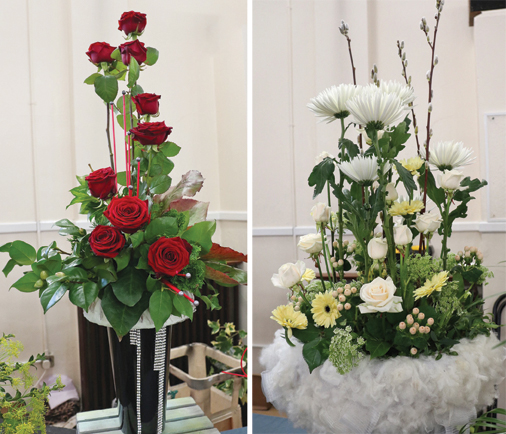
Bromsgrove Flower Club welcomed talented NAFAS National Demonstrator Lorena Dyer for a demonstration entitled Lipstick, Powder and Paint. She produced nine stunning floral arrangements (including those pictured) which were then raffled at end of the afternoon.

Once again The Flower of the Month Competition and the Flower Arrangement competition (Take Three Flowers) were well supported. Members and visitors were able to purchase handmade cards and crafts from Mrs Pat Davies.

The Club meets on the third Thursday each month at 2.15pm (except Jan) in All Saints Church Hall, Burcot Lane, Bromsgrove B61 1AF.  For more information contact Wendy Robertson on 01905 480571.

No need to knead

bread

Jen

Keen baker Jen Morris, of Rowney Green, makes an easy loaf with seasonal watercress.

Watercress, in season this month, has a long history of cultivation in the UK. It originally travelled by train, with “the watercress line” running from Hampshire where it was grown to London to be sold at the markets. Its punchy, peppery taste is a distinctive seasonal treat.

This bread is easy to make; it’s literally combined and then baked – no yeast, no kneading, no rising. It isn’t the sort of bread you can slice for sandwiches, but works beautifully as part of a ploughman’s lunch, or partnered with watercress soup.

Ingredients:

50g watercress, roughly chopped

110g Lancashire cheese, roughly crumbled

175g self-raising flour, plus a little extra to dust the top of the loaf

1 tbsp chopped chives

1 medium potato, approx 175g

1 large egg

2–3 tbsp milk

1 tsp salt

Method: 

1) Heat your oven to 190C / 170C fan / Gas 5. Grease a solid baking sheet.

2) Sift the flour into a large mixing bowl, add the chopped watercress, two-thirds of the cheese, the chives and the salt.

3) Peel the potato and, using the coarse side of a grater, grate it straight into the bowl. Mix with a palette knife to combine.

4) Beat the egg and milk together and gradually add it all to the mixture, folding in with the palette knife, until you have a loose, rough dough.

5) Transfer the dough to the baking tray and, keeping the rough texture, pat it gently into a 15cm round.

6) Lightly press the remaining cheese over the surface. Sprinkle with flour.

7) Bake the bread on the middle shelf of the oven for 45–50 mins, until golden brown.

8) Cool on a wire rack before slicing.