Home Blog Page 18

U10s are on run of victories

team

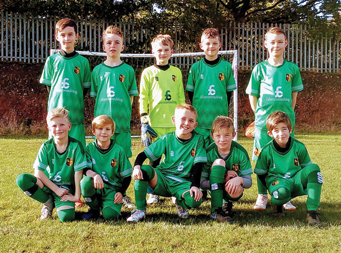
Alvechurch U10 United is one of two teams for boys at under-10 (Year 5) level.

The team is coached by local residents Richard Deering, Ben Bellingham and Dan Priest, and the team is made up predominantly of boys from the Alvechurch area.

The 2019/20 season has been an exciting one for the boys, as they have sported new kits kindly sponsored by local businesses. The home strip has been sponsored by The Gas Centre Limited, with the away strip sponsored by Faber Consulting.

The Gas Centre is a supplier of plumbing supplies whose director, Pete Deeley, is dad to the team’s bustling vice-captain, Reece. Faber Consulting is a specialist business development agency run by coach Ben and his wife Caroline, whose son Leo is the team’s captain and attacking midfielder.

The team are currently on a run of five consecutive victories, and looking to add more silverware to the Spring Cup, which they won in their first season together.

What can I do for biodiversity?

Mary Green provides 10 ways to ‘think global, act local’.

Last month I wrote about some of the things we could collectively do locally to help with biodiversity. Biodiversity – maintaining a habitat for all natural life – is one of the key ecological issues we have, along with climate change, pollution and depletion of natural resources.

I wrote about how farmers, local councils and other bodies could improve the environment for wildlife – and us. This month I will concentrate on what each of us as individuals can do for biodiversity.

To tackle environmental issues, you have to “think global and act local”. Here are some big thoughts you can have for the new decade, and how you can act on them locally, in your own life.

1: Don’t see “nature” as primarily there for your benefit, to improve your physical or mental health (though it will) or escape into for the weekend. Treat it with respect and get to know it first. Spend time really looking at the natural world around you. Everywhere is covered with plants, which also live under the soil in their roots. Birds, mammals and smaller creatures live on these plants.

Everything feeds on and feeds something else. Nothing is ever wasted. Try keeping a daily wildlife diary so you have to spot something every day, and notice how things live.

2: Stop thinking about creatures and plants as pests and weeds. In the balance of nature there’s no such thing. I heard a radio presenter recently saying that we shouldn’t hate wasps. Wasps, she said, were really useful – they preyed on other pests which destroy crops.

All this did was exempt wasps but carry on demonising the other insects. We need them all, however irritating. In the same way we need nettles, brambles, ground elder and all the other plants we call weeds. You can change the way you speak about nature – no labels as pests or weeds – and see them differently.

3: This means rethinking our ideas about beauty and cuteness. A wasp or hoverfly isn’t pretty whereas a blue butterfly is, but both are needed. Cute furry animals don’t need more protection than slugs and snails. Dandelions are just as beautiful as roses, and far more environmentally valuable. Look at images of all wildlife, not just cute furry animals with big eyes, or pretty flowers. See how delicate and intricate they all are. Watch a bramble patch for a while.

4: It follows from this that we shouldn’t use pesticides, fungicides or herbicides. All are meant to kill wildlife. Whatever you do to kill a creature or a plant will have knock-on effects on the whole environment. Manage your house and garden without any of these chemicals and see if you can get your neighbours to do so too.

By allowing slugs you will protect thrushes and hedgehogs. By not weedkilling dandelions you will provide vital nectar for early emerging insects. Fungi are essential for the natural cycle – our soft plants and trees need them.

5: Plants need to live and die in their natural cycle. So, don’t routinely mow or prune in your garden during the spring and summer. If you have to mow grass (for sports, say, or for walking access) keep this to a minimum: leave other areas of grass and just mow paths through. You’ll see a great diversity of plants come. You can cut it in winter.

Let hedges and trees flower and fruit and grow tall, and only trim them in winter if you have to. Leave seed heads on flowers until they have shed seeds. This way you will help the plants thrive, let nutrients go back into the soil, and provide habitat for insects and birds the year round.

6: In nature, dead leaves are a rich source of nutrients for the soil. Don’t sweep them up. Let them lie on any planted areas, just clearing paths through and getting them off hard surfaces if you want to. Dead twigs and clippings are great habitat for fungi and insects, so leave them in piles. No need to spend money on “bug hotels” and less to put in the garden waste bin. There’s no point putting up bat-boxes if you cut down and remove vegetation that hosts the insects bats feed on. Be untidy!

7: Include some native flowers in your garden as well as “garden” varieties. Non-native flowers may produce nectar, but they will not host insect larvae. Every insect has a special plant or plant group it feeds on when young. When the butterflies have got nectar from your buddleias, they will need native plants to lay their eggs on for next year. Native flowering trees and shrubs make great hedging round your garden and will feed insects and birds.

8: If you have wildflowers in your garden which you see as weeds, decide which ones you quite like and leave them to grow and flower alongside your garden ones. They will provide habitat for native species of insects. Let the others grow on a bit and if you feel you have to remove them, pull them by hand and compost them to add to the richness of your soil.

Or eat them, if you know what you are doing! “Weeds” are strong successful plants – herbs – and contain many beneficial chemicals. I had my first salad of dandelion, garlic mustard, cow-parsley and Cornish garlic on January 5!

9: Make compost out of everything you can. A simple heap left for a year will produce wonderful compost from green waste. If you want to include lots of cardboard and twiggy bits, you need to be more sophisticated about having a hotter compost system. If this is too daunting, get together with neighbours and do one together.

Don’t use artificial fertilisers. They disturb the balance of the soil and are actually unnecessary. Look at nature. It produces its own fertilisers. Don’t use peat: in fact, don’t use any soil material which comes from a different place. Your soil is right for your patch.

10: There is no bare soil in nature. Trees and plants take in carbon and lock it up in the soil. Every time we dig or rotavate or clear by covering with plastic, or even worse, weed-kill it, we have destroyed the complex balance of organisms in the soil and released the carbon back into the atmosphere. Arable farming, which involves clearing the ground every year, is the greatest cause of habitat loss in Britain.

So, only make holes to plant things and avoid bare earth. Think about layers of plants, from ground cover to soft low ones to tall woody ones with climbers and shrubs in between. Don’t cover ground with decking or paving unless you have to. If you have to, say for parking, put flowering plants in tubs round it, and make the most of native hedging.

There is a basis for ten actions – and I could easily think of ten more! The great thing is that by acting for biodiversity you will also help counter climate change, depletion of resources and pollution. For example, leaving hedges to grow long and tall helps them absorb diesel particulate pollution.

Following a no-dig method helps absorb carbon and slow down climate change. Using your own compost instead of artificial fertilisers and not using peat helps save the earth’s resources. Not mowing a patch of grass allows it to absorb excess water and prevents flooding.

Don’t worry if you can’t do everything. If you do even half of this, you can be helping restore our local habitat. What’s more, it’s enjoyable, finding out more about what’s around us, and seeing how to help it without feeling you have to control it.

Here’s a poem I wrote a few years ago for St Valentine’s Day, our early spring festival.

St Valentine
Those medieval poets who invented romantic love
How would they see us now, sweet Valentines,
Presenting hot-house roses that look like plastic
And sitting in with our M & S dinner for two?
I’ve never got the point of dating sites, or lonely hearts –
Start with the relationship and seek someone to fit –
I still see it the old fashioned way. There’s a person
Comes into your life, by any road, windfall or ice fall
And you work out what the hell to do with them.
They move into your days, your heart, sometimes your body
And when you look around you find
You are now walking in another direction
Where strange flowers grow and all the maps are gone.
Or not, of course, and they just touch your life
And you move on the way you want to go.
Not just romance or lust, but friendship too
So unpredictable. You meet someone who seems
Just right to get along with, sharing your views
But somehow you never like them. Someone else
An odd choice, living with a mind so different,
Becomes a fast friend, walking alongside you.
How lovely that this mystery endures
People who fill the corners of your life.
No-dig gardening

beds

hannah

Hannah Genders peers into the future of gardening.

I know, I know, it sounds too good to be true! But bear with me because I think it is the future of gardening for a number of reasons.

I first came across no-dig gardening, or minimal dig gardening if you prefer, in 2006 when we were filming for a programme on allotments. The aim of the programme was to find the most sustainable, eco-friendly allotment in the UK.

The couple who had set up a no-dig allotment really did seem to be doing much less work and producing fabulous crops. It made me use mulch much more and consider how I gardened, but at that point I didn’t take it wholeheartedly onboard.

The idea of protecting the soil surface rather than constantly exposing it to the elements is a permaculture method. Permaculture in its simplest form, both in agriculture and gardening, is to develop ecosystems that are self-sustaining, and work with nature to improve the planet, not work against it.

When we look worldwide at the frightening way we are losing soil – a report in 2017 quoted the figure of 24 billion tonnes of fertile soil being lost per year through intensive farming – clearly something needs to change.

So, with a no-dig method, the idea is to protect the surface of the soil as the most valuable and most fertile part of the garden. This is done by mulching the soil with well-rotted compost which is laid on and not dug in. This top part of the soil is then planted up with as little disturbance as possible. It becomes incredibly fertile, not only with massively increased worm activity but also with mycorrhizal fungi, which we now know are vital for plant growth.

This whole subject is something very close to my heart, and an area I want to learn more about for myself and for a new vegetable garden I am setting up, but it is also the subject I want to promote at this year’s RHS Malvern Spring Festival (more about this later).

With this in mind, I made a trip in November last year to meet the guru of no-dig gardening, Charles Dowding. Many of you may already follow Charles on his YouTube channel or his online teaching videos, which are excellent. He regularly gets tens of thousands of viewers to his well-informed gardening films.

Charles is a market gardener and has been practicing no-dig, organic gardening since 1982 on several different soils. In total, he now works around a quarter of an acre of intensive, organic growing at his garden, “Homeacres”, in Somerset.

When I visited in November there were still plenty of vegetables in production and it looked amazing, mainly brassicas outside along with neat rows of salad crops in the polytunnel. Since 2003 Charles has also developed a method to produce continuous-cropping salad. The compost area is vitally important to this method of gardening and it was neat and well-maintained.

Charles admitted he does buy in some mushroom compost as he literally cannot produce enough compost for his garden each year. Each autumn he will mulch all the beds with compost, and what interested me was that he only adds around one inch of mulch. The beds have now become so fertile and aerated that they don’t need lots of mulch to keep them producing well.

There are no edges to the beds in most of the Homeacres garden, but each growing area stands proud of the paths due to the mulch being added year on year. Evidently wooden edging can encourage slugs and snails.

No-dig gardening also produces fewer weeds (which really does seem too good to be true). The first reason for this is that the organic matter lying on the surface as a mulch acts as a weed suppressant. Secondly, the soil does not need to “recover” after being dug and disturbed – soil recovers itself by producing weeds and covering itself up again.

Thirdly, as the soil is not disturbed, the seeds in the soil are not exposed to light and therefore much less likely to germinate. Hoeing the surface off is the main task in keeping weeds at bay and this needs to be done regularly.

The beds in Charles’ garden are long and thin, allowing each side to be reached without treading on the soil and therefore keeping it aerated and not compacting it, the same as any raised bed system. The new plants are pre-grown in the polytunnel as he has a problem with mice; this is something I have done in my current garden for the same reason and I know it works well.

These small plug plants are then planted directly into this top fertile surface at the right time of year and romp away. Keeping the ground mulched like this also helps keep moisture and warmth in on any soil.

As I mentioned before, I want to demonstrate and promote this method of growing in the feature I run at The RHS Malvern Spring Festival. My feature is called The EGG (Eco, Green and Growing) and the plan is to have talks and plenty of opportunity for learning and asking questions.

I feel very honoured to say that Charles Dowding is joining us on the first day of the show to do just that – unfortunately he can only do one day, so his partner Stephanie will take over for the rest of the weekend.

Stephanie is also a no-dig gardener and food writer, specialising in plant-based recipes which can be grown on the allotment. She has run kitchen gardens on private estates and restaurants, worked in no dig market gardens for 11 years. Stephanie also uses homegrown and foraged plants to make natural products for home, body and garden.

She speaks widely on these subjects (including at RHS Wisley and BBC Gardeners’ World Live), has written several books and writes for national publications including Kitchen Garden Magazine. Her blog is: https://www.NoDigHome.com

At The EGG we are also promoting community projects, both inner-city and rural, and this year for the first time in any RHS flower show they have made the area I am in plastic-free. (Well, Glastonbury did it!). Come and see us and learn from the experts.The RHS Malvern Spring Festival runs from May 7–10: learn more at https://www.rhsmalvern.co.uk

Charles has a very informative website (https://www.charlesdowding.co.uk) and regular programmes on YouTube (‘Charles Dowding’). He and Stephanie also run courses at Homeacres.

Venus catches us up

pleiadesBrianAmateur astronomer Brian Watkiss peers into the Village night sky.

February, the last full month of the winter: hooray! Sunset is getting later and we are all warming up a bit?! If you walk/cycle/drive each evening at tea time, towards the sunset, you will undoubtedly notice a bright object in the sky, looking like aeroplane landing lights or a UFO or something.

It’s there every night, in exactly the same spot and noticeable long before any stars are visible – so what could it be? Regular readers will no doubt be thinking, “That’ll be Venus” (or possibly “Why am I reading this nonsense again?”). But, why does Venus behave this way when everything else in the sky shifts westward on a daily basis, by roughly one degree each day as the Earth trundles round its orbit?

Well, it’s closer to the Sun than we are and so it orbits faster, taking just 225 days to go round. So it is catching us up just quick enough to counter our movement round the Sun. As it gets closer it will apparently move the other way and disappear in an instant, but that is a few months away.

Mercury does a similar thing but as it only takes 88 days to orbit the Sun, it is here and gone in a flash – relatively. It pops its head over the western horizon briefly in the second week of the month reaching its highest on the 10th but it never gets very high in the sky and disappears very soon after sunset.

As the sky gets darker, we begin to see the famous harbingers of the end of winter, high in the south. First off is the Pleiades, very distinctive as a fuzzy, cloudy patch dotted with bright, bluish stars (if a fuzzy, cloudy patch can be distinctive?). It’s due south at seven in the evening, quite high in the sky but a nearby bright Moon will spoil things for the first few days of the month.

betelgeuse
Betelgeuse imaged by the Atacama Large Millimetre Array (ALMA/ESO/NAO/NRAO/E.O’Gorman/P. Kervella)

To the left and slightly lower is the bright star Aldebaran, sitting within the vee formation of Taurus the bull. The obvious redness of this star shows that it is a red giant, one of many in this area of the sky. Left and lower again is the constellation of Orion, possibly the most famous after the Plough. Orion has two really bright stars: Rigel, down in the bottom right hand corner, and Betelgeuse in the top left.

But wait, what has happened to Betelgeuse? It used to be the brightest star in Orion but is now dimmer than Rigel and barely brighter than Bellatrix and Saiph in the other two corners. Well, Betelgeuse is a red giant, in fact a giant among giants, and these huge stars live fast and die young. It is much younger than our Sun and, like a troublesome teenager, it is rather unpredictably variable and since October has been decreasing in brightness.

This may be due to the turmoil in its boiling interior or it may have blown off a cloud of gas and dust which now partly obscures it, or it may have just gone into a bit of a sulk and is ready to explode. Unlikely, but keep a look out; you never know!

Art for all the family

marina
Marina Davis

RichardBromsgrove artist Richard McIlwraith explores art and pottery activities for all ages in Alvechurch.

Print, paint, draw, sculpt. “Hey Clay” creative ceramics. Clubs, workshops, teaching, learning. Children, parents, together, apart. ART!

What a glorious opportunity for villagers! Get in touch with Marina Davis and allow that New Year’s resolution – to give you and your family’s creative well-being an artistic boost in 2020 – to come to true fruition.

Marina trained in Public Art and Design at Chelsea College of Art in the 90s, where she developed her practice in sustainable design. She has taught art, ceramics, photography and design technology over 25 years in primary and secondary schools within the Midlands and outer London. She has undertaken commissions for large-scale public murals, ceramic installations, stained glass projects, fine art painting and pottery.

Marina says: “Clay is a wonderful sculptural material and, since my teens, ceramics has been of interest to me. As my children have got older, I have had more time to work on developing my own creative practice – in painting and drawing, stoneware pottery, hand-built slab pottery and sculpture. My design influences continue to be from nature and landscapes.”

In early 2018, she established Art and Soul Creative to offer a diverse range of arts activities, to run alongside her ongoing fine art painting and studio pottery commissions.

“We’ve had great fun in the parent and child workshops, pottery clubs, kids’ clubs and school holiday clubs. It’s been a wonderful journey and opened up great opportunities for like-minded kids and adults to get creative.”

In the last two years, Marina has hosted several Craft Council “Hey Clay” Events at Alvechurch Library to offer residents the opportunity to explore creative ceramics. She hopes to run this activity again in 2020. For more information about Marina’s weekly clubs, school holiday workshops, tuition for students and adults, and commissions, visit www.artandsoulcreative.org or email artandsoulcreative.org@gmail.com

Please get in touch if you would like me to write about an art event near you:
richard@galleryart61.com
https://www.galleryart61.com

Quiche for cold days

quiche

Jen

Keen baker Jen Morris, of Rowney Green, makes a sweet and cheesy winter warmer.

While the weather is still cold and wet, it feels very satisfying to eat something comforting and warm. The sweet flavour of butternut squash and nutmeg, combined with the savouriness of Wensleydale and thyme, make this a delicious combination.

In place of Wensleydale you could equally use Lancashire or feta cheese; you want something crumbly and sharp, to provide contrast to the sweetness of the squash.

Ingredients:

Small butternut squash, peeled and cut into chunks

1 tbsp olive oil

250g ready-rolled shortcrust pastry (or make your own)

2 eggs

300ml single cream

100g Wensleydale, crumbled

Good grating of nutmeg

1 tbsp fresh thyme (optional)

Method:

1) Pre-heat your oven to 200C / 180C fan / Gas 6.

2) Toss the butternut squash in the oil in a roasting tin and put in the heated oven to roast for 35 mins, until tender. Set the squash aside to cool down.

3) Meanwhile, line a flan tin with the ready-rolled pastry, then cover the pastry with baking parchment and baking beans (or dried pulses if you don’t have baking beans). Put into the oven with the squash to “bake blind” for 15mins.

4) Remove the baking beans and parchment from the flan case, then bake the case for a further 5 mins.

5) Whisk together the eggs, cream, cheese and seasoning.

6) Remove the case from the oven and turn down to 190 C / 170 C fan / Gas 5.

7) Put the butternut squash into the pastry case and pour in the egg mixture.

8) Bake for 40–45mins until set. Remove from the oven and leave to cool for 15 mins, before serving.

Plan gets a big ‘yes’

cover

Lickey & Blackwell and Cofton Hackett parish councillors are delighted that residents voted to accept their Neighbourhood Development Plan.

Six years in the making, the Plan required the approval of more than 50 per cent of voters in a referendum on December 12.

There was a 71 per cent turnout, helped by the fact the vote took place on the same day as the General Election, with 3,372 people out of a possible 4,721 turning up to have their say.

Of those, 87 per cent of voters said “Yes” to the Plan, although there was some surprise that 427 people said “No” (compared with 54 in Alve-church’s referendum in 2019).

“A few papers were left blank or selected both Yes and No. It seemed some people were unaware what we were asking them to vote for,” said Lickey & Blackwell’s parish clerk Lisa Winterbourn.

Although the Plan is not fully accepted until Bromsgrove cabinet has given its approval, it should now be adopted as an essential guide for planning officers, developers and councillors in Bromsgrove.

Coun Nick Forknell, chair of Lickey & Blackwell parish council and of the Plan’s steering group, said: “We are delighted with the record turnout in the referendum and would like to thank all who voted “Yes”.

“We now have extra ability to protect and maintain the rural character of our area and the opportunity to build on its heritage to shape our future.

“I would also like to thank the members of the steering group and all residents who supported us in the six years of work required to prepare this important document.”

* Meanwhile, in the General Election, Conservative incumbent and Chancellor of the Exchequer Sajid Javid not only retained his Bromsgrove seat but increased his majority. He received 34,408 votes (63.4 per cent, up 1.4 from last time) and now has a majority of 23,106.

In second place was Labour’s Rory Shannon with 11,302 votes (down by 10.5 per cent), followed by Dr David Nicholls for the Liberal Democrats on 6.779 votes (up by 7.9 per cent). Finally, Green Party candidate Kevin White polled 1,783 (up 1.2 per cent).

There was a turnout of 72.3 per cent, despite the wet weather.

Praise for out-going clerk

tammy

Tammy Williams is leaving Alvechurch Parish Council, where she has been interim clerk and Clerk for almost four years, to work for The National Lottery.

Parish chairman Marc Worrall praised her work, saying: “Tammy has done an exceptional job for us. I personally would like to take this opportunity to formally thank Tammy very much for all of the hard work she has put in over her time with us.”

Former chairman Andy Humphries added: “Tammy has brought a huge amount of professionalism to the job. Without over-egging it, you have done an excellent job, Tammy.”

Christmas cheer

group
Cyndy, Sue, Linda, Topsy and Beverley show their wares to Santa (Photo/ Keith Woolford)

A group of friends held a Christmas Fair in the School Room at Lickey Hills Country Park.

Calling themselves “The Crafting Friends”, they sold gifts and stocking fillers before Santa popped in to spread some cheer and check they had all been good girls!

More Christmas pictures here

‘Heritage site’ outcry

before after
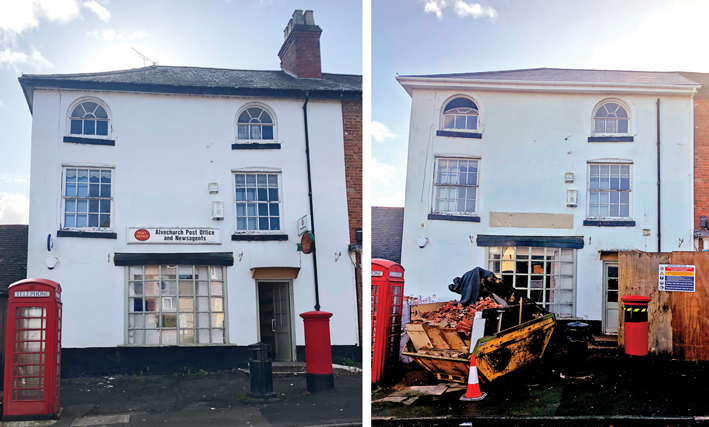
Chim, chimney, chim, chimen-no . . .The changing roofline of the Alvechurch Conservation Area.
Plus: The post box was sealed by Royal Mail (right) over fears of falling debris, Alvechurch Parish Council heard.

Missing chimneys should be rebuilt, urges expert

The demolition of the chimneys on a “heritage asset” in the centre of Alvechurch has provoked an outcry and demands that it be reinstated.

They were removed during work on the building on Bear Hill that housed Alvechurch Post Office until the end of November 2019.

Now Bromsgrove District Council’s Conservation Officer has recommended that the chimneys should be rebuilt and also that the new white plastic guttering and soffit board under the eaves be removed and materials in keeping with the originals be used instead.

The building was constructed in the 19th century to be used as Alvechurch Grammar School. It has been used for many years as Alvechurch Post Office until its sale.

A planning application to turn it into two commercial ground floor units and two upstairs residential flats was due to be considered by Bromsgrove’s planning committee by December 23.

It is not a listed building, but the Conservation Officer states in her report to the council that it “is a heritage asset that does meet the criteria for the Local Heritage List”.

She adds: “It is a rare example of polite architecture within the Alvechurch Conservation Area.

“The building stands as a landmark feature on Bear Hill due to its scale and prominence.”

The officer says the chimneys should be “reinstated to the original detailing”, as should the guttering and soffit.

Her recommendations were backed by Alvechurch Parish Council, although there were fears that planning officers may not be so enthusiastic.

Coun Andy Humphries told the council: “I spoke to the planning officer concerned and I got a feeling of total complacency.”

District councillor Charlie Hotham said: “This comes down to the whole nuance of the council.

“The role of the council is to set up rules and the council enforces the rules,” said Coun Hotham. “But if they do not enforce the rules, what is the point of the council?”

Click here for The Village View