
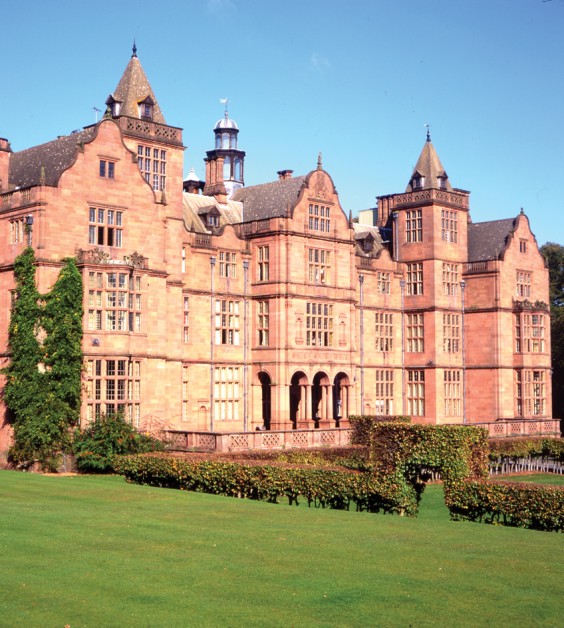
Anyone who has visited the National Garden Scheme website (https://www.ngs.org.uk) will probably have noticed that this year the grounds of Hewell Grange, our ‘stately home’ in Tardebigge, will be opened to a lucky few villagers.
They feature an 18th-century park and lake laid out by Lancelot Brown and modified around 1812 by Humphrey Repton.
The Village was invited to look around Hewell Grange, a prison for the past 60 years, in 1999. Here, we publish some of the pictures taken by Les Ladbury and by The Village as well as a history of the building by the late local historian Margaret Mabey.
Hewell Grange, hidden away on our doorstep in Tardebigge, is an arresting sight. It is even more remarkable on the inside – both for its Renaissance-style splendour and for the prisoners who live there now.
This great house at Tardebigge is our local stately home, but few people have ever seen it. Indeed, it is so well hidden among the great trees of its grounds that most people don’t even know it is there.
And as for the past 60 years it has been one of HM’s prisons, it isn’t open to the public.
But when it was built in the 1880s it was the sensation of the neighbourhood – this splendid mansion built for the young Lord Windsor in a style chosen by himself and not at all what the architects had expected him to fancy.
It replaced a huge Palladian house built by an 18th century ancestor dangerously close to the lake in the park. Gradually the foundations had subsided and when Robert, Lord Windsor, came of age in 1878 it was decided to abandon it and build a new one on higher ground.
Lord Windsor was a wealthy young man with profitable coal-producing estates in Wales, and the London architects Bodley and Garner were very pleased to be asked to design his new house.
They were a good deal less pleased when he rejected their plans as not at all what he had in mind.
There was even more consternation when he began to describe what he really wanted – it sounded so fantastic, quite unlike what people admired at the time. But Lord Windsor was artistic and had travelled around Italy admiring its Renaissance buildings.
Messrs Bodley and Garner heard with dismay that he intended to build a Renaissance palace in rural Worcestershire and are said to have felt so unequal to the notion that they handed him over to a younger partner who might be more amenable to his ideas.
The outside of the new Hewell Grange, Lord Windsor explained, was to look like one of the great Elizabethan mansions, like Hatfield. But inside – and here his imagination really ran away with him – it was to resemble a Florentine palazzo such as any Medici might have envied.
It took seven years to build. The dark red sandstone he wanted could be found no nearer than Runcorn in Cheshire, and it all came by canal to the Old Wharf at Tardebigge.
It seems incredible that such vast amounts of stone could have meandered slowly over the country and then been lugged up hill and down dale to the site by a horse-drawn tramway. But the motor age had not yet dawned.
Lord Windsor had just married and his 18-year-old bride was very artistic, too, sharing his enjoyment in finding adornments for the house. There were trips to Italy to buy marble chimney pieces and statuary and to decide which Renaissance marvels should be copied for their own rooms.
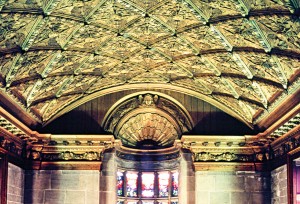
Looked at from the outside, the new Hewell Grange, though impressive, gave no hint of the splendour within and visitors ushered into the enormous, lofty central hall must have gasped in wonder.
The marble pillars, arched galleries, elaborate plaster work, the intricately carved ceiling – it was quite overwhelming. And what made it even more remarkable was that the young man who had dreamed it all up was such a diffident, unassuming person – not grand at all.
Woodcarvers, sculptors, tapestry workers were brought from abroad to work on the décor of the house.
Workshops were made for them in the old house down by the lake. Two Italian woodcarvers stayed for several years carving the winged angels on the ceiling in the chapel. Its stained glass windows, some designed by Lord Windsor himself, were made in a specially constructed studio.
In Lady Windsor’s sitting room there was a marvellous ceiling of carved and painted wood in a maze-like design copied from a 16th-century palace in Italy.
It could not be described as a cosy home, but it did have some very up-to-date amenities. It was the first great house to be built with electric lighting and it even had a form of central heating, without which it would have been hardly habitable.
Outside, there were elaborate gardens, Lady Windsor’s special interest, and her husband, very knowledgeable about trees, saw to the planting of the many splendid specimens which now hide the house from us.
And the old mansion down by the lake? Its gutted, overgrown shell is still there, and a persistent legend claims it was blown up during a firework display to entertain the Shah of Persia when he came to visit Lord and Lady Windsor in their magnificent new home.
Hewell Grange gardens are open as part of the National Garden Scheme on May 19-20. Numbers are limited and places have to be booked in advance. See https://www.ngs.org.uk of the “Yellow Book” for details of how to apply.
