
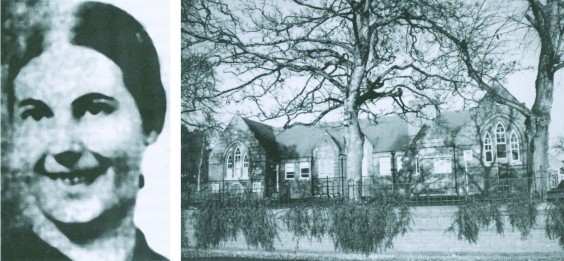
Local author Anne Bradford, whose ghost stories we have featured previously, has now published a book of Foul Deeds & Suspicious Deaths Around Worcester. Here we tell her (slightly abridged) tale of a wartime murder in the quiet streets of Lickey End…
This story takes place in Bromsgrove in 1944, when a large number of American GIs arrived to take over the running of the town’s two hospitals for injured soldiers.
“One person who was enjoying the arrival of the Americans was 33-year-old Florence Porter. In 1944 her family were living at the Bromsgrove end of Little Heath Lane, Lickey End. This was a long, winding lane, and only a few yards away and almost opposite the Porters’ home was the local school (shown above).
Florrie was an attractive girl, almost five feet ten inches tall, and with long dark hair. A bright girl, she worked as a clerk at the Austin Motor Company, and her bubbly personality made her popular with everyone.
She loved music and dancing and had at one time played in the local jazz band, but by 1944 she had dedicated most of her spare time to war work and had joined the St John Nursing Division at the Austin works.
On the evening of Thursday October 26, Florrie walked into Bromsgrove with one of her sisters, Doris, saying that she had an appointment with a man named Hal.
Doris went off to meet a friend and left her in Bromsgrove at about 8.20pm. The previous day Florrie had told another sister, Winifred, that she was meeting Hal.
A barmaid at the George Hotel said that between 9 and 9.30pm she went into the smoking room and saw an American officer with a girl. They appeared to be friendly and were laughing and talking.
Later she recognised the young lady as Florrie. She did not see them leave.
Another woman went into the smoking room at 9.40pm and saw Florrie with the American officer. They left ten minutes later.
The Porters’ neighbour was an assistant foreman at the Midland Red Garage in Bromsgrove. He happened to be standing on the corner of School Lane and Birmingham Road at about 10.20pm when, by the light of the lamp on the opposite side of the road, he noticed Florrie going by with an American officer.
They came from the direction of Bromsgrove and turned up School Lane, towards Florrie’s home. The neighbour saw only their back view, but the American appeared to be an officer, wearing a mackintosh blouse with dark trousers and a hat.
That was the last time Florrie was seen alive. About 10.30pm, screams were heard by those living nearby, but as it was a wet and windy night no one took any notice.
Florrie did not return home that night. Her mother wasn’t worried because she often stopped overnight at a friend’s house in Bromsgrove to save the long walk home.
Rain spread across Bromsgrove overnight and the next morning dawned cold and damp. Two boys, Albert Egan and his younger friend, seven-year-old Louis Price, were cycling to school, and as they went along Alcester Road past the back of the school, Albert noticed something blue under a veranda in the playground.
Lying there, on her back, her head turned to the side and with face and hair covered in blood, was the body of Florrie Porter.
Her left hand was under the body, her gloves were near her head and nearby was a large pool of blood. Her coat was open, her skirt was “disarranged”, but her blue underwear was in place and it was this which had caught Albert’s eye.
With remarkable composure, he sent Louis to notify the school caretaker, and four police officers were quickly on the scene, joined by the chief constable, the detective superintendent and some American officers. The school was closed for the day and the children sent home.
Florrie’s remains were taken to the pathology lab at the old workhouse on Birmingham Road. Her face was badly bruised on the left eye, left cheek and nose. Either she had been punched twice or her attacker was wearing a ring.
Evidently she had attempted to scream but a hand had been clamped over her mouth, causing more severe bruising. She had fallen backwards against a wall or the playground, as evidenced by the bruises on the back of the head.
She had died from stab wounds to the chest and neck. A stab wound on the left side of her neck had cut the jugular vein and the carotid artery. There were six more wounds to her chest, and holes in her woollen jumper showed where the knife had been plunged in.
One of the wounds had penetrated her heart and there was blood in the nails of her right hand. Her assailant would not have been bloodstained as there was no spurting. There was no evidence of sexual activity.
Only one weapon had been used, and as the blade was only just over half an inch wide, the wounds must have been inflicted with great force by a strong person. Since there were no cuts on either hand, she could not have tried to defend herself, which suggested that she was unconscious when she was stabbed.
The overnight rain had washed away any footprints or other clues.
An inquest was held the following Monday, then postponed until Monday December 4 to allow time for investigations. The Americans were not represented at either inquest.
Bromsgrove Police, Worcester CID and American G-men with military police were all on the case. Scores of statements were taken, interviews were held with American officers and there was an identity parade at the local US hospital.
The police issued an appeal, asking for the officer with Miss Porter to come forward, and a description was issued.
The man was a first or second lieutenant, aged about 24 to 30, height five feet eight to five feet ten, well-built, low-browed, clean-shaven, bull-necked, dark hair cut close, sticking up and growing well down the forehead. Not surprisingly, no one came forward.
For three days the following week, American soldiers were out with “magnetic” mine detectors, searching for the knife. Schoolchildren also joined the hunt.
On Saturday, Florrie’s handbag was found lying in some bushes at the front of a house known as Norton Farm. A pool almost opposite was drained, but there was no sign of the murder weapon.
The press were told: “One of the complications of the case is that the wanted officer may be among the hundreds of US men who have passed on from the local camp to other establishments.”
A final word comes from Eric Robertson who, in 2007, wrote an article for Bromsgrove Museum during a project to preserve old memories of the town. He wrote:
“I can also remember a young girl been murdered in School Lane; they were seen in the George Hotel. My mom worked there, and the police took her to all the American bases to identify the man she had been seen with.
My mom did find him, but because they threatened the family, she could not say who he was.”
For more foul deeds of the area, check out Anne’s book – published by Pen & Sword Books Ltd and priced £9.99, available from all good bookshops (ISBN: 9781845630669)
