
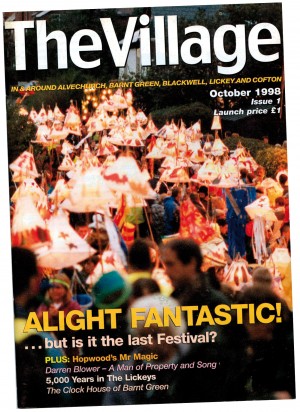
Over its first ten years, The Village has seen a lot happen, but not too much change . . .
It’s ten years since issue one of The Village rolled off the press. As with any new venture, we hoped for the best but we probably didn’t imagine it would still be around ten Octobers later.
Its impetus came in large part from the huge swell of community feeling generated by the Alvechurch Alight lantern processions the previous two autumns.
Walking along with so many people, all joining in from villages across the area, it felt like there was a common thread running through their lives. Our hope was to try to tie that together every month.
It was no coincidence that we launched the magazine in an October, just after the event, with an Alvechurch Alight scene on the front cover.
We are still around today (even though Alvechurch Alight isn’t) because people want us to be. If no one read The Village or responded to the adverts that support it, we wouldn’t be here.
At the same time, the people of these communities to the east of Bromsgrove are a very active, interesting bunch and we have never, ever been short of something to put in the magazine.
While a lot happens all the time, very little has changed over ten years. There have been a number of controversies, mainly involving planned developments, which have stirred emotions; but it’s difficult to think of any major upheavals.
The Alvechurch bypass was opened before we began, and the biggest recent change – the scarring of our landscape by the M42 – happened 30 years ago.
We have yet to see a housing development on the scale of those threatened on a number of occasions over the past decade.
The large field between Twatling Road and Pinfield Woods in the Lickeys was left alone and the 12 acre fields between Fiery Hill Road and Barnt Green Cricket Club were also spared designation as an Area of Development Restraint (ADR) – better known as a future building site in the Green Belt.
The Twatling Road threat inspired a favourite magazine cover of the 85 so far, declaring “R.I.P The Green Belt”. Let’s hope it made a difference.
None of the fields around Alvechurch which were designated ADRs has yet fallen to housing, although two of them are now home to the new schools, leaving the old schools site for housing at some point.
Even the rash of back-garden builds has slowed to a trickle, mainly through Bromsgrove District Council’s moratorium on new planning approvals, although one residential development has raised a few eyebrows.
On a road with some very nice red-brick Edwardian homes, the tall blocks of apartments or giant homes that have mushroomed in Laurel Gardens, off Bittell Road, Barnt Green, do seem alien and out of place.
Meanwhile, we still wait with some trepidation to hear if the Government really will ask for as many as 10,000 homes to be built in the Arrow Valley between Alvechurch and Redditch. All niggling would pale beside the horror of extending the former new town into our villages.
Development of one sort or another was also behind perhaps the two most contentious issues of the past decade.
The first saw a local church at odds with the community after it decided to sell to a major housebuilder a patch of land given to it for use as a churchyard extension.
The ambitious plan by St Laurence Church was to use the £1million-plus proceeds from the sale to pay for the building of a ship-shaped church extension to be called The Ark.
Unfortunately, the church failed to get the community on board before it set sail on this voyage, which to those navigating must have felt close to foundering at times.
More than 150 people took the time to fill in questionnaires printed in The Village at the request of protesters, with 81 per cent disagreeing with The Ark proposals and 82 per cent opposing the sale of the land, known as the Black Paddock.
It culminated in a hearing before an historic Consistory Court at St Laurence Church in March 2003 where, memorably, one member of the committee behind the plans said that nothing would be achieved if they “approached every Tom, Dick and Harry in the village and asked about what we wanted to do”.
As we know, the court gave the go-ahead and a number of large houses were built on the Black Paddock – although there is still a piece of public open space in front of them for anyone to use – and eventually The Ark itself was moored at the side of the church.
It is in many ways an inspirational piece of architecture and a very useful village amenity, but the waves of discontent stirred by its arrival continue to ripple through the community to this day.
The Ark, however, is an example of something that did happen; another controversial plan is still to come to fruition – that for a large-scale rendering plant at Hopwood.
Again, this ended up in a hearing, this time before a Government planning inspector where the farm behind the scheme was represented by a very clever and skilled barrister.
The protesters, calling themselves Hopwood Against Rendering Movement (HARM) were represented by local electrical parts salesman Jeremy Roberts after Worcestershire County Council withdrew its opposition days before the inquiry.
At the time Mr Roberts told The Village: “With six days to go, our last friend has left us. Now I am going to have to represent HARM before the Government inspector. I am a salesman, not a lawyer.”
Three days of complex arguments followed focusing on whether the chimney needed for the plant was acceptable in the Green Belt.
Despite 1,000 written objections and protests by a number of local bodies and MP Julie Kirkbride, the inspector said he had to make his decision purely on planning considerations and gave the go-ahead for the chimney.
This cleared the way for the owners of Mayfield Farm to seek a pollution prevention and control licence to allow the proposed plant to process around 85 tonnes per day of animal waste.
As this issue of The Village went to press, the licence was still to be issued.
But on a greener note, Mick Robbins, of Mayfield Farm, has planted around 48,000 tree whips, including oak and hornbeam across 170 acres of farmland between Alvechurch, Hopwood and Barnt Green. It could one day be a fine wood.
There has been no change either on the southern slopes of the Lickey Hills where lorries laden with clay and spoil make their way up Old Birmingham Road before turning down Alvechurch Highway to deliver their load to Marlbrook Tip.
The owners continue to work to cap the 50-acre tip so they can build a nine-hole golf course with spectacular views, despite the lorries creating what was described as a “living hell” by one resident at a public meeting in Lickey in March 2007.
Residents were assured then that another two years was all that was needed. So district councillor Ann Doyle has six months to plan an escape after declaring her reluctant support for the scheme and adding: “I do hope that in two years you will not string me up from these rafters.”
For the strangest case of plus ça change we need look no further than Lickey End where in November 1999 the people asked if they, like the villages to the east of them, could have a parish council.
After some to-ing and fro-ing between Whitehall and Bromsgrove District Council, this was agreed and elections were held in June 2001 . . . when the people elected 10 councillors, all of whom had campaigned against having a parish council.
At their first meeting they submitted a formal request for the council to be dissolved and have been waiting, in limbo, ever since.
There have been countless other rumblings of discontent and disagreement reported in these pages down the years – most recently over the building of affordable homes in Hopwood and a multi-use games arena in Swan’s Length playing field, Alvechurch.
The Village intends to continue to report wherever it can and to be a platform for everyone out there to air their views, ideas and talents.
So much of this magazine is created by its readers and we hope to push that further still over the next year with a proper online presence where everyone can take part 24 hours a day.
We have been able to increase the number of pages in the magazine thanks to our switch to a distribution company from Royal Mail a year ago. This created a few teething problems, but these are mainly sorted out.
And while the economic downturn may be challenging, we are well-placed to weather such storms.
So here’s to another ten years of everything changing and yet more things staying the same!
