Home Blog Page 817

Colourful Canada

Hannah Genders encounters maple trees, water sports and bears on an inspiring trip.

Having just written last month’s article on autumn colour, I then had the opportunity to visit friends in Canada – Toronto and the lakes and forests in northern Ontario. The “fall” colours were so inspiring that I hope you will forgive me for writing another article on this subject.

The weather was kind to me, particularly during the first week of my visit, which meant that many of the leaves were still on; because the temperature drops so quickly as they head into winter, their fall – our autumn – can be very short.

The difference in Canada compared to the autumn display we see in our native trees is the swathes of red and orange. This is due to their native Maple trees, which grow in profusion over there.

The Red Maple (Acer rubrum) produces a stunning display of red and orange foliage and the Sugar Maple (Acer saccharrum) does the same – this is the one from which they extract the famous maple syrup (I did try it on pancakes for breakfast, but still prefer toast).

Also providing a striking red display was the Sumach (Rhus Typhina), one of the shrubs I mentioned in last month’s article. We grow this as an ornamental garden shrub, but in Canada it grows like a weed, thriving on the shallow soils, and, due to its tendency to “sucker”, creates whole banks of fabulous colour in their woodland and scrub habitats.

Along with this backdrop of colour the silver birches grow in profusion and their white bark contrasts beautifully with all the bright variety around them.

In Northern Ontario there are about 30,000 lakes, and while visiting friends who have retired to one of these lakes I had the chance to do some canoeing. The colours truly come alive with the reflection from the water and gave me lots of ideas for combinations of water and autumn planting on future landscape projects.

Whilst out canoeing I also came across a little pitcher plant growing in the shallows; each pitcher had a soup-like substance where the plant had devoured insects for extra nourishment, but again, what beautiful colour!

As well as being excellent canoeists, my friends enjoy running in the forest. I went out with them during my stay, which was another opportunity to see more of the trees and to talk (when I was able) about the very wide variety of wild flowers they have in the area.

We also had to take with us a bell and some bear spray. The bell, I was told, was to let any black bears nearby know that we were approaching so as not to startle them and provoke an attack.

And what was the bear spray for? Well, not (as I joked) to make the bears smell better, but to scare them off. The thought of being close enough to effectively spray a large animal that may have you on his lunch menu made me run my fastest times ever.

We did actually see some bears on the side of the road; they were fairly small and probably this year’s babies, beautiful to look at but thankfully not close enough to need spraying.

So it’s good to be home, safe and sound, with abiding memories of stunning natural beauty, wild woods and vast expanses of water.
Spooky. . .

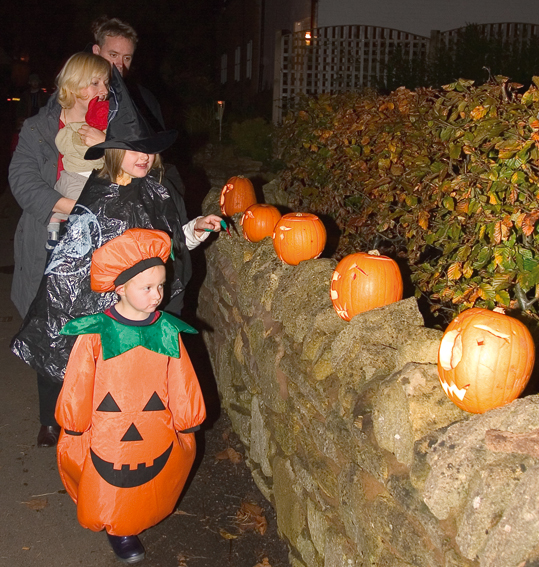
A plethora of pumpkins was on display at Halloween as Burcot village celebrated the spookiest time of the year.

Villagers young and old were invited to do some creative pumpkin-carving – the impressive results were then displayed around the village, along with some other scary characters.

The display attracted many visitors and plans are under way to repeat the event next year.

A few words. . .

Continuing our theme from last month, we’d just like to thank everyone who has contributed towards this magazine over the past year.

It means The Village is very much fulfilling its mission to provide a showcase and a soap box for all the people and organisations who care about what’s going on around them.

It is their community involvement that makes this area one of the better places to live and helps to differentiate it from some of the anonymous suburbs around the West Midlands conurbation.

In an age when far too many people spend so much time behind their own doors, at work or travelling to and from it, those villagers who get out and make things happen are to be thanked and praised

Without them, there would be no Alvechurch Alight, village halls would fall into disrepair, scout and guide groups would disband . . . and unwanted developments would go unopposed or slip through unheard of.

In just one example, Cofton Hackett villagers have been far-sighted enough to club together to buy a beauty spot to make sure someone with a big wallet doesn’t shroud their area in uncertainty.

And for as long as people are making a difference, we hope this magazine will be able to help them. Happy festivities!

Hunting for extra funds

Janey Hewitt reports on a special school’s fundraising efforts that will benefit the whole community.

Hunters Hill School in Blackwell has been awarded a grant of £385,000 from the Big Lottery Fund for a new sports hall, subject to them raising £129,000 themselves.

The three-building project comprises a new sports hall, toilets and changing facilities. Once this is completed, the old sports hall will be converted into a new library, which will be at the heart of the school. The new sports facilities will be used by the pupils during school hours, and community groups at weekends.

Head teacher Ken Lewis is keen to get the project under way: “Permission has been granted by the landlord, Lottery Fund and planning department. The school looks set to succeed, but unless we can raise the additional money before June 2005 we will lose the Lottery grant.”

Hunters Hill recently announced the result of their annual art competition run for their very special children. The nine finalists, whose artwork features on the school’s annual Christmas cards and calendar this year, had the opportunity to visit the publishers, where the cards and calendars were being printed.

Mr Lewis said: “This was a great opportunity for the children to see the culmination of their hard work and to gain some insight into the world of publishing. It was a unique learning opportunity.”

This year the school was sponsored by A1 Paper Stationery Ltd, of Camp Lane, Handsworth, Birmingham, who paid for all the printing costs.

Mr Lewis added, ‘We are indebted to Mark Jones and his team at A1. This means that all the proceeds from the sale will go towards the School Sports Hall Programme. This is a community project, not just for the school. Local residents will be able to use the sports facilities as well as local schools and, of course, pupils at Hunters Hill. The community has always been very supportive of our school.”

A spokesperson for the school said: “We have worked towards this objective for over two years. The award and granting of planning permission by Bromsgrove District Council has been a major step forward. This is a super opportunity for everyone living in or around the village of Blackwell.

“The school would like to say a big thank you to everyone who supported us by buying our Christmas cards and calendars, and also to Blackwell village, who have made a generous donation from the fete proceeds.”

However, with £129,000 to find, the task is not yet complete. The school is appealing to readers of The Village to support this project, either with a donation or by passing on details of the appeal to organisations that may help, such as the Rotary Club or the Round Table. Every little helps.

Hunters Hill School, which became a registered charity (1091007) in 2002, provides education for children who have emotional, learning and behaviour difficulties. 

For further information contact Mr Bill Kearns at Hunters Hill School, Spirehouse Lane, Blackwell. 0121 445 1320.

www.huntershill.org.uk
e-mail: enquiry@hunthill.bham.sch.uk

Living with Birmingham Rep

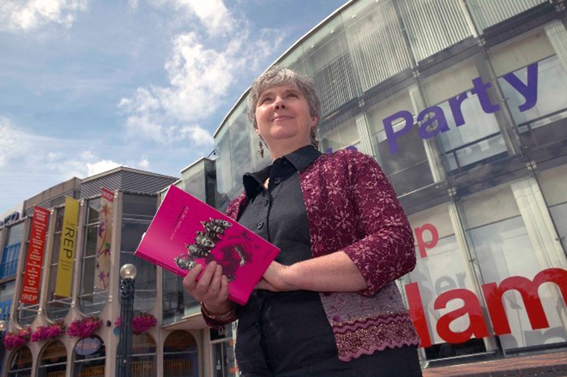
Claire Cochrane with her latest book outside the ‘new’ Birmingham Rep (Pic/ Edward Moss)

Shakespeare and one theatre in particular changed my life, writes Claire Cochrane.

My home on Sandhills Road, Barnt Green, will be 100 years old in 2005 and, as any visitor to the house soon discovers, the piles of books and papers include a mass of records relating to a theatre company which is pretty much the same age.

At the time that Barnt Green was beginning to expand, a small group of amateur actors was holding regular meetings in a much larger, grander house in Moseley called The Grange. Led by Barry Jackson, youngest son of the wealthy grocer George Jackson who founded the Maypole Dairy chain, the group developed out of home theatricals to performances in local venues.

By 1912, they were calling themselves the Birmingham Repertory Company with high-minded aspirations to found a theatre devoted to innovative ways of staging classic plays especially Shakespeare and the best of the new literary drama.

In 1913 on Station Street just behind New Street Station, Jackson opened what was the first British purpose-built repertory theatre. It went on to become one of the most famous regional producing theatres in the country responsible for launching the careers of many famous actors, including Laurence Olivier and Ralph Richardson.

Memory plays tricks, but as a child growing up in Birmingham I think I was first taken to the Rep for Christmas 1951 to see Beauty and the Beast. I seem to remember enjoying a small fat dragon. But that was as nothing compared with the excitement generated by seeing a very young Albert Finney play Henry V in 1957. We sat very close to the stage and I was thrilled: effectively hooked on Shakespeare for life.

By the time the Cochrane family arrived in Barnt Green in 1981, I’d seen a lot more plays in many different theatres, acted and directed as an amateur myself, taken a degree in English and worked as a secondary school teacher.

The move to Barnt Green, however, coincided with an MA at the Shakespeare Institute in Birmingham. That in turn led to research into Shakespeare production at the ‘Old’ Birmingham Rep from its origins at the beginning of the century up until the move to the ‘New’ theatre on Broad Street in 1971. By the time the doctoral thesis was completed in 1987, it’s fair to say that Shakespeare and the Rep had changed my life forever.

Researching theatre history is about trying to recapture the experience of the most ephemeral of arts. Once the applause has died away nothing remains except individual memories which can be distorted, newspaper reviews which can be biased, faded designs, some photographs (if you’re lucky) stage manager’s “prompt books” which have to be interpreted and dog-eared lists of props and costumes

When I first encountered the Rep archive, it was in a dreadful mess piled up haphazardly in a room at the top of the Broad Street theatre. I even found Sir Barry Jackson’s certificate of knighthood on the floor. My first year of research was spent dusting photographs and scrabbling around in cardboard boxes.

That all changed when the Sir Barry Jackson Trust agreed to the transfer of these precious records to Birmingham Central Library where any member of the public can access them.

The journey through the theatre’s history was fascinating. How many people realise, for example, that each time they see a production of Shakespeare in “modern dress” – and  some theatre-goers are still rather shocked if Shakespeare isn’t performed in wrinkled tights and puffy Elizabethan- style trunks – that this method of revitalising a classic play originated in Station Street?

In 1925 audiences in London and Birmingham flocked to see Hamlet “in Plus Fours”. Olivier and Richardson both played in The Taming of the Shrew in modern dress in 1928. In 1945 the theatre guru Peter Brook started his career directing Paul Scofield at the Rep. Albert Finney was preceded in the company by Ian Richardson and followed by Derek Jacobi.

After the publication of my book Shakespeare and the Birmingham Repertory Theatre 1913-1929 in 1993, the Trust commissioned me to write an updated general history. Birmingham Rep: A City’s Theatre 1962-2002 was published last year. It was a long haul juggling the task with teaching at University College Worcester.

Also, while writing about the relatively distant past and the long-dead has its obvious difficulties, committing to print the disasters as well as the triumphs of the very-much-alive can be quite perilous. I had to look at financial statements as well as some stunning photographs and talk to artists about disappointment as well as celebration. And I’ve seen an awful lot of plays at Birmingham Rep!

That huge building on Centenary Square – and I have explored the reasons for its size and structure – can play host to audiences of over a thousand each night. Many hundreds of artists, craftspeople, technicians, managerial and support staff have collaborated on the enterprise and the theatre reaches out to an ever-widening multi-cultural community.

In a hundred years the Rep has come a long way. Back in 1951 I couldn’t have guessed where that Christmas treat would lead me.

The Birmingham Repertory Theatre 1913-1929, The Society for Theatre Research, 1993, ISBN 0 85430 053 8 (£15); and The Birmingham Rep: A City’s Theatre 1962-2002, The Sir Barry Jackson Trust, 2003, ISBN 0-9545719-0-8 (£10) are both available through Amazon.

A City’s Theatre may also be bought at the Birmingham Rep itself or Claire has a few copies in a cardboard box at home. Telephone 0121 445 2816.

The Rescuers

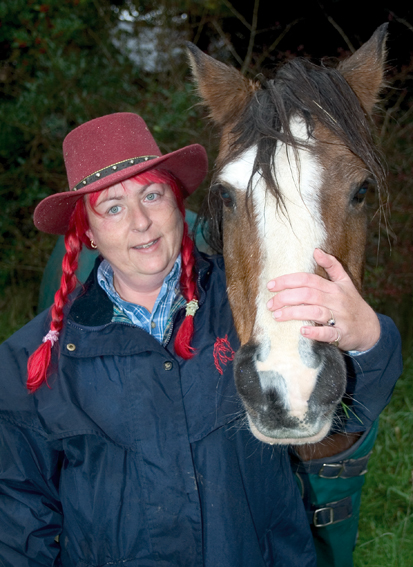
Raynor with Wella whom she has owned for 31 years

Janey Hewitt meets the Barnt Green animal-lovers dedicated to helping  the creatures no one else wants.

Barnt Green Horse and Rescue Centre is celebrating its recently-awarded charitable status and founder Raynor Walker is champing at the bit to continue the centre’s work in rescuing animals. With more guests than she has room or money for, she is seeking extra funds.

Since the centre was set up 13 years ago, Raynor has rescued horses, sheep, goats, parrots and even an iguana (which has grown to six feet in length since being re-homed). The centre is run by Raynor, her mother Jean, and her daughter Zara, with Dr Lucy Wilkinson a recent addition to the team.

The centre welcomes pre-arranged visits from the community. “We have children with learning disabilities to visit us,” Raynor enthuses. “Some have never seen a pony or a sheep before. They ask ‘Is that what we really eat?’ It is lovely to see the expressions on the children’s faces as they stroke a pony.”

Raynor has also started visiting schools to talk about the centre. “If you can teach young children how to look after animals, there will be less suffering later on in life,” she says.

The centre is currently raising funds for a mobile shelter. “Old ponies and horses need a shelter in the cold winter nights,” shivers Raynor. Pupils in years 4 to 7 at a Redditch school recently raised £87 from a bring-and-buy sale for the centre. Local pubs hold charity collections and Banks’s brewery has pledged to match funds raised by Hopwood House. “Community support such as this is fantastic,” says Raynor.

Future fundraising events include fun nights, discos, a quiz night at the Victoria pub in Barnt Green, a sponsored walk from Hopwood House (calling at eight pubs on the way), pleasure rides and a Christmas ride around Clent.

I asked Raynor what her vision is for the future of the Centre in five years time. “It would be wonderful to own our own land and be self-sufficient,” she replied. “Maybe someone will leave the centre a legacy!”

She summed up the centre’s success: “I have the time, the dedication, the love, and lots of support. When you have that you can go a long way.”

Tel: 0121 457 8251
Email: raynor@bgar.org.uk 

The Inn-place

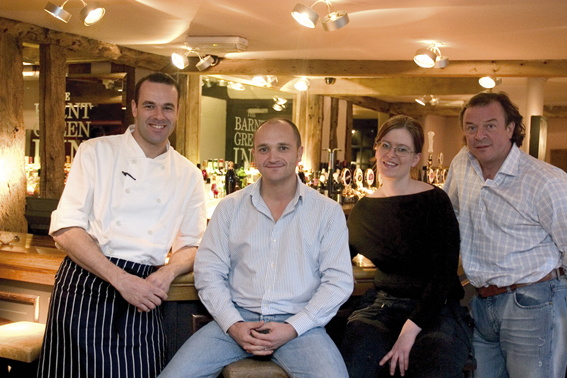
Head chef Duncan Mitchell, managing partner David Singleton, general manager Natalie Edmonds and managing partner Paul Salisbury

ADVERTISEMENT FEATURE

The Barnt Green Inn has been recreated as a bright, modern venue sure to find favour with drinkers and diners across the area.

It has been revamped by business partners Paul Salisbury and Paul Hales, the team behind the popular Saxon Mill, at Warwick, and Cock Inn, at Wishaw.

The dark, old-fashioned decor of the former Toby Carvery has made way for an interior with the emphasis on luxury and style “without being pretentious”.

The aim is to make customers “feel automatically at home, with casual drinking and dining areas, ambient lighting and real fires and a large outdoor terrace.”

The bar areas are a mix of old and new, including two large “party” tables, while the restaurant takes an organic theme with teak tables, limestone flags and wide oak floorboards. There is a mix of seating for cosy dinners for two or larger gatherings.

Head chef Duncan Mitchell brings his experience at the Baraset Barn, Stratford-upon-Avon, and The Swallow Hotel, Birmingham, to Barnt Green. The menu includes prime steaks, fired pizzas, classic salads and seafood.

Natalie Edmonds, general manager of a 40-strong team, said: “We are delighted to have restored the Barnt Green Inn with its Tudor origins and introduce a modern, eclectic look which we are sure the residents of Barnt Green will love.”

Interior designer Sue Salisbury said: “I wanted to make sure we complemented the original features within the building. New is obviously new and the old has been restored to bring out its true beauty.”

Opening hours: 12noon-11pm (Mon-Sat) and 10.30pm (Sun). Food is served from 12noon-2.30pm and 6pm-9.30pm (Mon-Sat) and 12noon-4.30pm (Sun). Children welcome.

22 Kendal End Road, Barnt Green B45 8PZ
Tel: 0121 445 4949

Good luck to the protesters

0

I am writing to wish Coun Lord and all those opposing the proposed rendering plant in Hopwood the very best of luck in their efforts.

It is unbelievable that such an application could even be considered.

 Janet King, Blackwell

Joggers should alert dog-walkers

0

I’m writing to tell you about a problem my friend and I have met on several occasions in the Lickey woods and the spinney that leads on to Fiery Hill Road. We walk our dogs regularly every morning and we go out quite early, about seven.

My friend has a rescue cross greyhound who is protective towards her  and when suddenly we are confronted by a jogger directly at our side, my friend’s  dog is startled and gently warns the jogger off by moving close to him. We then get a barrage of insults and swear words, which is upsetting, and sometimes threats have been made.

We are not aware of the jogger before this happens. Now I remember when I skied abroad, skiers behind used to shout “to your right” or “to your left” and I wondered whether joggers could develop a language of their own which could inform dog owners that they are approaching and allow the owner of a protective dog to hold him until the jogger has passed.

Do other readers have any suggestions to help?

Angela Carmalt , Barnt Green   

From Pits to Joy

0

In answer to Morris Jephcott’s question regarding a burial site somewhere in Pestilence Lane for victims of the Black Death: As a child growing up in Hopwood, I remember a farm called Black Pits, which I was told got its name from a pit on its land which was a burial site for victims of the Black Death.

This farm was later renamed Jingle Joy and is now the Cramar Cat Sanctuary.

Mrs C Adams, Alvechurch