
Hannah Genders encounters maple trees, water sports and bears on an inspiring trip.
Having just written last month’s article on autumn colour, I then had the opportunity to visit friends in Canada – Toronto and the lakes and forests in northern Ontario. The “fall” colours were so inspiring that I hope you will forgive me for writing another article on this subject.
The weather was kind to me, particularly during the first week of my visit, which meant that many of the leaves were still on; because the temperature drops so quickly as they head into winter, their fall – our autumn – can be very short.
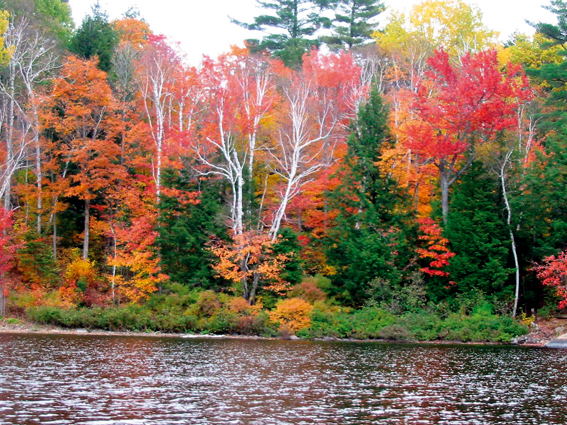
The difference in Canada compared to the autumn display we see in our native trees is the swathes of red and orange. This is due to their native Maple trees, which grow in profusion over there.
The Red Maple (Acer rubrum) produces a stunning display of red and orange foliage and the Sugar Maple (Acer saccharrum) does the same – this is the one from which they extract the famous maple syrup (I did try it on pancakes for breakfast, but still prefer toast).
Also providing a striking red display was the Sumach (Rhus Typhina), one of the shrubs I mentioned in last month’s article. We grow this as an ornamental garden shrub, but in Canada it grows like a weed, thriving on the shallow soils, and, due to its tendency to “sucker”, creates whole banks of fabulous colour in their woodland and scrub habitats.
Along with this backdrop of colour the silver birches grow in profusion and their white bark contrasts beautifully with all the bright variety around them.
In Northern Ontario there are about 30,000 lakes, and while visiting friends who have retired to one of these lakes I had the chance to do some canoeing. The colours truly come alive with the reflection from the water and gave me lots of ideas for combinations of water and autumn planting on future landscape projects.
Whilst out canoeing I also came across a little pitcher plant growing in the shallows; each pitcher had a soup-like substance where the plant had devoured insects for extra nourishment, but again, what beautiful colour!
As well as being excellent canoeists, my friends enjoy running in the forest. I went out with them during my stay, which was another opportunity to see more of the trees and to talk (when I was able) about the very wide variety of wild flowers they have in the area.
We also had to take with us a bell and some bear spray. The bell, I was told, was to let any black bears nearby know that we were approaching so as not to startle them and provoke an attack.
And what was the bear spray for? Well, not (as I joked) to make the bears smell better, but to scare them off. The thought of being close enough to effectively spray a large animal that may have you on his lunch menu made me run my fastest times ever.
We did actually see some bears on the side of the road; they were fairly small and probably this year’s babies, beautiful to look at but thankfully not close enough to need spraying.
So it’s good to be home, safe and sound, with abiding memories of stunning natural beauty, wild woods and vast expanses of water.
