
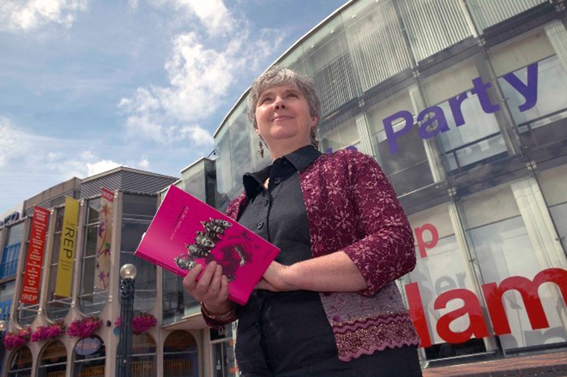
Shakespeare and one theatre in particular changed my life, writes Claire Cochrane.
My home on Sandhills Road, Barnt Green, will be 100 years old in 2005 and, as any visitor to the house soon discovers, the piles of books and papers include a mass of records relating to a theatre company which is pretty much the same age.
At the time that Barnt Green was beginning to expand, a small group of amateur actors was holding regular meetings in a much larger, grander house in Moseley called The Grange. Led by Barry Jackson, youngest son of the wealthy grocer George Jackson who founded the Maypole Dairy chain, the group developed out of home theatricals to performances in local venues.
By 1912, they were calling themselves the Birmingham Repertory Company with high-minded aspirations to found a theatre devoted to innovative ways of staging classic plays especially Shakespeare and the best of the new literary drama.
In 1913 on Station Street just behind New Street Station, Jackson opened what was the first British purpose-built repertory theatre. It went on to become one of the most famous regional producing theatres in the country responsible for launching the careers of many famous actors, including Laurence Olivier and Ralph Richardson.
Memory plays tricks, but as a child growing up in Birmingham I think I was first taken to the Rep for Christmas 1951 to see Beauty and the Beast. I seem to remember enjoying a small fat dragon. But that was as nothing compared with the excitement generated by seeing a very young Albert Finney play Henry V in 1957. We sat very close to the stage and I was thrilled: effectively hooked on Shakespeare for life.
By the time the Cochrane family arrived in Barnt Green in 1981, I’d seen a lot more plays in many different theatres, acted and directed as an amateur myself, taken a degree in English and worked as a secondary school teacher.
The move to Barnt Green, however, coincided with an MA at the Shakespeare Institute in Birmingham. That in turn led to research into Shakespeare production at the ‘Old’ Birmingham Rep from its origins at the beginning of the century up until the move to the ‘New’ theatre on Broad Street in 1971. By the time the doctoral thesis was completed in 1987, it’s fair to say that Shakespeare and the Rep had changed my life forever.
Researching theatre history is about trying to recapture the experience of the most ephemeral of arts. Once the applause has died away nothing remains except individual memories which can be distorted, newspaper reviews which can be biased, faded designs, some photographs (if you’re lucky) stage manager’s “prompt books” which have to be interpreted and dog-eared lists of props and costumes
When I first encountered the Rep archive, it was in a dreadful mess piled up haphazardly in a room at the top of the Broad Street theatre. I even found Sir Barry Jackson’s certificate of knighthood on the floor. My first year of research was spent dusting photographs and scrabbling around in cardboard boxes.
That all changed when the Sir Barry Jackson Trust agreed to the transfer of these precious records to Birmingham Central Library where any member of the public can access them.
The journey through the theatre’s history was fascinating. How many people realise, for example, that each time they see a production of Shakespeare in “modern dress” – and some theatre-goers are still rather shocked if Shakespeare isn’t performed in wrinkled tights and puffy Elizabethan- style trunks – that this method of revitalising a classic play originated in Station Street?
In 1925 audiences in London and Birmingham flocked to see Hamlet “in Plus Fours”. Olivier and Richardson both played in The Taming of the Shrew in modern dress in 1928. In 1945 the theatre guru Peter Brook started his career directing Paul Scofield at the Rep. Albert Finney was preceded in the company by Ian Richardson and followed by Derek Jacobi.
After the publication of my book Shakespeare and the Birmingham Repertory Theatre 1913-1929 in 1993, the Trust commissioned me to write an updated general history. Birmingham Rep: A City’s Theatre 1962-2002 was published last year. It was a long haul juggling the task with teaching at University College Worcester.
Also, while writing about the relatively distant past and the long-dead has its obvious difficulties, committing to print the disasters as well as the triumphs of the very-much-alive can be quite perilous. I had to look at financial statements as well as some stunning photographs and talk to artists about disappointment as well as celebration. And I’ve seen an awful lot of plays at Birmingham Rep!
That huge building on Centenary Square – and I have explored the reasons for its size and structure – can play host to audiences of over a thousand each night. Many hundreds of artists, craftspeople, technicians, managerial and support staff have collaborated on the enterprise and the theatre reaches out to an ever-widening multi-cultural community.
In a hundred years the Rep has come a long way. Back in 1951 I couldn’t have guessed where that Christmas treat would lead me.
The Birmingham Repertory Theatre 1913-1929, The Society for Theatre Research, 1993, ISBN 0 85430 053 8 (£15); and The Birmingham Rep: A City’s Theatre 1962-2002, The Sir Barry Jackson Trust, 2003, ISBN 0-9545719-0-8 (£10) are both available through Amazon.
A City’s Theatre may also be bought at the Birmingham Rep itself or Claire has a few copies in a cardboard box at home. Telephone 0121 445 2816.
