
Ceramic painting gives adults and kids a chance to unleash their creativity, says Sally Oldaker.
At the risk of sounding like a recruitment poster for journalism, the job really does give you the opportunity to try some diverse experiences – my latest activity was ceramic painting, which I had never come across even in the course of GCSE and A-level Art classes.
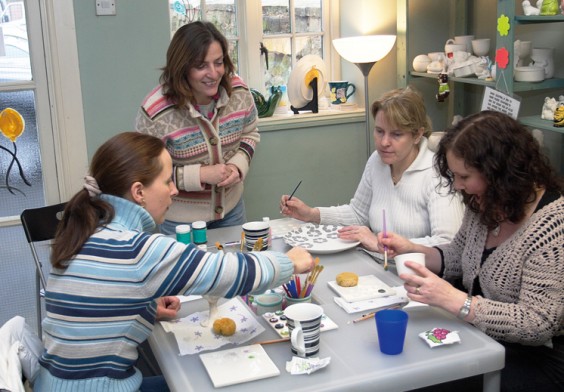
Julie Finn-McDonald runs the Brushstrokes ceramic painting studio at Tardebigge Court, offering both adults and children the chance to produce an original piece of ceramic artwork.
Children’s parties, family sessions and painting courses are all available at the studio, or Julie will bring the equipment to a school or home.
She took over the business in June 2005, after its original founder was forced to give up through ill health.
“My own daughter came to a birthday party at Brushstrokes, and that’s when I found out the business was for sale,” Julie recalls. “It seemed like such a great idea that before I knew it, I had agreed to buy it!”
Already working as a Technology teacher at St Bede’s middle school in Redditch, Julie had the necessary credentials to continue the success of a creative venture like Brushstrokes.
Her artistic background also included a degree in Silversmithing and Jewellery Design at the Birmingham Institute of Art and Design (now part of the University of Central England) and her PGCE (specialising in CDT) from the then Wolverhampton Polytechnic.
“At first I continued to teach and ran Brushstrokes on the side, but there wasn’t enough time for both,” says Julie. “I thought it was time I did something different, so I gave up teaching to concentrate on Brushstrokes.”
Her teaching skills make her an ideal person to coach others, particularly children, in the technique of ceramic painting. It’s not as difficult or as messy as you might expect, and makes a novel theme for a party.
“It’s not just for children, though!” Julie stresses. “Kids’ parties are my main activity, but lots of adults come too, from retired people to hen parties or social groups – there’s one group made up of mothers who have autistic children, and coming here gives them a chance to have a break and do something for themselves.”
Another misconception is that painting a plate or mug is all that’s on offer. I had rather expected to be given a plate or a tile, and as if to prove the point, Julie had arranged for me to paint a “tea for one” set consisting of a stacking mug and mini-teapot.
An example designed by Julie was on the table to provide inspiration, painted in turquoise with a design of yellow squares and black spirals.
In order to demonstrate the technique, Julie wanted me to do a similar design, although I could choose my own colours. Because the paints change colour when they are fired in the kiln, Julie has displayed “finished” examples of each shade on the wall to help you decide.
I picked a lavender purple for the exterior of the cup, teapot and lid, deep blue for the visible interior of the wide teacup, and turquoise for the extra detailing.
The first step was to create a design of irregular squares on the exterior surfaces, achieved by sticking down pieces of masking tape cut to the required shapes.
When this was done, the inside of the cup could be painted, using a large brush to give a thick coverage for a deep colour. This part would need three coats, to be completed later.
To achieve the mottled effect of Julie’s “one-I-made-earlier” tea set, a smaller brush was to be used – since my lavender choice was a paler colour, I was advised to use a lot of paint and, to use a technical term, “splodge” it on rather than paint in strokes.
Once I had painted over the whole surface, the masking tape would be removed, leaving the square-shaped areas clear.
It’s a fun process, especially if, like me, you haven’t used paints for a while. The only difficulty is working out how to hold the pieces while you paint them, and Julie is on hand to offer tips on this and other aspects of the technique, such as how to hold the brush – sounds simple, but I’ve learned there’s a certain way to paint the rim of a teacup!
After adding another coat of the deep blue inside the cup, it was time to peel off the masking tape and fill in the gaps. The paints are incredibly fast-drying, so there are no worries about smudging the main colour by this stage.
Painting in the squares with turquoise was the more daunting bit, but Julie selected a very thin brush for precision, and we were even able to carry on a conversation as I painted.
One final coat on the cup’s interior, and then the final touch – drawing spirals on the now-dry turquoise squares with a squeezy bottle of black paint.
A background in cake-decorating will serve you well here – shaky hands are a no-no – but Julie points out that potential mistakes can be corrected when the paint dries.
However, the great thing about creative activity is that even when you are essentially making a copy of an original, there is room for individuality, and the hand-made aspect always ensures that every piece is unique.
I was pretty pleased with the final look of my tea set, although this was by no means the finished article – Julie would now leave it to dry for a day, then glaze it, leave it another day, and finally fire it in the kiln where the true colours would appear.
“I usually tell people to allow a week before they pick up their work, so that I don’t have to rush things,” Julie explains. “Younger children sometimes don’t understand that they will have to wait, so I give them each a balloon animal to take home in the meantime!”
It’s touches like this that make Brushstrokes such an appealing concept, along with the fact that it offers everyone an opportunity to be truly creative.
“In this day and age we like things to be instant – it makes a nice change to do something that takes a little bit more time and care,” says Julie. “Plus, people are keeping up a traditional craft that’s been done for hundreds of years.”
As well as tea sets, you can also choose to paint a plate, mug, bowl, vase or panel, while children often paint figurines such as teddies, pigs or fairies. One nursery group decorated plates with their own handprints to give as Christmas presents.
Julie buys the ceramic pieces from a mould maker, and each has a “shelf price” to which a set fee is added to cover use of equipment. She can provide a template or stencil for an existing design, though some people prefer to create their own.
“Most people need to have a starting point, especially if they’ve never done anything like this before,” she says.
Above: Julie (second from left) supervises a group of artists at the studio.
Brushstrokes
Tardebigge Court
(opposite the pub at Tardebigge)
01527 540500 / 07950 955793
