Richard Peach revisits Grovewood Farm Dairy, which is leading the way for local producers.
It’s not so long ago that we would go to the shops, fill up a basket with food and not give a thought to politics or ecology, or wonder about the source of the goods we were buying.
A sausage was a sausage and a pint of milk was just what it said on the bottle.
Oh, for those simple times: now we are bombarded with fear, guilt, doubt and confusion. How many “food miles” have been squandered in getting this packet on to the shelf – and what is it packed in . . . a plastic carton that cost loads to produce and will now be tricky to dispose of for centuries?
Is it even going to be good for us? After years of food scares, from BSE to bird flu, we have to keep our wits about us, stay ahead of the news and make sure we know where our food is coming from.
It’s no wonder people cling to the hope that food being labelled “organic” offers a simple route to nutritional safety – and then find they have to pay a hefty price for this hope.
And this is just for the fresh stuff . . . “ready meal” eaters must surely be able to switch off their critical faculties completely and just swallow.
The power of the big supermarkets is usually blamed for these ills, and one product in particular is often held up as an example of how that power has skewed the market.
Milk is sold very cheaply in supermarkets as a way of getting shoppers through the door, but that means the shops are reluctant to pay more than they have to to their suppliers.
The result is that the wholesale price of the white stuff has been driven down as producers have to accept a lower return or find something else to do with their dairy farms.
It is no wonder, then, that one local farm, sandwiched between falling prices for its milk and loss of control over its product as the industry became increasingly centralised, decided to go it alone.
The Village first reported from Groveley Farm, near the top of Hopwood Hill, almost five years ago when its local milk delivery business was just starting to flow.
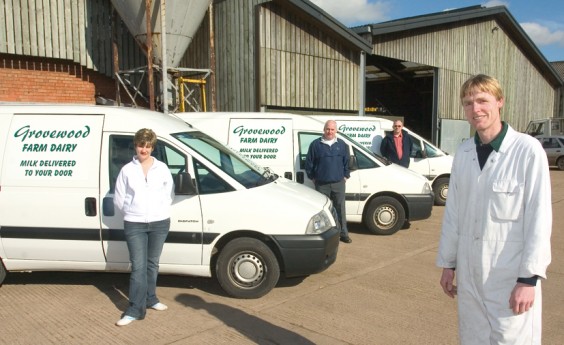
Now pints of Grovewood milk – the name is an amalgamation of Groveley and Hopwood – are delivered right across the area covered by this magazine, from south Birmingham to north Redditch and from Lickey to Rowney Green.
Farmer Mark Elliott, whose idea it was for Groveley Farm to plough its own furrow, has found himself almost unwittingly at the vanguard of the reaction against the industrialisation of food production in this country.
While we the consumer could whistle in the wind forever waiting for local supplies of many foods, our milk at least can come from cows we can see, grazing on grass we can see carpeting the fields above Upper Bittell Reservoir on our doorstep.
What’s more, it hasn’t spent days being tankered for miles and miles around the country’s roads or, worse still, been brought in from abroad; a pint of Grovewood will have been produced and bottled the day before you get it and travelled, oh, perhaps five miles at most in a delivery van.
As Mark says: “Wouldn’t you prefer to have your food from a mile or two away, where you can see where it has been reared; a fresh product delivered the day after it has been produced?
“The food miles are at a minimum, local labour is involved in producing it – and you can’t get a food any more traceable.”
With around 3,500 customers now on his books, there are a lot of people who already agree with Mark, who has lived at Groveley Farm since his parents moved there in 1966.
But wouldn’t he have even more Grovewood fans if he went “organic” – if supermarkets have climbed on the bandwagon, surely he could too?
This is clearly a topic that frustrates Mark and he has a mental checklist in place that he can call on whenever he is asked the question.
“You can’t get much greener than a glass bottle,” he begins, “and the worst part of the organic market is that it so often comes in a plastic container, about the most un-organic thing you can produce.
“Also, there are no restrictions on how far organic milk has travelled, and quite often it has come from abroad. The food miles are considerable to get your milk from Denmark or Poland.”
Mark goes on to explain that the “organic” tag is mainly about chemicals in two forms: medicines and fertilisers.
“With medicines, the only time we give them is when an animal is ill. Organic farms can also give medicines when animals are ill,” he says.
“The main difference is with fertilisers. In order to get the grass to grow consistently, we apply chemical fertiliser a couple of times a year. Organic farms are not allowed to use any at all.
“Because of this, they can’t grow as much grass on the acreage and therefore they can’t have as many cattle per acre.”
Mark adds: “I don’t want to decry organics, I’m sure they are doing a good job, but if we wanted to be organic we would have to go through a two to three-year process and we would have to become a lot more expensive because we would have fewer cows per acre.”
He wonders if the people of this area would be willing to buy his milk if it suddenly became a lot more expensive for what he believes would be very little difference.
“I have this conversation with people time and again and I have never had anyone say they don’t like the way that it’s done here. I would invite anyone to come round the dairy and see for themselves.”
What they will find is a small-scale set-up where around 4,000 litres of milk are produced each day from a herd of 200 cows. It’s pasteurised then separated to take the cream from it, enabling Grovewood to offer semi-skimmed, skimmed or full milk.
Then the milk is homogenised, or blended, to produce the required product before it goes into glass pint bottles bearing the Grovewood oak tree emblem or sealed into poly bottles, with 500ml, one litre and two litre capacities. These are stored in a huge walk-in fridge, from where the roundsmen pick up deliveries.
The milk is delivered on alternate days at between 43p-45p per pint bottle, depending on location. “People want our service, but often they’re just not aware of it,” says Mark.
“All they have to do is give us a call and we will sort it all out.”
Grovewood Dairy
0121 445 6670