Missing teeth can make you feel self-conscious about your smile, and can also cause health problems – but Acorn Dental in Barnt Green offers a safe and affordable way to replace them.
The practice specialises in dental implants, which look, feel and act just like natural teeth. In this procedure, a titanium screw is used in place of the natural tooth root. It is placed in the jaw, where it holds an artificial tooth, bridge or denture.
“Unlike dentures or a bridge, a dental implant becomes firmly attached, or integrated, with your own bone and acts in a similar manner to the natural root of a tooth,” says Dr Manoj Parmar, who owns Acorn Dental with his brother, Dr Dipesh Parmar.
“Implants also help to preserve the condition of any healthy adjacent teeth by eliminating the use of clasps and the need to grind down adjacent teeth for support.”
The team at Acorn usually recommend implants rather than dentures (false plastic teeth), which many people find difficult to adapt to as they can slip out of place when eating or talking – and there’s also the hassle of having to take them out at night. Another downside is that partial dentures may encourage infection and decay in other teeth if not fitted and cleaned properly.
“As long as the patient has healthy bones and gums, dental implants would be the better option,” says Manoj. “They actually stimulate the bone and gum tissue, giving you an attractive result over time, and with good oral hygiene, they can last up to 20 years.”
As experienced perfectionists in advanced dentistry, the team at Acorn provide meticulous care and attention to detail to ensure the implant procedure is as stress-free and relaxing as possible.
The process begins with a consultation, where the dentists will listen to the patient’s particular concerns and perform a comprehensive examination. The information gathered will be used to create a plan unique to the patient.
Next comes the careful and precise placement of the implant, carried out under local anaesthetic. An “after-care” kit is provided to help minimise any pain or swelling.
The jaw bone will fuse to the implants over eight to 12 weeks. Meanwhile, the prosthetic replacement teeth will be made in-house to the highest quality. These teeth are then attached to the implants to complete your new smile!
“Although the initial investment may be a little more, over time implants are a more cost-effective solution than dentures and bridge-work,” adds Manoj.
OPEN EVENING – Introduction to Dental Implants Wed 20th November, 6.30–8.30pm Come and learn about the benefits of implants Refreshments available Free attendance – but please register your interest and book
as there is limited space.
Patient Testimonial All the staff at Acorn Dental are so kind and considerate. I have been a patient there for many years and cannot speak more highly of such a professional company. I have had major, and I mean major, dentistry including extractions, fillings, implants and even cosmetic. Dipesh is a saint, he takes so much care with everything, as I know his brother Manoj does. The surgery has a really comfortable feeling, which helps a nervous person to relax. No one enjoys going to the dentist, but needs must, and I would never go anywhere other than Acorn. Gerry Jinks (80 years young) See Case 1, below
22A Hewell Road, Barnt Green B45 8NE Tel: 0121 447 7300 https://www.acorndental.co.uk Free parking for 3–4 vehicles Access is via a private drive at the side of Savoir Faire boutique.
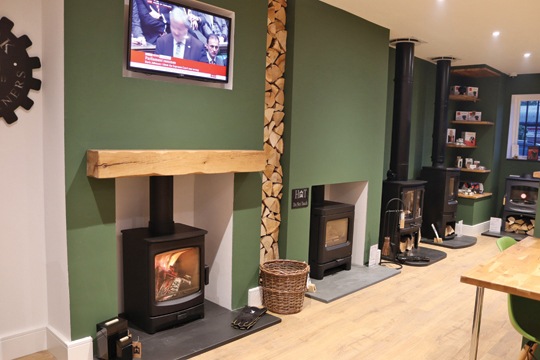
The Cosy Stove Company is a modern independent company that holds traditional values. Formed in 2014, The Cosy Stove Company began its journey within a Bromsgrove garden centre, and has recently made its home in the centre of Bromsgrove on the Sanders Road Estate.
The new showroom is beautifully fitted out with some of the best brands of wood-burning stoves in the industry, which the team are very proud to sell. The company caters for all styles of home, from a cosy cottage right through to a modern new build, with its comprehensive range of wood-burning stoves.
Choosing the right stove is an important decision, and the experienced and knowledgeable team in the showroom will begin by guiding you through your options – giving honest and sound advice with a relaxed and no pressure approach.
Following your visit, The Cosy Stove Company offers a free site survey to see what options are available to you, but also to get a feel for the size of the room and offer comprehensive advice to help you choose the right stove for your lifestyle.
Once you have purchased your new wood burning stove, you will be handed over to the skilled team of HETAS-registered engineers.They will complete your installation from start to finish, providing a professional, clean and friendly service.
For those entering into the world of an extension or new build, the team have a keen eye for design and practicality which they are happy to share with home owners, builders and architects alike. Their advice can save you time and money as well as presenting ideas that you may not have considered.
The Cosy Stove Company can guarantee a quality stove and installation that will help your home offer a hearty welcome, providing many years of comfort and warmth.
Despite the recent bad press surrounding wood-burning stoves, the company would like to reassure all customers that its stoves meet and exceed all government plans and are 2022 Ecodesign Ready.
Ecodesign is the European-wide programme for lower emissions. Ecodesign Ready stoves can reduce particulate emissions by 90 per cent compared to an open fire and 80 per cent compared to an old wood-burning stove, and The Cosy Stove Company offers some of the cleanest burning stoves available on today’s market.
New address: Unit 11, Sanders Road, Bromsgrove, B61 7DG Tel: 01527 916 339 https://www.thecosystovecompany.co.uk
Alvechurch amateur weatherman Phil Thomas records the changes.
There was a chilly start to October with a couple of ground frosts on the 2nd and 3rd. After that the weather turned milder and quite changeable. Rainfall up to the 18th was near normal for October.
The mean temperature was 0.8C above average. The reason it has been so mild is due to quite warm overcast nights with little chance for temperatures to drop under clear skies.
October 2019 (to the 18th)
Mean Max 14.2C 0.4 above average
Mean Min 7.6C 1.2 above average
Mean 11.0C 0.8 above average
Rainfall 61.9mm 69% of average
Sunshine 42.9 hrs 46% of average
September started with little rainfall up the 21st (only 10.6mm), but there were several spells of heavy rain during the last 10 days of the month: 58.6mm (23rd to 24th) and 58.4mm (27th to 30th) producing local flooding.
Overall September was a very wet month with 145.5mm of rainfall, and mild again – continuing the mild wet autumn.
September 2019 Mean Max 18.9C 0.6 above average
Mean Min 10.1C 0.4 above average
Mean 14.5C 0.5 above average
Rainfall 145.5mm 240% of average
Sunshine 134.1 hrs 107% of average
Outlook As October becomes November, it looks to be largely settled and dry with a mixture of cloud and sunshine. Any spells of rain are likely to be confined to the far northwest.
Clear conditions at night may allow temperatures to fall a little below average with overnight frosts and fog patches likely. During November, there is a chance of more unsettled conditions with some rain or showers possible at times, however there is high uncertainty this far ahead.
More information at https://www.alvechurchweather.metsite.com
You can see an improved HD weather-cam, updated at one-minute intervals, at: https://www.alvechurchweather.metsite.com/webcam_alvechurch.php
Beware of short-term swings in the market, warns Martin Pryor.
Trade wars between the US and China, as well as Brexit and tensions in various parts of the world have all made markets more volatile in recent months. Unsurprisingly, private investors have become more nervous.
A recent survey by leading investment house Schroders revealed that almost three-quarters of UK investors said they were influenced by political developments and market movements and checked their investments at least monthly. Nearly one in five investors said that they were waiting for the dust to settle before making investment decisions.
So is it the wisest choice to allow political uncertainties and market swings to colour your investment judgements?
FIVE-YEAR PLANS
Most investment experts agree that five years is the minimum period that an investor should expect to hold share or bond-based funds. And the longer the holding period, the more likely it is that funds invested in shares will outperform cash deposits or bonds – although there is no certainty that this will happen.
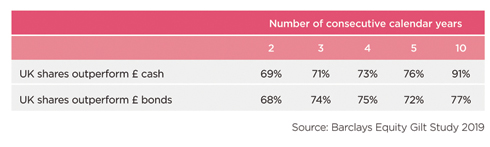
Over five years or more, most of the headline-grabbing news normally fades away or is overtaken by other events. The value of taking a longer-term approach is well illustrated in the table (below) from the latest Barclays Equity Gilt Study, published earlier this year.
This shows the probability of UK shares outperforming UK government bonds (gilts) and cash (as measured by Treasury Bills) over various consecutive periods between two and ten years, based on real data tracking between 1900 and the end of 2018.
For example, UK shares outperformed cash deposits in nearly three-quarters (73%) of four-year periods over the 118 years; and shares outperformed cash in over nine out of ten periods of ten years.
Just over the past five-year period from the start of 2014 to the end of 2018, the UK experienced two general elections, two referendums, the resignation of a prime minister and the arrival of Donald Trump in the White House. Despite all these upheavals, investors in UK shares who stayed the course received an overall return of 22.2% against just 1.8% from cash. Adjusting for inflation shares were 8.4% ahead over those five years, while cash lost 9.4% of its buying power.
THE RIGHT DAYS
Of course, stock markets can fall and sometimes they can drop very quickly. But the rebounds from falls can also happen quickly and are likewise hard to predict. A very small number of days have historically generated a surprisingly large proportion of total long-term returns. Over the past 30 years to 2018, about 0.2% of days generate roughly half of total performance.
So if you come out of the market, you could be missing out on key growth moments. For example, the US stock market as represented by the S&P 500 index of large companies had an overall market return of 1,000% over the 30 years to 2018. Removing the 10 best days would halve the performance to just 500%.
It is a similar story with the Euro-pean Stoxx 600 – the less stellar long-term performance of a 470% increase over 30 years would have been halved by leaving out the 10 best days on which the market moved upwards the most.
Ignoring the short-term noise in favour of paying attention to longer-term developments has two other benefits:
Your investment turnover will be lower, reducing overall costs; and
You can stop worrying unnecessarily about the daily changes in investment values.
The value of your investments, and the income from them, can go down as well as up and you may not get back the full amount you invested.
Past performance is not a reliable indicator of future performance.
Investing in shares should be regarded as a long-term investment and should fit in with your overall attitude to risk and financial circumstances.
Contact Pryor Portfolio Management for more information: Tel: 07961 162818 martinpryor@ppm-ifa.co.uk https://www.ppm-ifa.co.uk
Amateur astronomer Brian Watkiss peers into the Village night sky.
November, and the evenings are getting dark now that the clocks have gone back and the Sun sets a little after four in the afternoon. Still, we have Guy Fawkes to look forward to and we can start stargazing before tea!
Unfortunately, it is time to bid farewell to Jupiter for this year as it starts to disappear behind the Sun. Look for it as soon as the sky starts to darken, from about five o’clock, very low in the glow of the sunset and give it a little wave.
On the first day of the month there will be a crescent Moon to the left of it and to the left of that is Saturn. You will have to wait until the sky gets darker though, as Saturn is not as bright as Jupiter. The ringed planet is also very low in the sky as this part of the ecliptic, close to the Sun, is not very high at this time of year.
Saturn is with us all month but getting closer to the sunset every day. The Moon is close by on the 2nd and again on the 29th. Interestingly, Pluto is quite close to Saturn too although you would need a very powerful telescope to see it. Still, it’s nice to know where it is, isn’t it?
Venus starts to make an appearance towards the end of the month too but it will be very low indeed. Being so bright, you may spot it passing Jupiter during the last few days of November. An ultra thin crescent Moon sits between these two planets on the 28th.
At the other end of the day, Mars is visible at six in the morning. It sits just above the bright star Spica low in the south east, just beating sunrise which occurs a little after seven.
Well, that’s all of the major planets taken care of with one exception: Mercury, and this month Mercury does something curious (Mercurious?). On the 11th it passes between the Earth and the Sun, something it does every couple of months or so, but this time the Sun, Earth and Mercury are in a perfect straight line so Mercury will pass across the face of the Sun.
Now, you won’t see it by looking at the Sun; this will merely damage your eyes. It can only be seen with a telescope by either projecting an image through it or with a good solar filter. So, if you know someone with a telescope, badger them to set it up (with the finder scope capped!) and get projecting (but NEVER look through the eyepiece!). It starts at half past twelve and lasts just under four hours.
A week later, the 18th, sees the peak of the Leonid meteor shower. A bright Moon is around at this time but it is always worth keeping an eye cocked for meteors a few days before and after this date.
Finally, on the evenings of the 28th, 29th and 30th of the month you should definitely visit Alvechurch Village Hall to see the stars shining there!
Mary Green explores the fruits, nuts and fungi of autumn.
Last month I wrote about the cornfields we see around us. They’re not the only harvest, and this year there has been a good harvest of other growing things.
Among other arable crops around here, there’s lots of oilseed rape. It is a seed of a plant in the cabbage and mustard family. Its bright yellow flowers in April are well known now in our countryside, but I can remember when they first appeared, so it’s relatively recent in the UK.
It was introduced as a source of cattle feed, called canola in the USA, but is also much used now for edible oil, including golden cold-pressed virgin oil as well as the cheaper kind used in food manufacture. The seeds are small and black and are harvested in late summer.
Unfortunately, it is even worse for the environment than corn. On top of herbicides as used in other arable crops, the pesticide regimen is complex. The flowers need insects to pollinate them, but then pesticide is used after the seeds are set to stop small beetles that feed on the grain getting at them, but of course it gets rid of all the other insects too.
There have been attempts to farm it organically – there is one organic farm in the north of England but their whole crop is already bought up, so it’s impossible to buy organic rapeseed oil that hasn’t meant heavy use of pesticide.
There used to be far more crops than these, and you still see them occasionally. The main ones are pulses – peas and beans. There isn’t really a difference between peas and beans, the rounder ones usually called peas and the elongated ones beans.
They were traditionally grown for animal feed but also for human consumption. We used to have “field beans” on our farm and I have seen them near Cofton a few years ago. Field peas are also occasionally found – I saw some near Tardebigge.
These older varieties predate the modern peas and beans grown commercially for human use in market gardens nowadays and were often dried and kept over winter. I can remember making “pease pudding” out of dried yellow peas. It’s funny how this has gone out of favour in the face of the ubiquitous hummus, which is basically the same thing!
One kind of pea you don’t see much around here is the Carlin pea, otherwise known as Maple Pea, Pigeon Pea, Brown Pea and Black or Grey Badger Pea, first recorded during Elizabethan times.
They are still grown in the north of England and are specially used for a Passion Sunday meal. That’s a good example of how a food stored through the winter was used for celebration in the spring. They are rather uninspiring-looking when dried but taste nutty and delicious cooked, and fresh they are sweet enough to eat raw – I’ve grown them.
A specialist grower who has kept these old varieties alive (the Carlins in Shropshire) is now harvesting the first crop of chick peas in this country, as climate change has made the summers hot enough. In Warwickshire the first harvest of usable haricot beans has happened too, so we can soon have local baked beans as well!
Having high-protein beans and peas as a staple food helped give a varied diet to country people in the past. They also used other seeds and fruits, of course. One is buckwheat, not grown much here but it could be. It is not a wheat, but related to some of our common arable wildflowers (and to Japanese knotweed!) and is gluten free and high in protein and fibre.
It’s much used in eastern Europe and Russia, including in the lovely pancakes called blinis. Experts on ancient foods think many more seeds like this were ground and eaten in our earlier times before we got hooked on wheat.
In the wild the harvest has been excellent this year. All kinds of fruits and nuts were once part of our diet and that of our animals. Many trees have had what’s called a “mast year” – a year full of fruit. Oaks have produced masses of acorns this year. They do it all together and communicate with each other through chemical signals in the mycorrhizal fungi which run between their roots.
This way they outwit the squirrels and jays that take the acorns away, as there are so many that there will still be enough for more trees next year. Even if squirrels take acorns away, they bury them to eat later, and forget some of them, so they grow well away from the parent tree. Acorns were used for pig feed but were also used during wartime to make a kind of coffee.
Edible nuts have been plentiful too. Hazel nuts were very profuse, but you had to get them very early before the squirrels. Sweet chestnuts have grown well too – you need a good summer for them.
The other kind of chestnuts, conkers, have been great this year but you can’t eat them. They have had cosmetic uses, though. Beech mast is good this year, another old animal food and a usable source of edible oil for humans.
Some fruit has been spectacular this year, other kinds sparse. It often depends on whether trees caught any of the odd late frosts while in blossom or were affected by the dry spring. But native fruit like sloes, and their relatives plums and damsons, have been good.
Wild crab apples have been plentiful but orchard apples a bit variable. There have been bushes full of blackberries and elderberries, and even hips and haws that you can add to your hedgerow jam.
All these fruits and nuts are food for wild birds and mammals, who also spread the seeds. Even poisonous fruits like yew are edible to birds because they pass the seeds, the toxic part, straight through them.
Some trees have seeds that are designed to be spread by the wind, with little sails called keys. Maples, sycamore and ash spread this way. Others, like poplars and some willows, have furry white cotton-wool like material which the wind carries.
Some have done well this year, but ash has been a bit odd. Two near me are full of keys, but my female tree and many others nearby have nothing. One has ash flower galls, caused by a tiny insect, which are harmless.
And under the trees, you may have found fungi. Wet and warm weather in late summer and autumn brings these out. They are there all the time underground, some of them huge. The bits we see, the fruiting bodies, usually come up once a year and shed spores. Many of them are edible, but you need to know what you are doing.
I must mention too the great harvest we have been having all summer and autumn from the Incredible Edible planters in Alvechurch. I have been “trimming” their herbs regularly, and lots of people have benefited from the beans, tomatoes and other food grown. A big thank you to Tim and his team for enhancing Alvechurch’s environment.
Autumn was for our ancestors a time of plenty, when grains, seeds, fruit, nuts and fungi provided good food, with some for preservation for winter eating and some for their animals. Harvest festivals began at Lammas, in August, with the first cut, and ended with the end of autumn on October 31.
All Saints Day on November 1 was the start of winter, hopefully with full larders as the available food disappeared. At this time of year, it was believed, the dead were nearest to the living, so it was a specially sacred time marked with fire ceremonies. Now we have Bonfire Night to remind us, with its fires, hot food and spicy mulled drinks.
Have a look at the last golden hazel leaves, though. The nuts have long gone, but the little catkins for next year’s fruit are already there.
The poem is one I wrote at this time a couple of years ago.
Autumn fires
The village smelt of fire this evening
A little fog bringing it around us
My neighbour is installing a wood burner
And the canal boats are smoking gently.
Bonfires are growing in fields and gardens
And I am eyeing up pumpkins
Not for carving into lanterns
But for soups and roasts, fire inside.
The ash trees are finally alight
And the red flames of maples flicker
It all burns up, lovely for a while
Forget about the ash and brown tomorrows.
The Riding for the Disabled group based at Seechem Equestrian Centre in Rowney Green celebrated its 50-year anniversary with a special event for riders and their carers, organisers and volunteers past and present.
The RDA itself is also reaching its 50th anniversary, and the Seechem group was one of the first to be set up. Originally held in fields belonging to the first organiser, Jean Scott, it moved to Seechem in 1969 and has flourished there ever since. The group is very grateful for the support and help that Seechem Equestrian Centre provides.
During the afternoon, riders from the Cerebral Palsy Midlands group demonstrated a drill ride to music, while the Mixed group performed a Countryside Challenge ride, where they were asked to post letters, pick apples from trees, open gates and deal with typical hazards found while out on a ride. This was followed by a tea party for all.
Volunteer helpers are always welcome; there is currently a waiting list for new riders but anyone interested in either should go to one of the weekly, term-time sessions on Thursdays at 1pm, at Seechem Equestrian Centre, Rowney Green B48 7EL.
This article starts with a love story: our great friend Sue, who lives in Alvechurch, recently met and married Roger. Everyone who knows them is thrilled for them, and their wedding was featured in The Village in 2018. And with Roger came, for Sue, not only a love of gardening and flowers, but a house in Southern Bulgaria.
Roger had been saying to me for the past year that he wanted me to see the wildflowers in Bulgaria, knowing I would love them. So in June this year we had a treat – we went to stay in Roger’s house in the Rhodope mountains which border Greece in the south of the country. The house is at four thousand feet (the height of Ben Nevis) with views out to the surrounding mountains – they are very green mountains due to the woodlands that cover them.
The sloped valleys around the house and all over this area of Bulgaria are laid out to hay meadows with a few vegetable gardens dotted in between. The farming history of the area is traditional hay meadows grazed by cows, with the milk used for local cheese and yogurt.
Bulgaria is a poor country that has not been able to afford pesticides, so the meadows have built up a fantastic matrix of flowers and, with the flowers, bees and butterflies in numbers I don’t think I’ve seen since I was young. When walking through a woodland you would come across a puddle with 20 or 30 butterflies drinking, not just one or two as we are now more used to seeing in the UK.
The mountains have lots of wildlife, birds of prey and brown bears! The warning signs about the bears say you should lie down and be quiet if you come across them, but as the locals say, “We just laugh at these signs; who is going to lie down in front of bear?”
Let me tell you about the wildflowers. There are whole fields of orchids, mainly common and pyramid orchids at the time of year we went but listed in the guidebooks for the area are many, many more. I tend to do wildflower identification by knowing the cottage garden perennial and then working out what the wild version is.
Wild geraniums, geums and blue-flowered anchusa were all in flower in June and as you walked out of Roger’s house in the mornings the air was alive with bees and insects buzzing. The landscape is managed very sustainably with the hay being cut in late June and September after the flowers have seeded down.
The lifestyle is very idyllic but there is a sadness to the story too, as the younger generation have left the rural villages and moved into the cities or further afield into Europe to look for work. Bulgaria is currently the fastest-depleting population in the whole of Europe, so the villages are largely dying out, it’s still a poor country and although now in the EU, it retains its own currency.
The climate and soils seem ideal for growing food as well as wildflowers – potatoes, beans, and strawberries were all growing in the village we stayed in. The management of the meadows depends on the grazing and milk production continuing in the same way, and it looks as if this will finish when the current generation have died or left. The local milk farmer to Roger’s house had just finished the year before, being unable to survive on the low price that he was being paid for the milk – a bottle of water is more expensive.
And yet you can see with just a small raise in living standards, it is a beautiful place to live and a very healthy place. A report in 2016 showed the Rhodope Mountains to be home to the highest percentage of centenarians not only in Bulgaria, but worldwide. It goes on to state that the mixture of a healthy diet, especially the yogurt, the cleanest air in the whole of Bulgaria and a low-stress lifestyle are all contributing factors. Really, what’s not to love?
We spent a week out there and did many walks in the surrounding countryside. If you are tempted to visit, I would also recommend the second city, which is called Plovdiv and well worth going to see. It is ancient with cobbled streets, Roman amphitheatres and aqueducts, and this year it is the European city of culture, so there is loads going on.
Action from the 3–2 loss against Nuneaton Borough (Photo/ Ian Macvie)
Alvechurch FC end a run of defeats with a morale-boosting victory.
Alvechurch will be hoping that an impressive 1-0 victory against St Ives Town – their first win in either league or cup since the end of August – will mark the end of a run of poor form.
The result moved them to 16th in the table and will boost confidence going into the next league match against top-ranked Coalville Town – as well as their trip to Peterborough Sports in the first qualifying round of the FA Trophy, taking place just after we went to press.
Before that, there had been two more defeats in cup competitions – firstly a 2–1 loss at Redditch United in the Southern League Challenge Cup, and then another penalty shoot-out against AFC Wulfrunians in the Birmingham Senior Cup.
The latter came after a lacklustre 0–0 draw in normal time, with few chances for the ’Church boys. The spot-kicks saw debutant Rikardo Reid have his shot saved and Jordan Goddard strike the crossbar, putting the visitors through 3–4.
* After such a mixed start to the season, manager Darren Byfield has made plenty of changes to the squad. New signings include central midfielder Courtney Richards, who has played for Brighton, Torquay, Nuneaton, Solihull and Braintree.
Three new goalkeepers are now on the books. Matt Sargeant has returned from Nuneaton, having left to join Rushall Olympic last season and previously played for Tipton, Worcester Halesowen and Sporting Khalsa.
Matt Cotton has signed from Coleshill Town, and the third keeper is Joe Slinn who started his career at Port Vale before joining Walsall and more recently Atherton Collieries.
Experienced centre-forward Kyle Perry has joined from Bromsgrove Sporting. He has scored goals wherever he’s been and his clubs include Port Vale, Tamworth and Lincoln.
Joining Kyle up front is Kye Dryden who has joined the club from Chelmsley Town, while right-sided player Archie Brennan arrives from Cheltenham Town. 18-year-old Archie has progressed through the Cheltenham academy and has joined AFC on loan to gain first team experience.
The final signing sees the return of fan favourite Mitch Botfield. The combative central midfielder has returned from Stourbridge, having joined them in the close season. Mitch started his career at Walsall, moving to Halesowen and Evesham before gaining a football scholarship in the USA.
Due to the influx of new players to the club, goalkeeper Lloyd Ransome has rejoined Walsall Wood, Kyle Rowley has moved on to Stratford Town and Danico Johnson has joined Racing Club Warwick.
Congratulations to 16-year-old George Clarke, who has joined Cheltenham Town as an academy player.
The promising right-back has been playing for the Alvechurch under-18s and made his first team debut in a man-of-the-match performance against Wolverhampton Sports SC in the JW Hunt Cup, having played for the under-18s the night before.
’Church’s assistant manager Peter Till has also decided to leave the club to extend his playing career. Peter arrived at the club as Darren Byfield’s assistant in the close season from Walsall Wood FC, and has made cameo appearances from the substitutes’ bench, but has decided to return to Walsall Wood as a player. Everyone at the club would like to thank Peter for all his hard work during his stay at Lye Meadow.
* Congratulations to Ben Usher Shipway on winning the player of the month award for September, and to Rahis Nabib who won the goal of the month award for his 30-yard strike at Wolverhampton Sports SC.
* For more info or sponsorship enquiries, please contact Trevor Ball at saintsarehot2@btinternet.com or visit https://www.pitchero.com/clubs/alvechurch
Follow the club on Twitter @Alvechurch1st
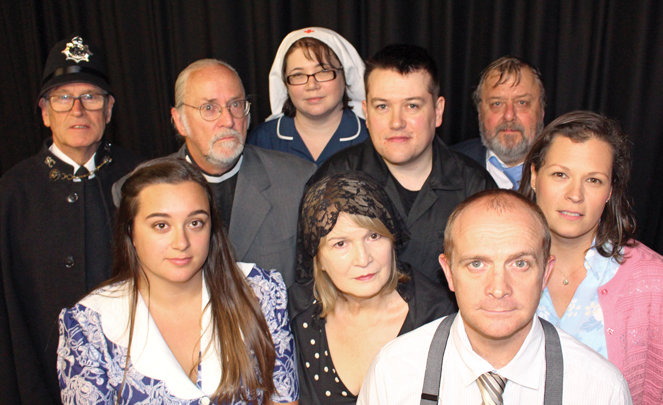
Back row: Steve Siddle (Sgt Dobson), Ges Taylor (Vicar), Myfanwy Griffiths (Katy), Adam Brown (Dieter), Martyn Read (Chorus). Front row: Anna Pearson (Ceserina), Maura Williams (Signora Di Moreno), Jon Oseland (Richard), Rosie Pring (Rose)
On the 80th anniversary of the start of the Second World War, it is fitting that the latest production by Alvechurch Dramatic Society, An Unsentimental Journey, should be a new play set in the 1940s.
Written by ADS member Alan Clarke, it follows the story of Rose and Richard, married shortly before the outbreak of World War II, then separated for most of the war as Richard fights in Europe.
When he finally returns home to Alvechurch, can they pick up the pieces of their relationship? As wartime pal Tom sparks up a romance with their friend Katy, will Richard move on from his experiences in France and Italy? And what exactly happened to the German airman shot down over Alvechurch during the fighting?
Moving back and forth through time, this thoughtful play asks questions about life and love, both now and then.
Alan Clarke says: “I was particularly interested in why the generation who fought in World War II were often so reluctant to discuss their experiences. At first I thought it was mainly an understandable reaction to the horrors that they encountered, but gradually I came to realise that it was also due to the different responsibilities they had to take on and the contrast when resuming civilian life. This was particularly true for the women expected to return to carrying out traditional domestic duties.
“Although Alvechurch itself was barely directly affected, its proximity to England’s second city meant that its residents were acutely aware of the impact of the Birmingham Blitz. However, this devastation is less well-known than, say, that of its neighbour Coventry because reporting restrictions at the time meant that Birmingham could only be referred to as “a Midland town” to prevent the Nazis using the impact of their raids as propaganda. The bombing of Birmingham and its surrounding towns lasted from August 1940 to April 1943 during which 2,241 people were killed, more than 6,000 injured, and over 12,000 houses and 300 factories destroyed or damaged.”
An Unsentimental Journey will be performed at Alvechurch Village Hall from Thursday November 28 to Saturday November 30 at 7.30pm. Tickets £7 (£6 conc) from The Lounge, Alvechurch; on 0121 447 7071 or via email on: ads.alvechurch@gmail.com