
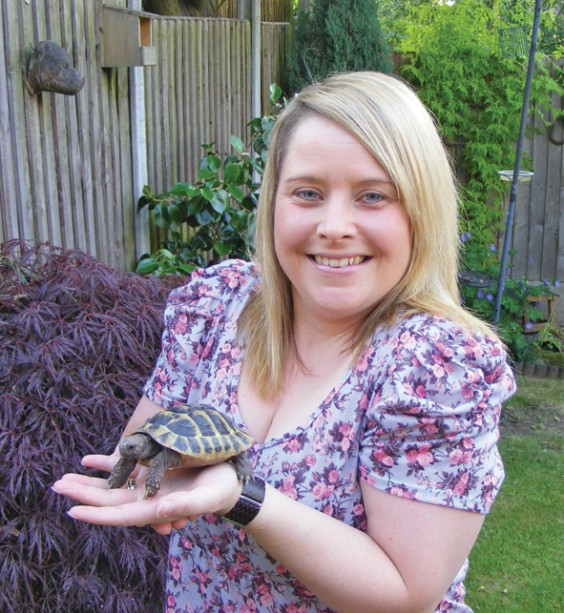
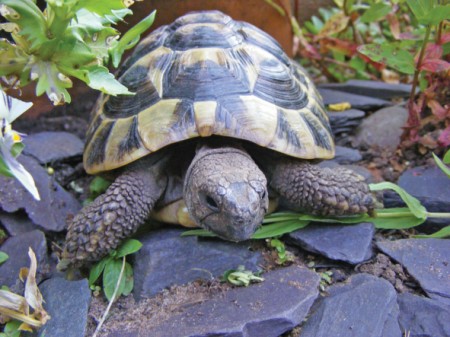
Rednal resident Mandy Biggs introduces us to her happy tortoise, Henry.
Henry is a Hermann’s Tortoise, and was born between December 20 and 22, 2006. We bought him from www.turbotortoises.com and he came with his own DEFRA certificate confirming he is captive, born and bred.
Henry lives indoors in a “tortoise table” with a mixture of top soil and children’s play sand, plus pebbles and slate to mimic how he would live in the wild. There is a heat lamp at one end and a cool part at the other. He has a UV light and a water dish, plus a wooden bridge that he likes to sleep under and walk over the top of. When you call his name he does look up, and comes to the edge of his house to be picked up.
For hot days, he has an outdoor enclosure, with a flower pot for shelter if he is too hot. A plastic sheet on the cover creates warmth when the sun shines. He has a water dish to bathe in, and pebbles, slate and edible plants: pansies, clover, and forget-me-nots.
He loves to eat clover (which we grow for him), dandelions, pansies, rose petals and leaves – and strawberries and cucumber as a rare treat. We bought seeds to grow his food ourselves to give him a varied diet. His foods are dusted with a supplement containing calcium to help the growth and health of his shell.
Henry enjoys a bath in a plastic tray of warm water (24C) – not too much water, just below his head – and he stays in it for around 10 to 30 minutes. I use a plastic spoon to drizzle the water over his back, which he loves.
After his bath he gets dried and put in his house for a feed. He puts himself to bed by going under his bridge. He sleeps with his bottom near the entrance but when we check on him in the morning he has turned himself around and his head is near the edge, peering out.
If it’s not hot outside we do let him roam around the lounge, but we have to watch him as he’s quite a fast mover and likes to get behind things he shouldn’t.
Twice a year Henry has a trip to Birmingham Nature Centre for an “MOT Tortoise Day” held by the Three Counties Tortoise Society (www.british chelonia.org) who provide support and advice to owners as well as checking weight and general health.
When we first took him in autumn 2007 he was only 7cm and weighed 55 grams, and by spring 2010 he was 11cm and 217 grams. Fingers crossed, so far he has always had a clean bill of health.
Bryn Morgan of Townsend Veterinary Practice offers some tortoise tips:
Most tortoises kept as pets in the UK are Mediterranean species from hot dry climates. Like other reptiles they are cold-blooded, so in the UK they need an external heating source.
Although not all species of tortoise hibernate, most of those kept as pets do. They should be in good condition as they will lose 1-2% of their body weight each month while hibernating and may not have the strength to wake up if unwell.
After hibernating your tortoise should be given a warm bath and he should start to eat within about two days. If he hasn’t started eating within a week he should be taken to see a vet.
To keep your tortoise fit, it is best to provide as large a pen as possible, with different areas to explore and for you to put feed. Make sure the garden is escape-proof, and also provide protection from animals like foxes.
Pet tortoises can build up a high burden of worms in their guts, so it’s recommended to worm them yearly with a product supplied by your vet.
It is important to know what species of tortoise you have so that its specific requirements can be checked. It is also a good idea to weigh your tortoise monthly and check him for any lumps or bumps. If you do notice any lumps or your tortoise loses weight or stops eating, then get him checked by a vet.
