
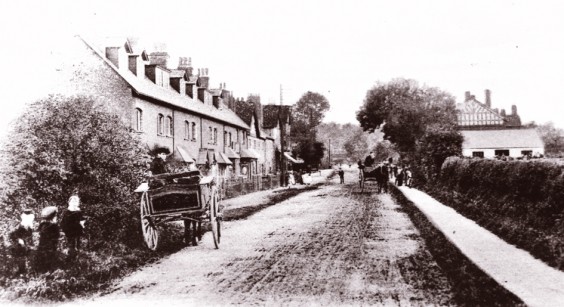
The Barnt Green of 1900-1914 saw the arrival of people who actually paid in cash . . .
This article, by local historian Margaret Mabey, who died three years ago, was first published in The Village in 1999.
Barnt Green’s history may not be long, but it is certainly unusual. There stood its railway station, waiting half a century for passengers: and when the village began its tentative development, the shops came before the houses.
By 1900 it consisted of terraced houses including several shops lining both sides of Hewell Road, at one end of which stood the Victoria Hotel, and at the other end a stone house tucked under the railway embankment and occupied by Lord Windsor’s bailiff.
A whiff of gentility was added by a neat villa called Lindworth, standing in its garden on the site now occupied by the modern block of shops, and by a large semi-detached pair of houses with a balcony slung across their fronts, which are still there (at the corner of Orchard Croft).
Bounded by Hewell Road and Bittell Road was a grander property with a paddock and orchard containing a handsome early 19th century house called The Poplars. Here lived Joe Penzer, the local government rate collector: he did his collecting on horseback.
But you could hardly call that a village. I don’t think the Windsor Estates expected it to grow and have a real identity of its own. But someone else did.
Behind the houses on the eastern side of Hewell Road was a farm called The Croft which had never belonged to the Windsor estates and in 1866 this property and its surrounding fields was bought by a Redditch businessman called JE Clift (founder and chairman of the Redditch Gas Company).
He never lived at the Croft: one can only conclude that he foresaw it would one day be profitable building land. By 1900 he had died, so it was his son who decided that Barnt Green was now ripe for expansion.
Building plots were offered for sale in the lanes edging the fields once known as Hither Sandholes and Far Sandholes, and they sold so quickly that a new road (Sandhills Road) was made across the fields and more houses were built there.
Many of the lots were sold separately so the houses varied greatly in size and design giving Barnt Green an appearance which may not be picturesque but has a character all of its own.
What sort of people came to live in these houses, and why did they come? Definitely in no way dependent on the big households on the hillsides, they were mostly professional people who worked in Birmingham – so they were daily railway commuters.
But they travelled second-class, leaving the first class to the top-hatted gentry whose carriages brought them down to the station every morning. The newcomers tended to wear bowler hats and to wait for the train in a separate group, scarcely acknowledged by the top-hats.
There was a story, which could have been true, about a bold bowler-hatted character who not only got into a first-class carriage with a grandee, but actually engaged him in conversation.
After a few moments Top Hat said: “Have you got a newspaper?” And when Bowler Hat eagerly proffered it, Top Hat closed his eyes and said: “Then why the devil don’t you read it?”.
The wives, of course, stayed at home in their nice new houses. Some of these were rented, but most were owner-occupied.
Owning your house was in those days something to be proud of, and they were all given names recalling honeymoons or some exotic fancy. (As late as 1950, few of Barnt Green’s houses had numbers: the postman just had to know all the names).
All the houses had quite large gardens, which were lovingly cultivated, most of the owners being in the prime of life. From an aerial view today these look like wooded groves and might make a developer’s mouth water if they were accessible.
For the housewives, one of Barnt Green’s main attractions was its shops, close at hand in Hewell Road. In those days, people shopped where they lived (none of the new houses had garages) and there they could buy their groceries, meat and fish, even if they did not aspire to the “oysters in season” with which Mr Longfield wooed his customers up the hill, upon whom he had hitherto depended – and whose orders had to be delivered on account.
The newcomers came themselves and paid in cash – both welcome novelties to the shopkeepers who began to multiply. There was a Post Office, too, and behind it the stables where gigs could be hired in pre-taxi days.
There was even a tea-shop, but that catered mainly for the trippers to the Lickey Hills awaiting the train back to Birmingham (a sixpenny return fare on Bank Holidays).
The Lickeys, now almost all free of access, were much appreciated by the new residents for their family walks, and they could also explore the network of quiet lanes that tangled over the ancient Worcestershire landscape.
Within the new village, a cricket club was soon playing on a not very level pitch between Sandhills Lane and the railway: at the grander cricket club, now Barnt Green House, the newcomers were not made welcome.
A Social Club also sprang up, at first in a house, but soon thriving enough to build its own premises in Blackwell Road. These amenities were, of course, for men only, but the ladies did manage to start a branch of the Women’s Institute.
By 1909 there was even a church in Sandhills Road replacing the wooden mission hut which, between Hewell Road and the railway, had served the original Hewell Road inhabitants.
A benevolent Quaker called John Gibbins had already provided a wooden Meeting House and given a piece of land behind Bittell Road as a sort of Recreation Ground. This was later virtually hijacked by the affluent hill dwellers for a Badminton Club.
So by 1914, thanks to the shrewd foresight of John Edward Clift of Redditch, Barnt Green was well on the way to becoming a real village community.
Pictured top: Hewell Road in about 1920 – it was not surfaced until 1933.
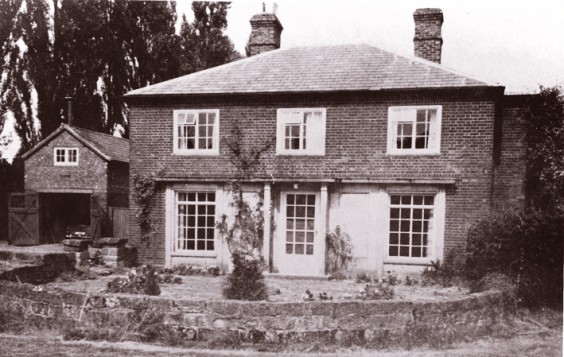
The Poplars (above) stood at the corner of Bittell Road and Hewell Road, Barnt Green, until it was demolished in 1968. Villagers can learn more about its history at an evening being held at St Andrew’s Church, Barnt Green, in the autumn.
It is being organised by Rob Norton, whose grandparents, Col and Mrs EV Godrich, owned and lived at The Poplars from 1900 until 1968.
The history evening at 7pm on October 25, to mark the 40th anniversary of the building’s demolition, will include a slide presentation and display of paintings by Mrs Godrich. All proceeds will go to the church.
Meanwhile, Rob is hoping a Village reader may know where Job Penzer, the tax collector who originally lived at The Poplars, is buried. He believes his final resting place may be in the churchyard at Alvechurch.
