
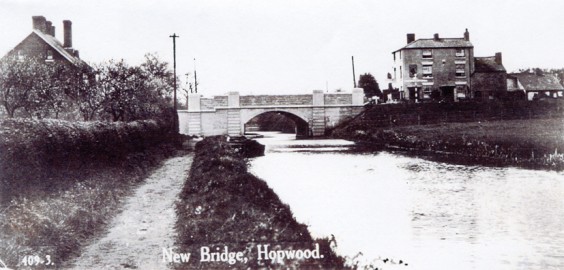
Ian Hayes unearths the tale of engineering ambition that brought the canal to Hopwood.
There was not much to Hopwood before the coming of the canal. A cluster of farms and orchards around a minor crossroads and, probably, a few nail makers’ cottages were linked to Alvechurch and Northfield by winding lanes.
There was no direct link to Birmingham – that was to come with the Pershore Turnpike in 1826.
The Worcester and Birmingham Canal was originally conceived as a broad or barge canal and bravely set off from Birmingham, penetrating the Wasthills ridge before reaching Hopwood and running out of funds in 1797.
The following is an account of the opening of the canal to Hopwood which appeared in the Worcester Herald for April 8, 1797.
‘We have the satisfaction of announcing to the public the completion of the Great Tunnel upon the line of the Worcester and Birmingham Canal. The first brick of this stupendous work was laid on 28th of July 1794, and it was wholly arched over on 25th February, 1797.
It is also noteworthy to remark that 1,782 yards, 2 feet and 8 inches were finished on 1st January 1797.
“At the commencement of the undertaking the practicability of it was treated with the greatest ridicule; it was said that the embankments, the deep cutting and the tunnel could not be executed; yet, by great skill and attention of the engineers, Messrs Jones and Cartwright, the whole business is most substantially finished.
“The extent of the tunnel is upwards of a mile and a half, and yet so straight that it may be seen from one end to the other, and the accuracy of the brickwork well worthy of attention.
“On Monday last, for the first time, the Committee’s barge, attended by other vessels of 80 and 60 tons burthen, passed through it and landed their cargoes at Hopwood Wharf.
“The country manifested their cordial satisfaction on this occasion by the ringing of bells, etc and this important fleet was received in its passage through the tunnel by the discharge of guns, a band of music composed of wind instruments immediately struck up, and a very numerous attendance accompanied the vessels to the end of the trip. The passage through the tunnel was one hour and four minutes.
“The country that will be supplied from the wharf is extremely populous and extensive, the towns of Alvechurch, Feckenham and Redditch, with the large parishes of Beoley, Studley etc. etc. will be furnished with coal etc. by this grand communication, and the farmers will find a very ready and cheap conveyance for their grain to the populous town of Birmingham.
“To the public, as well as to the proprietors, great benefits must arise from the undertaking; the latter for the perseverance in this very arduous business, the difficulties of which, however, are now at an end.”
The optimism may have been a little misplaced. We have a broad canal ending, with respect, in the middle of nowhere, without even an adequate highway system.
Some preliminary work had taken place on the next section to Tardebigge but at one stage it had been suggested that the final length to Worcester should be by tram road.
This part was eventually constructed with narrow locks, effectively ending the concept of wide river barges travelling through to Birmingham from the Severn.
In the meantime the financial position was dire and the situation was not helped when it was found that Dr Thomas Hooper, the Company Treasurer, had used a proportion of the Company’s funds for his own purposes.
A halt was therefore made at Hopwood until the financial position improved, but meanwhile the engineers were more or less out of a job. Thomas Cartwright shortly reappeared, constructing a couple of miles of canal in South Wales, before being recalled around 1805 to re-start the Worcester and Birmingham Canal from Hopwood towards Tardebigge.
Although the temporary terminus eventually boasted limekilns and a small pub, it was not until the extension was complete that a store, blacksmith shop and cottages appeared. At one time there were three licensed houses beside the canal but now only Hopwood House, built in 1867, remains.
The use of Hopwood as a “port” fell with the rise in importance of wharves at Alvechurch and especially Tardebigge. Today it is difficult to imagine vessels of 80 tons capacity serving the little wharf at Hopwood.
* My thanks to Revd Alan White for background material from his excellent book, Chronicles of the Cut.
Above: The site of original terminus on the east side of the road.
