
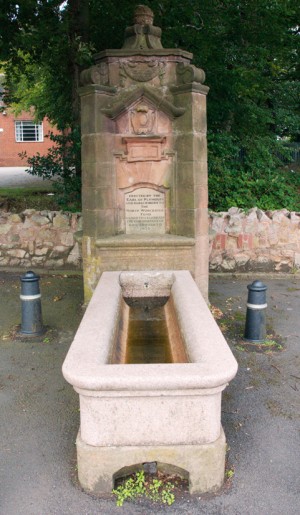
Neville Billington, of the Bromsgrove Society Local History Group, explains why a Lickey monument built a century ago was vital to the welfare of hard-working horses.
The Lickey drinking fountain and horse trough was erected in 1906 and commemorated the coronation of Edward VII four years earlier.
The Bromsgrove Society has joined with Lickey and Blackwell Parish Council and the West Mercia Probation Service to carry out restoration work to celebrate the monument’s centenary.
A ceremony to mark this and the completion of the refurbishment programme will be held on Friday May 5, with the monument unveiled at noon by Bromsgrove’s MP Julie Kirkbride.
The advance of motor traffic in the decades following the Edwardian period led to the demise of horse-drawn vehicles and the monument sadly fell into disuse.
Members of the Bromsgrove Society’s Local History Group have not been able to trace any records or information about the work and planning that went into the erection of the feature, other than what can be seen on the two sandstone plaques.
The only record is one showing that the North Bromsgrove Urban District Council said the waterworks company would have to provide water free of charge.
One of the plaques tells us that Lord Plymouth was involved and it is believed that he donated the small piece of land upon which the monument stands. The Earl of Plymouth in 1906 was Robert George Windsor-Clive and it is thought that he made a financial contribution, too.
However, the main funding came from either the North Bromsgrove Fund or the North Worcester Fund, depending on whether one relies on the inscription on the monument itself or the caption of a 1916 picture postcard. Whatever the correct name, no records of such a fund can be found.
Notwithstanding its short useful life, the drinking fountain tower in particular remains a pleasing Edwardian artefact and the Bromsgrove Society and Lickey and Blackwell Parish Council believe the entire monument is worth preserving – it is confidently hoped that the refurbishment project will ensure the feature is cherished by the local community for years to come.
Broadly similar sums of money have been invested by the Bromsgrove Society and Lickey and Blackwell Parish Council towards the refurbishment project, with the society covering the cost of a new crown to replace the original that was broken.
It is thought this damage was caused by a branch falling from one of the trees – probably at some point between the wars.
Local retired stonemason Mike Ford has kindly undertaken the cutting of the new sandstone crown. The parish council has covered the cost of general refurbishment of the stonework, and a valuable man-and-muscle contribution has been made by offenders working under the West Mercia Probation Service, co-ordinated by Society member John Barnett.
HORSE AGAINST HILL
By the time the Lickey Drinking Fountain and Horse Trough was unveiled in 1906 the long-distance coaching trade had long been overtaken by the railways, but the Edwardians were still relying on horses and draught vehicles for transport of goods and people.
In the modern world, it is difficult to grasp the hardship that horses had endured for centuries in the service of man. Without doubt the way over the Lickey was traversed by packhorse trains and waggoners from very ancient times – the modern road closely follows the line of the Roman road, and even that probably partially coincided with an earlier track.
By the mid-Victorian period, the subject of equine welfare seems to have attracted some public concern, even though this was still a generation before the idea of a horse trough at Lickey was first mooted.
This being the centenary year of the facility, it is timely to reflect on the physical strain horses endured on climbs such as this. Of obvious importance was the need for horses to be properly watered when coping with hills of this severity.
As 1906 arrived, local people may well have seen the recent coronation of their new king as something to celebrate in a way that would be both patriotic and humanitarian.
It would have been only the most cruel driver who refused his horses a drink from the Arrow stream that runs beside the road at the bottom of Rose Hill. Nonetheless, a further drink at the top of the hill surely provided a well-earned bonus.
In the coaching era the Old Rose and Crown Inn – conveniently near the foot of Rose Hill – was a posting house where horses could be changed and rested overnight. But this was a luxury that was probably rare relative to the amount of traffic that took this route.
One cause of toil for horses would have been the clutch of quarries that were near the foot of Rose Hill. Prior to about 1830 the only realistic route for transporting stone from these quarries to destinations to the south would have been over the Lickey, and one can imagine the sheer graft this meant for horses.
