Home Blog Page 815

Small is beautiful!

Pergola

Hannah Genders gives advice on how to make the most of a compact garden.

The New Year always seems to come around so quickly and it’s a time to review our gardens and make all those resolutions that are so difficult to keep.

One of mine for 2005 is to make my front garden “low maintenance” with the idea of spending more time in the fruit and vegetable areas and also to allow me to keep up with the cottage garden borders in the back where we sit.

This is the ideal time to redesign any space in your garden, from hard landscaping to a single border, allowing you time to get some ideas down before the mad rush of spring.

So let me give you a few hints on what to do when space is limited.

The first rule is to think through what you use your garden for; there is no point creating a beautiful cottage garden with delicate plants if your children (or your partner!) want to play football all the time, so be realistic about the needs of the space.

If you are thinking of changing the hard landscaping or if you have a new plot that has no paving at all, try mixing up materials and using some gravel to edge a patio area – this can add lots of interest to a space through texture and colour and will soften any hard edges like walls or fences.

Secondly, keep your ideas simple. When you have decided what you want to do in the garden, create areas for activity or relaxation and don’t try to put everything and the kitchen sink in.

A small patio area and pergola for sitting out is usually essential. Make sure this is in the area you want to sit in and has the view you want to be looking at and, most importantly to us Brits, that it is a sunny position – midday sun is not always the most important.

In homes where both partners work, I am often asked to design patios for evening sun as this is when clients are at home and longing to relax on a summer evening with a glass of wine. A west-facing seat can be just as valuable as a south-facing one.

I always love to add scented climbers on any sunny seat; what could be better than a cold glass of Chardonnay with the scent of honeysuckle and jasmine around you on a summer’s evening?

Thirdly, look at how you will move around the space and think about where a few simple focal points might go. When you first enter the garden, what is your eye drawn to?

If there is nothing attractive to lead you into the space, the use of a single pot, statue or specimen plant can make all the difference.

Using a pergola arch to walk through can add a dramatic third dimension to a little space and give the illusion of the area being bigger than it is.

Specimen plants used as focal point can be great fun – they are often expensive to buy as they have been grown at the nursery for years to reach such a spectacular size, but you will probably only need one to make that statement so choose a plant that you really love and will not tire of looking at.

Any good nursery should also have a comprehensive returns policy and it might be a good idea to ask about this before you buy.

Try to keep the ornaments you use in keeping with the style of the garden. If you prefer the traditional look, go for terracotta or stone. In this garden I use a beautiful piece of driftwood sculpture. 

If your garden is modern, try stainless steel or a finished plastic. There is so much to choose from at the garden centres now, but as always the more simple the idea the more striking it will be.

I hope this inspires you to get creative in you own garden, whatever size and shape it is.

Stylist to the stars

0

Model

ADVERTISEMENT FEATURE

Sally Oldaker makes a return visit to the Barnt Green salon whose boss has become a big name in the world of hair extensions.

When I last visited Scandals, manager Michelle Griffin was already a Midlands Regional Trainer for the Racoon hair extensions system, travelling around the UK to pass on her skills to fellow stylists.

Now she is working alongside top hairdressers, appearing at international shows and building a major reputation for herself.

“The last year has been amazing,” Michelle reflects. “In the summer I entered a competition and was chosen to join Racoon’s artistic team – we’re called the Rat Pack!”

The nine-strong team (whose name derives from the initial letters of Racoon Artistic Team) was picked from the company’s 1300 UK salons to bring new talent to the field of hair extensions, and is headed up by Stephen Messias, who for five years was Chairman of the Fellowship for British Hairdressing.

Michelle’s “audition” involved developing mood boards and designing two hairstyles, one avant-garde and one commercial, for a photo shoot.

The final took place in London, followed by a media launch for the team at top West End venue Sketch.

“The Rat Pack will be travelling all over the world doing shows, photo shoots and demos,” says Michelle, who is one of two trainers as well as the Midlands’ only representative on the team.

She has already been “whisked off” to Rome at the behest of Anthony Mascolo, head of TiGi, who wanted her to work with him at a big international show.

“He flew me out there first class and I stayed in a top hotel,” Michelle says excitedly. “I did the models’ extensions and he and his team did the styling.”

In March Michelle will be heading to Cyprus in her role as the Rat Pack’s head technical educator to train stylists at Toni & Guy salons, but there’s plenty of work coming up in Britain as well.

Members of the Rat Pack can be called upon if a celebrity makes an appointment for hair extensions at Richard Ward’s Sloane Street salon – Michelle has already “done” Lady Isabella Hervey as well as various TV personalities.

And TV hairdresser Lee Stafford invited her to train staff at his Brighton salon.

Michelle will also be developing placement courses for hair extensions and continuing to work with top name Beverley Cabella to develop new styling products specifically designed for extensions.

She has produced education videos with Anthony Mascolo and will collaborate with him this year for a collection of new hair techniques.

Meanwhile, what about Scandals, where it all began? “We’re really busy – we’ve been in Barnt Green for nearly five years now,” says Michelle, with an astonished expression at how quickly the time has sped by.

Since she is often working in London or abroad and only sees clients in Barnt Green at weekends, the day-to-day running of Scandals is in the capable hands of an expert team.

Her husband Rob – who rather incongruously still continues to run his gas engineering company – has stepped into the role of manager, while Emma is head of training. The other three stylists have all been trained to offer hair extensions.

Michelle wants to make Scandals a training academy for stylists, and a refurbishment is planned for this year.

She also aims to take the whole salon into the Fellowship for British Hairdresssing, so that the whole Scandals team will be able to attend shows and competitions.

“When I’ve established enough of a reputation, I’ll open a big salon in Birmingham as well,” Michelle says.

As well as offering all kinds of hair and beauty treatments, Scandals now provides something out of the ordinary – a resident clairvoyant.

Samantha Peyton, who met Michelle when she and her staff went for a reading, gives readings at the salon on the first Friday in every month.

“I’ve been here for about 12 months now, and I’m really busy,” says Sam, who is usually based in Lickey. “It seems to be a bit of a talking point for locals!”

Sam has worked as a clairvoyant and medium for several national newspapers and TV programmes, and says she offers a high standard in keeping with the lofty aims of the salon as a whole.

These include putting on a big hairdressing show to boost the salon’s reputation, which is currently being organised by Rob and Emma and scheduled to take place in the late spring in an as yet undisclosed Birmingham venue.

Michelle is also looking to boost the team at Scandals by employing another stylist and a trainee. If you are interested or would like to be a model for the show, give Michelle a call.

Dream wedding

0

Dress

ADVERTISEMENT FEATURE

It may be winter, but Continental Collextion can help you look forward to spring – particularly if you’ve got a wedding to attend.

The Barnt Green boutique has outfits for everyone from the bride to the evening guests.

Bridesmaid dresses from established labels like Frank Usher, John Charles and Ann Balon come in every conceivable colour and size, from all-in-ones to separate pieces for older bridesmaids, which could later be worn as evening wear.

For the bride herself, there are many options, from traditional dresses to a selection of ivory basques from the D’Lacey label.

Continental Collextion offers stunning jewellery to complement any outfit, and tiaras can even be made to order.

One client recently had a tiara made from components of the one her mother wore to her own wedding.

Speaking of mothers, there are also plenty of outfits for mothers of the bride, including a full range of accessories like hats (sale or hire), handbags and floaty scarves which are so popular at the moment.

Wedding guests will want to spend wisely on an outfit that will be suitable for other occasions too.

Italian label Georgia Netti specialises in separates to mix and match, in cool fabrics like cotton and linen, while clients who loved Peter Martin’s velvet and satin jackets this winter will be pleased to know there’s a spring and summer collection coming soon.

As well as elegant clothing for a day or evening wedding, Continental Collextion has a large range of prom wear, with many labels now creating specific ranges for the occasion.

Kelsey Rose, Attire and Chrystiano will transform teen girls into princesses for this important night.

Continental Collextion will be organising prom shows in local schools to showcase the range.

The boutique will also exhibit at a Bridal Fair at Studley Castle in February.

48 Hewell Road, Barnt Green
0121 447 7544

Pictured: An unusual dress by Georgia Netti.

Running with the ball

Juniors

After a troubled spell, Kings Norton Rugby Club in Hopwood is well on the way to recreating its past glories, fielding several adult and youth teams and encouraging Village youngsters to get involved.

Club President Roger Adams guides us through its 82-year history, taking in various relocations, post-war successes and a triumph for the determined supporters who set out to save their club.

Established in 1923 in Kings Norton, Birmingham, the club soon moved its base into the Bromsgrove Urban District Council area of Worcestershire, when it acquired a ground in Masshouse Lane before moving to Bells Lane where it had two pitches laid out on Bournville Village Trust land.

In 1929 the club joined the Worcestershire and Herefordshire Union of Rugby Football Clubs.

The team won the Inaugural North Midlands RFU seven-a-side Tournament in 1930 and achieved a unique double when its Colts side won a similar competition at The Reddings in the 1963/4 season.

The club has hosted numerous County matches and provided players for representative sides over the years, one notable player being Nigel Horton who went on to represent England, having begun his career at Kings Norton.

County boundary changes and housing development forced the club to move away from Bells Lane in 1973, its Jubilee year, and members worked hard to raise sufficient funds to buy 12.5 acres of agricultural land from Jack Bushell, an Alvechurch farmer whose landholding on Ash Lane was to be split up by the M42.

A two-storey clubhouse and three rugby pitches were soon laid out.

At the height of its success, the club ran five Senior teams plus a large Junior & Colts Section. The post-war record of playing results was achieved in the Club’s 60th year, with 24 wins, a draw and 10 defeats.

This was improved upon the following season, with 26 wins, a draw and just eight defeats; reaching the quarter finals of the North Midlands Cup, winning the New Town Games Cup in the rugby section; representing Bromsgrove & District and winning the BRMB Radio seven-a-side tournament.

With the onset of Leagues, the club had considerable successes under the captaincy and coaching of Phil Maynard, who went on to achieve great success at Worcester RFC then Stourbridge RFC before becoming Director of Rugby at National Division One side Pertemps Bees.

Phil is a life member and remains regularly in touch.

With the loss of rugby in schools and general apathy from outside sources, plus the pressures of competing in leagues, many junior rugby clubs with no natural feed, being located away from large communities, suffered from a lack of new players and falling income levels.

Kings Norton found itself in this predicament and slipped almost unnoticed into decline.

About five years ago, with the club facing an uncertain future, debts of some £27,000, and hardly able to raise two teams, a small but determined group of long-standing members took control and put in place crisis management techniques, made some tough cost-cutting decisions and searched out new income streams.

They rented off unused pitches for soccer and sought support from past members, who helped by arranging loans and sponsorship.

The Hopwood Park Welcome Break and The Westmead Hotel were just two of a number of local businesses who assisted the club in those difficult times.

The new 2001/2 committee put together a three-year Action Plan to ensure survival and lay foundations for the future.

A ground-levelling scheme involving landfill was completed in 2003, which will eventually provide an extra small pitch ideal for Youth Rugby.

During 2002 North Midlands Rugby Union officials recognised the club’s efforts and considerable self-help by its members; it invited Kings Norton RFC to apply for new government initiative funding, which would lead to the provision of County Standard pitch floodlighting.

In return the club has had to sign up to and embark on an approved Club Community Development Programme.

The new floodlighting was finally commissioned in September 2004. An inaugural game took place between The Kings Norton President’s Fifteen and The Guanos (a local Barbarian Rugby Team founded by Kings Norton members and originally based at Ash Lane).

Try-scoring legend Nick Baxter performed the switch-on ceremony for his old club and also played in the game.

The club now regularly fields three Senior teams and occasionally four. Internal refurbishments have since been completed and the club hosts County Youth coaching events and matches.

The new 11-13 years Junior Rugby Section began on September 11 2004 and regularly meets for coaching on Saturday mornings at 11am.

The Youth Section has been named “Kings Norton Rhinos”, recalling the rhino displayed for many years in the old clubhouse.

The club has linked recently with Crown Meadow School in Alvechurch, providing Tag Rugby Equipment and also sponsoring a coaching course for local youth worker Gareth Howells, who is based at the village’s St Laurence Church.

The club has also offered the use of its pitches to the school.

The equipment was presented to school representative Felicity Jordan by Bromsgrove MP Julie Kirkbride, during her December visit to Ash Lane.

The club is keen to create more local links, to provide greater opportunities for young people to enjoy and take part in playing rugby football.

he winning of the World Cup in Australia excited youngsters and encouraged them to take up the game.

We have a wonderful facility here in Hopwood and hope to attract more local people to come along and enjoy themselves; whether to try out playing the game, keep fit, train to become a coach or simply watch a game.

Everyone is welcome to come along and join in.

A new set of rugby shirts bearing a Rhino logo has been ordered and the Club is seeking some sponsorship for these; anyone interested should contact the Club President as soon as possible.

Roger Adams, Club President
01527 540871 / 02476 475724

Kings Norton Rugby Club, Ash Lane, Hopwood

The history detectives

0

George and Brian

There are plenty of sources that can provide information on your ancestors, writes Janey Hewitt.

A recent meeting of Lickey Hills Local History Society saw members and guests sharing anecdotes and artefacts.

The evening was led by George Gascoyne, who gave an interesting talk on researching family history, advising on the myriad available sources, how and where to search and pitfalls to avoid.

George listed parish registers, the census from 1841 onwards, wills and photographs as valuable sources of information – “If only people had dated and named family photographs” is a common complaint most researchers have.

Oral history is also important, with tales from relatives being a rich source. Ships taking people to the New World kept registers of passengers, so it’s worth checking out immigration lists if you’re looking for a particular name.

George reminisced about how at the age of five years he started school and received a certificate from the King for his contribution to the war.

He became interested in researching family history 15 years ago when his son, then aged 13, was set a school project on family history. George and his son interviewed Granny, and George caught the “researching family history” bug.

He studied English Local History at Birmingham University where he graduated with an MA.

He wrote a dissertation on Chadwich which involved researching as far back as the seventeenth century, involving visits to Christ Church College, Oxford.

George is currently researching information on WW1 prisoners of war hoping to trace more ancestors, and working on a talk relating to the Lickey Hills.

He believes it is crucial for researchers to join a family history society, where they are likely to meet distant cousins.

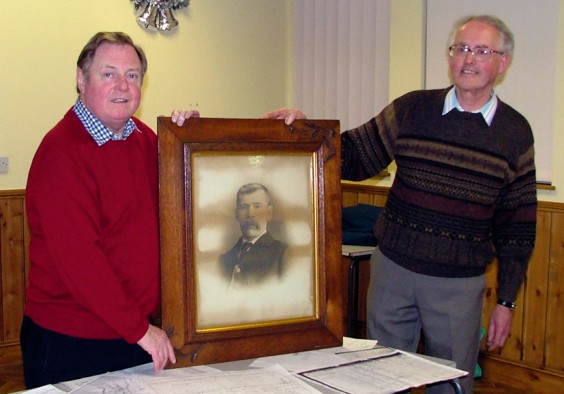
The society’s chairman, Brian Gould, brought along a record of his family history, which was greatly assisted by the family bible.
Published in 1789, it has been passed down Brian’s family and lists many of his ancestors. Brian was able to trace his ancestor William Gould (1713 – 1749). What a treasure!

Brian has a rich store of memories as he has lived in Rubery since 1967 when he joined Rubery History Society.

He has been part of Lickey History Society since 1992 when the two Societies amalgamated and he was appointed chairman around ten years ago. 

Other contributors to the evening included Joan Macarthur, demonstrating that history is not just about looking back, but looking forward and recording the present for future generations.

Joan talked about her father, Jack Pemberton, who was head warden at Handforth, Cheshire, in the Second World War.

This was 12 miles south of Manchester, with Woodford close by making planes, and the airbase at Ringway airport near Handforth in the flight path of enemy targets.

Joan displayed her war memorabilia, including photographs of a certificate signed by Queen Elizabeth (wife of King George VI) sent to Joan’s mother.

Queen Elizabeth sent a certificate to the lady of the house of all households who took in evacuees. 

There was also an identity card which was issued to Air Raid wardens. The wardens were known as the ARP (Air Raid Precautions) who were formed along with home guards to defend civilians.

Responsibilities included assembling at their post at the sound of the air siren and checking houses to make sure there were no chinks in the blackout, alerting residents where necessary.

ARP wardens were on hand in case of bombing, when they would co-ordinate operations, fight fires and provide First Aid, working alongside the Home Guard, police and ambulance people.

Joan has also kept a letter that she wrote at the age of eight, to her father in 1944 when he went to London as a relief bank clerk during the time of flying bombs. Although her father was only 34, Joan thought of him as “quite old”.

Only since then has she come to appreciate how young many of the men and women involved in the war actually were.

Dr Cath Elliot showed us an oil painting of Chadwich painted by herself around 30 years ago. Readers will see that this was before the M5 was built.

Cath copied the painting from a black and white print, which was used as a cover for the Bournville works magazine, and had to guess the colours.

The original watercolour, painted by a Mrs Hoyland in the 1930s, used to hang in Mr Edward Cadbury’s office.

* Chairman Brian Gould is currently writing a chapter on “the development of Rubery over the years” as his contribution to a local history book, which is being compiled by me.

If readers are able to contribute photographs and memories of Lickey and the surrounding area, please contact me on 0121 453 2310 or email .(JavaScript must be enabled to view this email address)

Above: George Gascoyne and Brian Gould with George’s family heirloom.

I spy a good ISP

ADVERTISEMENT FEATURE

Many people just upgrade their dial-up internet account to whatever broadband package their Internet Service Provider offers and may pay far more than they need to, writes Richard Peach.

But when you start shopping around for better deals, you soon find it’s nearly as mind-numbing as working out which mobile phone package to go for.

So I’ll offer some user experience here, with the rider that I have a vested interest – my chosen home broadband provider will knock 25p off my monthly bill for every customer who signs up to them saying that they were recommended by me!

Actually, I have day-to-day experience of two broadband providers; one at the offices of Platform Publishing, where we produce The Village and other publications, and one at home. One costs more than twice as much per month and is, on the surface, only half as fast.

The expensive one is from an ISP called Fast24 and costs £30 including VAT. This is for a service offering  a download data rate of 512k, but it has the advantage of having what is called a “contention rate” of 20:1. What this means, roughly, is that our particular line through to the internet can be shared by a maximum of 20 different users.

My home ISP is a company called PlusNet and for £14.99 per month (inc VAT) we get a 1Mb connection (twice as fast as 512k). But the contention rate is 50:1, which means that the actual user perception of internet speed is about the same as the Fast24 512k line.

To keep the PlusNet price down I also capped the usage at one gigabyte of data – uploaded or downloaded – per month. But in a household of four, with someone on the internet almost all waking hours, we have never got anywhere near that limit.

By my reckoning, then, we are getting the same service at home for less than half the price we pay at the office. And, even better, the service PlusNet has provided over the first four months has been impeccable.

Signing up and setting up was fast and problem-free and there has never been any down-time caused by problems at their end – while our office has been let down a number of times by Fast24 (although they say they are now upgrading their equipment to prevent this).

The PlusNet account also comes with all you could want, such as a static IP (in case you’re into internet gaming or even want to host your own email server), a web-based email service, 250Mb of web space to play with and a user-friendly members’ area with all sorts of useful information and tools.

So, why haven’t we switched the office to PlusNet? Well, for a start, it’s a good idea to have two ISPs available so you have a back-up, and the office needs an uncapped service as we send whole magazines to printers over the internet. Also, as soon as it becomes a business connection, it gets more expensive anyway, even on PlusNet.

From our home experience however, and from dealing with ISPs for around 10 years now, I would happily recommend PlusNet to anyone – although past performance does not guarantee . . . etc.

PlusNet, like most other ISPs, charges a one-off account activation fee for new users of £58.75, although as we went to press they were waiving the activation fee for people switching their broadband account to PlusNet

Have a look at https://www.plus.net to get an idea of what they offer and, remember, if you do decide to try them, enter the word platform in the box that asks who referred you. Alternatively, go to https://www.villageonline.co.uk and click on the PlusNet logo.

Broadband appeal

0
The Netac mini MP3 player would be an ideal stocking filler

Terry Williams extols the virtues of broadband technology. 

ADSL broadband is, technically speaking, a data transmission technique allowing multiple high-speed signals to share the bandwidth of a single cable via frequency division multiplexing.

What this actually means is that a single line can carry your telephone conversations at the same time as your broadband internet connection. A device called a “splitter” allows one line to go to the phone and the other to the modem. Therefore, unlike dial-up, you can be on the internet and accept and make telephone calls at the same time.

This is clearly one of the major advantages of broadband, with another being the speed of data transmission. As a rule, the faster the connection the more you will pay the Internet Service Provider (ISP). But even at the slowest level of 256Kbps upload and 256Kbps download it is still five times faster than dial-up.

For many home users this entry level service is just about ample. For business users or people wanting to download music, videos, or watch on-line presentations then a faster download speed of either 512Kps, 1Mb or even 2Mb service may be more appropriate, but at a higher cost.

If all you want from your computer and Internet connection is sending and receiving a few emails and the occasional look at a web page, then you are still better off stopping with a free ISP on dial-up. If you are paying a monthly subscription for a dial-up connection then you should think about changing over.

The cost of a pay-as-you-use service on Broadband can start as low as £10 per month (there may be set-up fees). There is now so much choice from broadband ISPs that the prices are being driven down and speeds of transmission being increased. Unfortunately most people just sign up with the dial-up provider they have always subscribed to without looking into the options.

So here are some points to ask about before joining a broadband ISP: contract length; set-up or activation fees; download allowance; contention ratio; cost of service related to speed; technical support phone costs; is a fixed IP address included and is equipment such as modem and filters offered for connection?

With so much choice out there, it is well worth looking at the smaller specialist ISPs who want your business, will offer you quality technical support and leave you feeling good about the experience. Look on the Internet to see how other users have found your intended ISP. This may change your mind especially in regard to some of the larger suppliers.

One website of interest is www.adslguide.org.uk which lists many of the UK’s ISPs with costs and performance charts, hardware comparisons and also an ADSL availability checker.

Many large ISPs will try to lure customers with free gifts such as modems and filters. Free modems tend to be of the USB type. While these work, they are very much second best to a good ADSL LAN modem/4-port router that has built-in Firewall to protect your PC from hackers from outside the PC.

A 4-port modem/router will allow the user to send broadband internet over lan cables to up to four computers. If Wi-Fi is added to this router then broadband can be sent to laptops and PDAs without cables.

A note of caution – never connect up to a high-speed internet connection without a solid Firewall and up-to-date anti-virus package in place. Your computer can become infected with all sorts of problems in just a few minutes.

ADSL broadband should now be available to most households and businesses in the area through the standard phone line. The coverage has been helped by BT increasing the distance customers can be from the exchange, therefore improving fringe coverage. People who have been refused Broadband because of cable distance from an enabled exchange may well now be advised to reapply.

At Shepley we act as a reseller for ZEN internet and have found the professional service they offer linked to the provision of a fixed IP address an excellent partner for the digital CCTV systems we sell. Using a fixed IP address allows customers to view their cameras in almost real time over broadband from any where in the world. For more details on broadband in general or to sign up over the phone please give us a ring on 0870-7586445.

On a different note, we expect one of the biggest IT stocking fillers this year to be tiny portable MP3 players. With prices starting at under £40 they are a must for the kids. These devices connect to the PC by USB cable and can store hours of music. They are carried around and used with earphones powered by batteries to play back the music. A small screen allows tracks to be selected or skipped. Some models even incorporate an FM radio.

Terry Williams is Managing Director of Lickey End-based Shepley Computers & CCTV. 

If you have any computer-related questions you would like him to answer
in future columns, please email them to: support@shepleydirect.co.uk

For more information on CCTV and PCs and links to related sites, see: https://www.shepleydirect.co.uk

A wealth of wreaths

Paul displays two examples of different designs

A Christmas tradition is being kept alive in Lickey End, as Sally Oldaker discovers.

Originating many centuries ago in Eastern Europe, evergreen wreaths represented continuing life during the depths of winter and also symbolised hope for the coming spring. We in modern-day England may no longer have much concept of a harsh winter, but nevertheless the idea of a Christmas wreath has survived and can still add a finishing touch to many homes.

The age of technology has led to mass-produced, imitation wreaths that somehow fail to capture that essential festive spirit, despite being easy to care for. For anyone who likes the idea of using “live” decorations and following the traditions of our ancestors, nothing less than the real thing will do.

Luckily for traditionalists and for tradition itself, the Arnold family of Lickey End are still producing “real” wreaths that promise to enhance your existing decorations. For the past 15 years the Arnolds, who during the rest of the year grow bedding plants, shrubs and nursery stock at their home, have set aside the weeks immediately before Christmas to branch out  – as it were – into the wreath business.

The family are a good advert for diversification – 22 years ago Peter Arnold and his wife Jessie bought the house and land with the intention of “doing something with it”, and their son Paul, after attending agricultural college and working at a local dairy farm, thought first of rearing cattle on the premises. However, realising that there wasn’t quite enough room, he decided to grow vegetables instead.

“We gradually found that modern farming methods required more land; land we didn’t have,” Peter takes up the tale. “So we then moved into pure horticulture.”

The wreath-making aspect was introduced later, beginning with a few made by hand to tap into the festive market. “But the demand was higher than that,” Peter says. “People wanted quality in quantity – so we streamlined the process to produce meaningful numbers of wreaths for wholesale.”

This means that the wreaths are not made entirely by hand but, as Peter explains, a little mechanical help had to be brought in if the business was to grow: “Making holly wreaths is difficult and painful on the fingers after the first thousand or so!”

The imported hand presses eliminate the need for “wiring”, a tricky process of binding holly stems on to a length of wire. Instead they attach a tin plate spur to the holly bunch. Artificial padded rings are also bought for the wreaths’ bases – traditionally these would have been made from spagnum moss on a welded wire frame.

“The harvesting of moss is unsustainable,” Peter points out, “so it’s better for the environment not to use it, and besides, the artificial rings do have the same properties as the ‘live’ ones.”

Holly isn’t the only plant the Arnolds use for the wreaths; last year a conifer ring was introduced and they also use ivy, berries and leylandii. Peter says they try to keep abreast of changing fashions, and the family have also developed a specially-made posy that exactly fits the dimensions of crematorium memorial stones, thus avoiding large wreaths overlapping other markers.

The Christmas wreaths are sold through a flower wholesaler in Birmingham, though they can also be bought direct from the Arnold farm. A number of casual part-time staff are drafted in to help with the construction, usually from the local area; some, like Lynda Parker, of Catshill, have been on the Christmas team for many years. And Peter is not averse to collaring additional recruits: “Anyone who turns up here may well find themselves doing some work!”

Obviously most of the wreaths are made to a tight schedule before Christmas, though a more gradual process exists for the handmade coloured bows – Jessie starts on these as early as February, preferring to make them in front of the TV. “Instead of knitting,” quips Peter.

You can buy your wreath at Crow’s Mill, Lickey End, Bromsgrove. Please call first on 01527 878470.

Direct help for AFC

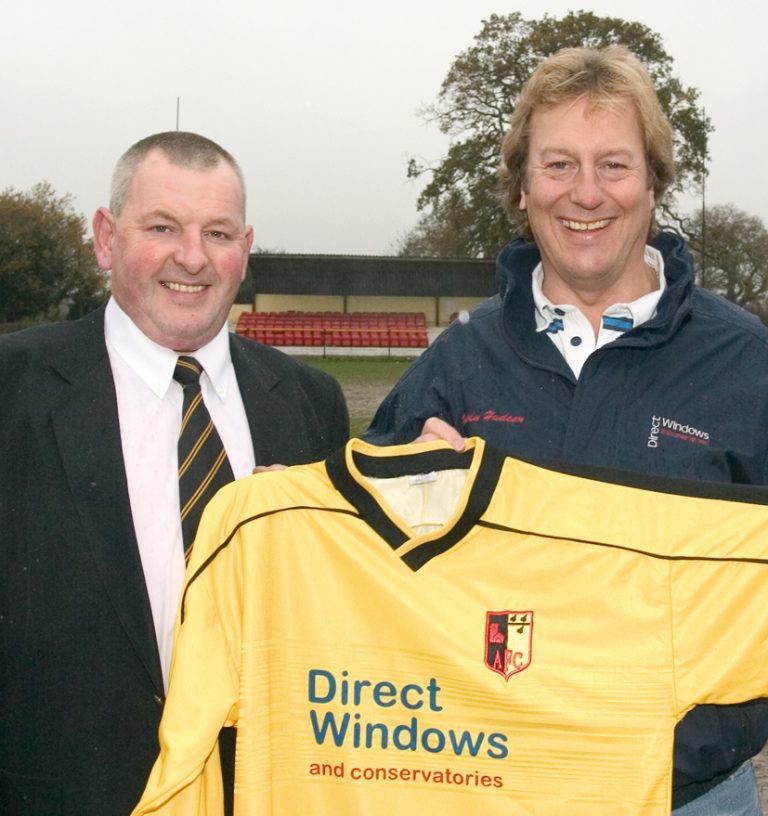
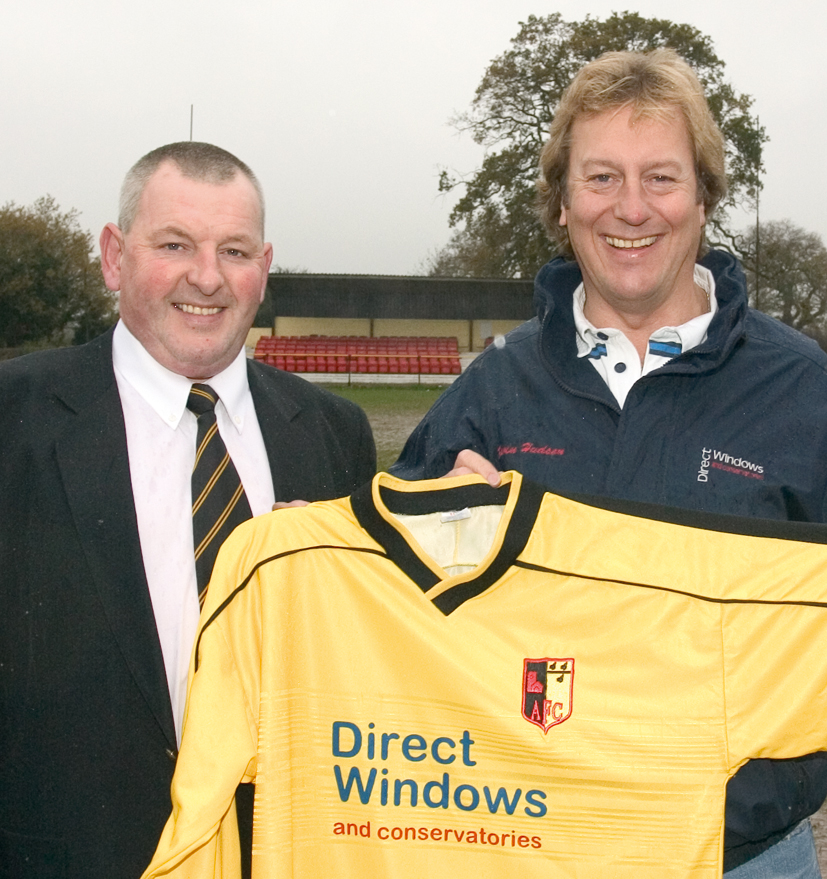
AFC Chairman Peter Eacock (left) with Kevin Hudson, whose company, Direct Windows and Conservatories, is the club’s new kit sponsor

Kit sponsorship deal boosts football club’s mission to succeed.

Alvechurch Football Club has a long and noble history in non-league football. The legendary cup-tie with Oxford United that went to seven replays is a record that will never be beaten due to the introduction of penalty shoot-outs.

In recent years the loyal supporters of  “The Church” have experienced a rollercoaster ride. In 2003 Alvechurch FC completed the league and cup double that propelled them back to their rightful place in the Midland Alliance. The 2004/5 season has seen major changes throughout the club with a new board, first team management and a influx of quality players.

The nucleus of the board is made up of local people: Peter Eacock (Chairman), Rob Waldron (Vice Chairman) Steve Denny (Treasurer and Secretary), Neil Tomlin, and supporters’ representative Glyn Slade, all of who have a common goal  –  to make Alvechurch Football Club successful.

This year the board has been bolstered by the inclusion of Colin Strong in the role of Director of Football. Colin brings with him 25 years’ experience in non-league football and will be working closely with the talented first team management team of Peter Frain and Paul Boost.

Another addition to the AFC board is Mark Clemson who will fill the role as commercial manager. Mark is upbeat about the future, saying: “At the outset of the season the new bard defined what we wanted to achieve; our mission statement if you like. It was very easy to articulate: Alvechurch Football Club will represent Alvechurch and surrounding areas at the highest level of competition possible.”

He continued: “Sadly, football and finance walk hand in hand these days, and each week it is a struggle financially to keep the club going.”

However, good news is on the horizon. AFC have just signed a kit sponsorship deal with local company Direct Windows and Conservatories.

Its managing director is a local businessman who lives in Alvechurch and whose “significant” financial support is much welcomed at the Club.

Peter Eacock, the Chairman of Alvechurch FC, said: “To have such a prestigious company’s support is fantastic. We are under no illusions – if we are to succeed in delivering our dream we will need the support of local business and the people of Alvechurch alike.

“We have a board that gives its time freely without remuneration. Our management team has created a team spirit that is delivering great results and the team is playing some good football. We have a fantastic loyal set of supporters who enjoy their football and are extremely knowledgeable. Each week, home and away, rain or shine, they turn up and give us their support. They deserve success and we are determined to give it to them.”

On the pitch, things are going well for Alvechurch FC. Their playing record for early November reads: Played 4, won 4. Goals for: 12; goals against: 0. They are also travelling to Holbeach in East Anglia in the second round of the FA Vase proper and are through to the semi final of the Worcester Urn.

Off the pitch, programme advertisement is on the up and the Club has ordered eight new pitch-side board advertisements.

If you would like to help Alvechurch FC by way of a programme advert or a pitch-side board, contact Mark Clemson on 07971 105435 or e-mail: clemsmw@supanet.com

‘Lawfulness’ not in public interest

0

I congratulate you on your initiative in taking the trouble to find out for all of us how the day-to-day operation of meat rendering affects people locally.

The more I learn about the proposed intention to site a rendering plant in a residential area, the more I consider those responsible should be brought to account. Councillor George Lord cites Bromsgrove District Council as being the culpable party.

The two certificates of lawfulness granted do not mean that it is ethical, morally right, and in the public interest for the plant to be implemented.

John F Rice, Cofton Hackett