
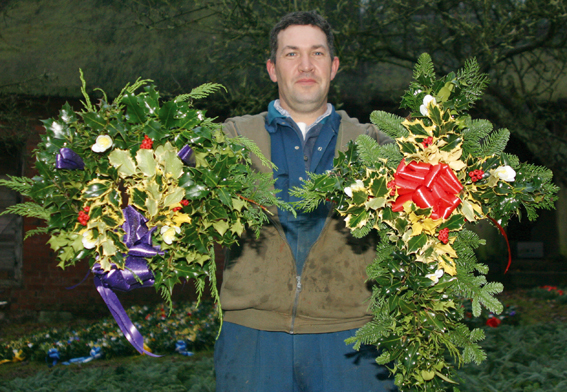
A Christmas tradition is being kept alive in Lickey End, as Sally Oldaker discovers.
Originating many centuries ago in Eastern Europe, evergreen wreaths represented continuing life during the depths of winter and also symbolised hope for the coming spring. We in modern-day England may no longer have much concept of a harsh winter, but nevertheless the idea of a Christmas wreath has survived and can still add a finishing touch to many homes.
The age of technology has led to mass-produced, imitation wreaths that somehow fail to capture that essential festive spirit, despite being easy to care for. For anyone who likes the idea of using “live” decorations and following the traditions of our ancestors, nothing less than the real thing will do.
Luckily for traditionalists and for tradition itself, the Arnold family of Lickey End are still producing “real” wreaths that promise to enhance your existing decorations. For the past 15 years the Arnolds, who during the rest of the year grow bedding plants, shrubs and nursery stock at their home, have set aside the weeks immediately before Christmas to branch out – as it were – into the wreath business.
The family are a good advert for diversification – 22 years ago Peter Arnold and his wife Jessie bought the house and land with the intention of “doing something with it”, and their son Paul, after attending agricultural college and working at a local dairy farm, thought first of rearing cattle on the premises. However, realising that there wasn’t quite enough room, he decided to grow vegetables instead.
“We gradually found that modern farming methods required more land; land we didn’t have,” Peter takes up the tale. “So we then moved into pure horticulture.”
The wreath-making aspect was introduced later, beginning with a few made by hand to tap into the festive market. “But the demand was higher than that,” Peter says. “People wanted quality in quantity – so we streamlined the process to produce meaningful numbers of wreaths for wholesale.”
This means that the wreaths are not made entirely by hand but, as Peter explains, a little mechanical help had to be brought in if the business was to grow: “Making holly wreaths is difficult and painful on the fingers after the first thousand or so!”
The imported hand presses eliminate the need for “wiring”, a tricky process of binding holly stems on to a length of wire. Instead they attach a tin plate spur to the holly bunch. Artificial padded rings are also bought for the wreaths’ bases – traditionally these would have been made from spagnum moss on a welded wire frame.
“The harvesting of moss is unsustainable,” Peter points out, “so it’s better for the environment not to use it, and besides, the artificial rings do have the same properties as the ‘live’ ones.”
Holly isn’t the only plant the Arnolds use for the wreaths; last year a conifer ring was introduced and they also use ivy, berries and leylandii. Peter says they try to keep abreast of changing fashions, and the family have also developed a specially-made posy that exactly fits the dimensions of crematorium memorial stones, thus avoiding large wreaths overlapping other markers.
The Christmas wreaths are sold through a flower wholesaler in Birmingham, though they can also be bought direct from the Arnold farm. A number of casual part-time staff are drafted in to help with the construction, usually from the local area; some, like Lynda Parker, of Catshill, have been on the Christmas team for many years. And Peter is not averse to collaring additional recruits: “Anyone who turns up here may well find themselves doing some work!”
Obviously most of the wreaths are made to a tight schedule before Christmas, though a more gradual process exists for the handmade coloured bows – Jessie starts on these as early as February, preferring to make them in front of the TV. “Instead of knitting,” quips Peter.
You can buy your wreath at Crow’s Mill, Lickey End, Bromsgrove. Please call first on 01527 878470.
