Aelfgythe Border Morris’ Squire, Pam Morley, reports on their wassail.
Aelfgythe Border Morris hosted another successful annual Wassail, starting at The Crown Inn, Withybed, with dancing from five Morris sides: Alvechurch Morris Men, Bloodstone Border Morris, Pebworth Morris, Ragged Oak Morris and, of course, Aelfgythe.
The participants and audience (assisted by John Bright’s Regiment of Foote from the English Civil War Society) processed through the village to The Weighbridge Pub at Scarfield Wharf. We were lucky that the weather was dry and not as cold as in previous years.
The Wassail ceremony, led by Steve, our Green Man, followed its usual pattern, with the help of the Alvechurch Community Choir who sang a traditional Wassail carol. The Green Man explained the purpose of a Wassail with many cries of “Waes Hael”, meaning live well, or good health, followed by the traditional response of “Drink Hael”, or drink well, from the audience.
The John Bright’s musketeers played their part in waking up the trees by firing several rounds, which produced some wonderful flashes of gunpowder. The audience also took an important role, joining in with the chorus of our Wassail poem and then hanging toast in the branches of the trees. The orchard had been decorated with many lights in the trees and looked absolutely magical.
After the actual Wassail was over, there was more dancing and then the invited guests were treated to very welcome hot soup and a buffet. The evening finished with a social gathering and music session.
Many people helped to make the evening such a success, and Aelfgythe would like to thank the publicans, Morris dancers and musicians, John Bright’s Regiment of Foote, Alvechurch Community Choir, ABC Leisure for their generous sponsorship and donation of a day boat pass for our raffle prize, and all our friends and supporters who worked hard to make sure the evening passed without a hitch.
We would also like to thank the audience for their contribution and support, and the kind permission from photographers Mark Easter and Rich Ward to use their fabulous pictures.
This year’s Wassail was the best yet, and we hope everyone had as much fun as we did. We are already planning next year’s event, which will be held on Saturday February 6, 2021.
If any women would like to try Morris dancing, or any musicians would like to play with the band, email aelfgythe@hotmail.co.uk for more details. You could be dancing or playing for next year’s celebrations! Until next year. . . Waes Hael to you all.
Coun Spencer with residents from Slideslow Ward and Jo Dalton from Worcestershire County Council
Sarah Rees reports from the Oakalls and Parklands.
Hundreds of residents attended a public session about improvements to the A38 corridor, including the Slideslow Roundabout. Representatives from the project team at Worcestershire County Council were on hand to answer any questions about the scheme.
The Bromsgrove Route Enhancement Programme (BREP) will deliver improvements on the A38 corridor between Lydiate Ash and the Hanbury Turn and consists of 12 individual schemes. It follows work that began last year to improve the junction with Barley Mow Lane, M5 Junction 4 and M42 Junction 1.
The BREP encompasses the Slideslow Roundabout, long considered a potential danger hotspot by Oakalls residents. The plans include proposed controlled pedestrian crossings on the four roads approaching the roundabout; the widening and upgrading of footways, including a new footway link to the Golf Club; road widening to create a two-lane exit onto the A38 northbound and southbound.
Coun Ken Pollock, the county council’s Cabinet Member with Responsibility for Economy and Infrastructure, said: “This is a very busy route and one that is used for a wide range of journeys, from local trips into the town centre, to linking major road networks, such as the M5 and M42.
“We’ve already made a start on improving this corridor and these additional schemes would go a long way to improving reliability of journey times for those who have to travel by car. They would also encourage people to use alternative travel by improving the local walking and cycling network.”
More information on the proposal, including maps of each of the 12 schemes, is available on the Worcestershire County Council website.
Parents Ian and Vicki Jones, Yvette and Andrew Bennett, and Diane and John Taylor at the tree planting
MEMORIAL TREES
Coun Caroline Spencer and The Rev Paul Lewis of Bromsgrove Baptist Church joined a gathering of residents for the planting of three oak trees on the grassy area on Davenham Road, replacing the large horse chestnut tree felled last August.
The new trees were planted in memory of Tom Jones, Charlotte Taylor and Harry Bennett – who all grew up on The Oakalls and sadly lost their lives at a young age.
The parents of Tom, Charlotte and Harry (pictured above) helped plant the trees, and a memorial plaque was placed next to each one. Rev Lewis then blessed the area where the trees had been planted.
Coun Spencer said: “These much-loved teenagers had enjoyed their childhood on The Oakalls and I felt this was a fitting way of remembering them all. There is now a special space for the families and their friends to pause and remember their loved ones.”
Please contact me with your news, views and concerns about any aspect of life on the estate. Email: oakalls@villageonline.co.uk
Dr Dipesh Parmar of Acorn Dental is an internationally-renowned cosmetic and reconstructive dentist and dental educator.
What is your favourite part of the job? Although doing routine dentistry can be satisfying, especially when you are relieving the patient of pain or fixing a broken tooth, the more complex cases are far more rewarding as we are changing patients’ lives. Complex cases usually involve different aspects of dentistry, and being able to coordinate the whole case together to create a dental masterpiece is somewhat special.
What is your least favourite part of the job?
I don’t have a least favourite part, but the most stressful times are when I have dentists themselves in my chair! I am privileged to be the dentist for many dentists, but I’ve lost many hairs in the process!
Where did you study?
I qualified from the University of Birmingham under the tutelage of some great dentists. Having an older brother, Dr Manoj Parmar, as a dentist and another, Hit Parmar, as a dental technician gave me a springboard at University, so I feel I got more out of it and I thoroughly enjoyed the training.
What other qualifications do you have?
My interests have always been in Cosmetic and Aesthetic Dentistry, meaning all dentistry should look natural and complement the patient, their personality and their health.
Traditionally, cosmetic dentistry has always been about placing veneers, but now there is huge focus on Orthodontics and composite bonding to achieve similar outcomes at reduced biological and financial costs to the patient. Often teeth are not in the correct position and traditionally they were drilled and covered with a veneer or crown (“cap”) to camouflage the tooth into a new position.
It makes more sense that if a tooth is in an incorrect position, it should be moved into the correct position. This will help us create a healthier bite, that looks better for longer.
Orthodontics is all about moving teeth and I currently have Diplomat status in Orthodontics from the University of Warwick, and am currently finishing a Master of Science degree in Orthodontics. I am also a qualified Invisalign provider and a Graduate of The Dawson Academy for Complete Comprehensive Care.
What has been your proudest moment in your professional life?
This is a tough one, but I would say it was when I won Best Aesthetic Dentist UK and my dental technician brother Hit won Best Aesthetic Technician UK at the 2018 Aesthetic Dentistry Awards. We were up against the country’s finest dentists, and to win the whole lot together was very, very special. Other proud moments were when I won Best Young Dentist at the 2017 Private Dentistry Awards, awards at the 2015 Aesthetic Dentistry Awards and 2012 Smile Awards.
When did you set up Acorn Dental?
My brother, Dr Manoj Parmar, took over Acorn Dental in Moseley in 2000, taking over one of the longest-established practices in Birmingham and we joined forces in 2010. We expanded it into a four-surgery centre of dental excellence, and in March 2019 we took over Barnt Green Dental Centre as our first satellite branch. We are getting many patients travelling from around the country to see our dentists so we need to branch out.
What services do you offer?
I focus on bespoke aesthetic and cosmetic reconstructions, including composite bonding, ceramic veneers and crowns, smile makeovers, treatment of tooth wear, management of the failing dentition and restoration of dental implants. I also do a vast amount of Orthodontics from simple to advanced cases, using Invisalign and conventional fixed braces.
My brother, Dr Manoj Parmar, is a fantastic implant surgeon. From single implants to full mouth reconstructions with dental implants, he can handle all cases, allowing us to work really well with each other.
Our other dentists at both practices can provide general dentistry, root canal treatment, gum treatments and non-surgical facial aesthetics. We like to treat everything in-house so we are in full control of final outcomes.
Are your treatments very expensive?
Our aim was never to be the cheapest in town, but the best. Dental treatment is not expensive either, however neglecting your teeth can be – hence the importance of regular dental check-ups and hygienist visits. The fees have remained the same since we acquired the practice. Our price list can be viewed on our website www.acorndental.co.uk. Finance options are available.
What do you do when you are not doing dentistry?
More dentistry! Unfortunately I do not get much time outside dentistry. If I’m not in the surgery fixing teeth and making smiles, then I spend a large amount of my time travelling the globe lecturing and teaching at some of the world’s most prestigious dental conferences. I am also clinical director of the UK’s most successful composite bonding educational course for dentists, Mini Smile Makeover. Once a month I teach 30 UK and international dentists minimally invasive aesthetic and cosmetic dental techniques. Otherwise it’s family time!
What are your future plans?
We have plans to extend and renovate the Barnt Green centre, which will hopefully be starting this year. I am also constantly being asked to set up a clinic on Harley Street so we are looking into that too, and my education programme for dentists is also going to be widened with more courses here and abroad. All our dentists are constantly working on personal and professional development; it doesn’t seem to end!
22A Hewell Road, Barnt Green B45 8NE Tel: 0121 447 7300 https://www.acorndental.co.uk Free parking for 3–4 vehicles. Access is via a private drive at the side of Savoir Faire boutique.
Martin Pryor explains where you can find value in today’s investment markets.
These are strange times in the investment markets. The looking-glass world of negative interest rates – where borrowers are rewarded for taking out loans and savers pay interest – has become a reality in parts of continental Europe and Japan.
In the UK, the Bank of England base rate has been below 1% for more than a decade. In the US, the central bank started cutting rates from a peak of just 2.25%–2.50%, set last December. The idea that interest rates would be “lower for longer” is edging towards “lower forever”.
Fixed interest securities (bonds) have also come under the spell of negative interest rates. At the time of writing, there were about $11.4tn of bonds, mostly government paper, offering a negative return to those investors who held them through to maturity.
There was a time when an investor in bonds would look forward to a return on their capital (i.e. interest); now some cannot even expect a return of their capital.
The decline in interest rates and bond yields since the 2007/08 financial crisis has overturned some traditional relationships in investment markets. For instance, it was once the case that the longer the term of a bond, the higher the interest rate. In many countries, such as the UK, US and much of the Eurozone, the return on a 10-year government bond is now lower than the central bank’s short-term interest rate.
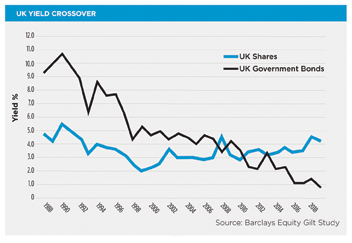
Another example of a norm that has been overturned is the difference in immediate income available from bonds and shares. It used to be that government bonds provided a higher income than shares because the latter offered the possibility of growth, not only of income but also capital value.
The graph above shows the historic yield advantage of bonds in the UK up until the time of the financial crash.
THE YIELD GAP
Since then, the picture has changed with a marked widening in the last few years of an income yield gap favouring shares over bonds. Ten-year UK government bonds currently have a yield of under 0.8%, while the average dividend yield on UK shares is over 4.3%.
There have been similar reversals in many other world markets. Even in the US, where interest rates are relatively high, the average share yield was 1.85% in mid-November compared with 1.88% for a 10-year government bond. But the average figure can itself hide a significant difference between individual shares, as is often the case.
l Value shares generally have a higher than average yield, but relatively limited growth prospects. A typical example would be a utility company.
l Growth shares are expected to see earnings grow faster than the norm and thus carry a relatively higher than average rating (and lower yield). The classic example would be a technology company.
In the past three years, value shares and the funds that favour them underperformed growth shares on a global basis, despite the higher dividends on offer. However, as the global economy shows increasing signs of slowing down, there could be an argument for taking a second look at the value sector. Many funds target value investing, although it is important to select the right ones.
The value of your investment can go down as well as up and you may not get back the full amount you invested.
Past performance is not a reliable indicator of future performance.
Investing in shares should be regarded as a long-term investment and should fit in with your overall attitude to risk and financial circumstances.
Action from the away defeat to Hitchin (Photo/ Ian Macvie)
Alvechurch FC hope for silverware against Bromsgrove Sporting.
Despite a poor run of form in which they hadn’t won a league match since New Year’s Day, Alvechurch now find themselves preparing for a cup final after a 3–0 thrashing of Kidderminster Harriers.
The Worcestershire Senior Cup semi-final took place at Lye Meadow, where ’Church booked their place in the final against league rivals Bromsgrove Sporting. The match will be played on Thursday April 16 at 7.45pm at Evesham United’s ground, and is Alvechurch’s only chance for silverware this season.
In the league, things haven’t been so rosy, with recent losses to Hednesford Town, Stourbridge, Hitchin Town, Tamworth and Peterborough Sports leaving ’Church second from bottom of the table. The home defeat to Tamworth was particularly unfortunate as the visitors’ two goals came on 76 minutes and in stoppage time.
They did manage a 0-0 draw at home to Leiston, but this was a game of missed opportunities – Alvechurch dominated the first half, but Kevin Monteiro missed a sitter before Rahis Nabi, Aaron Birch and Zazzi all fired off target.
With fans growing restless, chairman Richard Thorndike put a statement on the club’s website, urging supporters to get behind the team:
“Whilst I understand the frustration of our league position and lack of points on the board, it’s disappointing to see a few [fans] ‘arguing’ about the current situation.
“When you consider our playing budget and the fact we were left with only four players from our last season’s squad at the start of the season, it was always going to be a mammoth task to compete at this level.
“[Manager] Dean Holtham. . . asked for no money, instead offering his pay back into the team’s budget so we could improve the playing squad. A huge gesture, not to be understated.
“I’m certain there will be more good times ahead of us but now is a time for togetherness and supporting the team. We’re all Church, in good times and in bad.”
* International clearance has been approved for midfield player Joe Phillips to return to Alvechurch from Welsh league side Aberystwyth Town.
Joe previously played at Lye Meadow towards the end of the 2018/19 season but returned to the Welsh side at the end of the season. He was a Welsh Cup finalist with his first club Stourport Swifts.
Another fan favourite returning to the club is centre-forward Connor Deards. Connor brings vast experience, having had two previous spells with Church and his former clubs Redditch United, Bromsgrove Sporting and Lye Town.
West Bromwich Albion’s under-18 attacking midfielder Eoin Ashton has also joined on a month’s loan.
* Centre-forward Kyle Perry has left the club. Kyle joined Alvechurch from local rivals Bromsgrove Sporting earlier in the season but has decided to move on. The 6’4’ ’experienced target-man had played for Telford before going into the Football League with both Port Vale and Mansfield Town. He has also represented Tamworth, Lincoln City and Altrincham in his successful career.
Paul Douglas has also left after a short stay at Lye Meadow. The Bermudan international midfielder joined the club from Ilkeston and has now moved on to Stratford Town.
* Alvechurch FC is has a vacancy for a Commercial Manager – email Club Secretary, Steve Denny, for details.
* For more info or sponsorship enquiries, please contact Trevor Ball at saintsarehot2@btinternet.com or visit https://www.pitchero.com/clubs/alvechurch
Follow the club on Twitter @Alvechurch1st
FIXTURES (League unless stated)
Tues Mar 3 Biggleswade Town (A) 7.45pm
Sat March 7 Nuneaton Borough (H) 3pm
Sat March 14 Rushall Olympic (H) 3pm
Sat March 21 Coalville Town (A) 3pm
Sat March 28 Banbury (H) 3pm
Sat April 4 Rushden & Diamonds (H) 3pm
Sat April 11 Stratford Town (H) 3pm
Mon April 13 Broms Sporting (A) 3pm
Thur April 16 Broms Sporting 7.45pm Worcestershire Senior Cup Final (at Evesham)
Phil’s farm pond was very high on Sunday 16th and the field saturated with rainwater. It helps to prevent heavy rainfall run-off, reducing the levels of the rivers. In this case it flows directly into the River Arrow, reducing the flooding risk.
Alvechurch amateur weatherman Phil Thomas records the changes.
February was another very wet and windy month. The rainfall to the 17th was 84.6mm, already more than the month’as average of 52mm. The mean temperature was also above the local mean, standing at 6.3C, or 2.2C above the mean value.
There were some very strong gusty winds too – a gust of 49mph on the 9th, 44mph on the 15th and 43mph on the 16th. My automatic weather station was blown over despite being anchored by heavy flagstones!
All of these extremes are due to a very strong jet stream bringing warm moist air from the south-west, interacting with a cold air stream further north.
February 2020 (to the 17th)
Mean Max 9.7C 2.4 above average
Mean Min 3.1C 2.0 above average
Mean 6.3C 2.2 above average
Rainfall 84.6mm 161% of average
Sunshine 33.7 hrs 56% of average
January was very mild and damp with a mean temperature of 6.2C, which is 2.3C above the local 30-year mean.
No snow was seen falling during the month (the last recorded snow lying was in March 2018). The barometer reached an all-time high for my site (records going back to 1989). It reached 1049.1 on the 19th.
January 2020 Mean Max 8.C 2.0 above average
Mean Min 3.8C 2.6 above average
Mean 6.3C 2.3 above average
Rainfall 65mm 95% of average
Sunshine 53.5 hrs 106% of average
Outlook Into March, a continuation of unsettled weather is expected, broken by brighter but showery conditions. Temperatures should generally be above normal again for the time of year.
More information at https://www.alvechurchweather.metsite.com You can see an improved HD weather-cam, updated at one-minute intervals, at: https://www.alvechurchweather.metsite.com/webcam_alvechurch.php
Amateur astronomer Brian Watkiss peers into the Village night sky.
The year Marches on and winter finally comes to an end with the Vernal equinox in the early hours of the 20th. “How can you specify an exact time?” I hear you ask.
Well, although equinox means that day and night are the same length, it really refers to the moment the tilt of the Earth’s axis is exactly sideways on to the Sun – at 03:49 on the 20th. The day that has exactly twelve hours of daylight is the 17th. That’s the vagaries of our elliptical orbit for you.
The planet with the most nearly circular orbit is Venus and it is most upright on its axis to boot, so it has no seasons. It is the brightest object in our night sky, too, clearly visible shining high in the south west as soon as the sky starts to darken.
And it is still resisting the general daily westward drift of everything else in the sky, just getting a little higher each evening. As ever, look for the Moon close by on the 28th, the night when the clocks go forward.
Earlier in the month, on the 2nd, the Moon is very close to the brightest star in the constellation of Taurus. Start looking from about seven thirty, to the left and twice as high as Venus. You should see most of the “vee” of stars forming Taurus, with the beautiful Pleiades cluster to the right and giant Orion to the left.
We can’t mention Orion without referring to its red supergiant star, Betelgeuse, in the top left corner. It still doesn’t seem to be coming out of its dim phase (a bit like me!) and now looks like many other much smaller stars, leaving Rigel in the lower right corner as the brightest in the constellation.
It could be that it’s about to explode or indeed it may already have done so – we wouldn’t know for a little over six hundred years because that’s how long it takes its light to reach us. Keep watching.
Now, there’s a star that is even brighter than Rigel but rarely gets noticed! It is, as they say, hiding in plain sight; you just need to know where to look. High above Orion, you should be able to make out a pentagon of stars.
This is the constellation of Auriga, the Charioteer. Whoever thought this pattern of stars looked just like a man driving a chariot, I’ve no idea, but he is also seen to be holding a goat.
The topmost star can be seen to be bright yellow, just like our Sun, and this is, indeed, the brightest yellow star in the night sky. It is called Capella and is known as the Goat Star. It actually consists of two stars orbiting each other, each a little over twice the size of the Sun with a pair of red dwarfs orbiting a little farther out.
This little family often gets missed because it is so high in the sky so we all need to start looking up. But be wary of those hedgerows!
Mary Green looks at the way our diets have changed over the years.
I am writing this as a mild winter comes towards its end, hoping we don’t get late cold spells. There’s quite a lot of wild food about in the hedges now, where it’s been allowed to grow, and the birds are already singing for spring.
On February 1, I saw cherry plum blossom out and the first hawthorn leaves – and a barnacle goose! On February 2, Candlemas Day was cloudy with rain then fair and bright, so take your choice. And I saw a celandine out.
They say you are what you eat. It’s surprising how much our natural environment is shaped by our food choices and those of people in the past. Years ago, I think people were more aware of this connection, but our supermarket shopping habits have distanced us from our food sources and how they fit into the world around us.
It’s 50 years since Joni Mitchell sang: “Give me spots on my apples/ But leave me the birds and the bees…” and I wonder if we’ve learnt much.
Thank you, Maurice Brett, for your letter last month – in January I was talking about biodiversity but I will look at some other aspects of food over the next two months including the effects of animal farming and vegetable growing, this month looking at our immediate environment and next month at wider climate implications. It isn’t simple.
March is the season of Lent, the fasting period leading up to Easter. People talk of “giving up things for Lent” but really in older times there wasn’t much option. When people ate according to the rhythms of their farming year, this was a lean time. Winter stored foods were running out and there was not much of this year’s yet.
I guess if you went even further back, to pre-farming days, there would have been a different rhythm again. Hunter-gatherers found food hard to get in the winter but by March things would have been improving.
There are plenty of wild leaves around now, many of which were used in traditional Lent foods like Dock Pudding (made from bistort and other leaves). Wild plants like dandelion are important food for wildlife and once were for us.
In the Christian tradition of fasting, the priority was to stop eating meat and other animal products, using fish and vegetables instead. At one time you were allowed to eat barnacle geese, because of the myth that they were born from barnacles, small shellfish, or even that they grew on trees, possibly because the young ones jump into the sea from great heights.
This diet is generally good for health and the planet too. However, in this tradition fasting is followed by feasting, when those who could returned to meat-eating and sweet rich foods; now it seems symbolised by Easter chocolate (which was among the sweet rich foods you couldn’t eat in Lent).
There were sometimes a couple of breaks allowed. One was Mothering Sunday when workers were allowed a day off to visit their mothers and share a rich cake called a simnel cake. And I know a family of Irish Catholic origin where the kids were allowed to eat chocolate on St Patrick’s Day (and the adults to drink alcohol).
However, most people in past centuries ate meat or sugar so rarely that for ordinary people Lent probably wasn’t so different from normal seasonal eating. Lent seems to have been supplanted these days by Dry January and Veganuary, which is fasting after feasting, not before! In hard times, fasting helped people appreciate the feasts of nature that came after. In times of plenty, fasting follows feasting as a kind of punishment or cleansing.
Our landscape here shows the history of pastoral farming – raising animals for meat and dairy. It has made our fields and hedgerows, carved out of forest, and our meadowlands. In past centuries the meadows would all have looked more like Eades Meadow with a great variety of wildflowers and therefore of insects and birds.
People would have grown small amounts of grain for themselves, but there is no history here of big commercial arable land, which harms the local habitat.
You can even see the remnants of ancient farming in some places, like the field by Scarfield Dingle and the slope up to Cooper’s Hill, which have ridge-and-furrow marks. The Scarfield Dingle field still has amazing diversity of wild flowers, having been long unploughed.
The old map in the Historical Society museum shows evidence of strip farming around Hopwood even in the late 18th century. Cattle, sheep and especially pigs also grazed in woodland – Piper’s Hill is a good example of an old grazed wood with pollarded trees. We don’t have to think of tree planting as an alternative to agriculture: it can and used to be part of it.
Fish were important, even in this landlocked area. A farm of any size would have its fish pond or lake, and many big houses kept fish in their moats after they ceased to have a defensive purpose. Rivers like the Arrow were fished too.
We have quite a few fishing lakes around here now, often in old marl-pits (clay pits), some on the site of old fish-ponds and some newly-made. Nowadays they are for recreational fishing, as it’s not done to eat freshwater fish.
These small wetlands are also important for biodiversity, not just for fish but many insect larvae. Even birds need them: in last year’s dry spring there were reports of swallows not being able to find mud for their nests. Properly-managed ponds and streams also help prevent flooding. We have some new ponds round here in Withybed for these environmental reasons.
Wild meat was much more eaten in previous centuries. When I was young, we ate a lot of rabbit and the occasional pigeon. In earlier times people ate wild duck, moorhen, partridge, squirrel and lots of other wild animals which came under the heading of game or wildfowl.
Earlier still, “animal” foods would also have included snails, grubs, insects, rodents and small birds – actual big cuts of meat as we know them would have been rare. I’ve seen roast mice on a stick sold by the wayside in Malawi, and eaten fried insect larvae. Wild food was healthy lean meat, didn’t use up resources and when taken in small quantities didn’t harm wildlife too much.
However, when people started taking wild game in a big way, they upset the balance of nature. For example, in Britain many birds of prey were hunted to destruction so they wouldn’t take game, and otters almost died out, killed as vermin because they ate fish.
Here, the reappearance of otters on our canal and rivers and the return of red kites to the area are all good side effects of the decline in large scale game rearing and food fishing.
Further north, moorland biodiversity is still ruined by being kept for grouse shooting. Also, eating and trading wild meat in a big way leads to episodes like the coronavirus epidemic in China and species loss in Africa.
Trying to imagine the Village area in the past with its meadows and fish ponds, you also have to think of orchards. Here in Withybed we still have damsons, plums and apples in many of our gardens, including a special kind of local golden plum, the Warwickshire Drooper, unfortunately getting scarcer now.
Until the 1970s Tardebigge was full of apple orchards and cider makers. Along our canal and in some hedges you can find remnants of orchard trees as well as wild fruit trees, great food sources which are also invaluable for insects and birds. They help in carbon capture too.
People have eaten apples, pears, plums, cherries and damsons for centuries here, as well as sloes, elderberries, blackberries, wild service berries and all sorts of wild fruit. Restoring more orchards would be a great way to address both biodiversity loss and climate change.
We should shift back to eating more plants, like our ancestors did, but it isn’t a simple thing. Eating a wide variety of vegetable foods is obviously good for your health. It is good for tackling pollution, so long as it is grown sustainably, as it doesn’t contribute methane to the air like animals do. It does not use up vast quantities of the earth’s resources.
Seasonable vegetables are relatively cheap so helpful for people on low incomes. Sustainably grown vegetables can form part of a good habitat for wildlife. They can be bought unpackaged from local growers and some larger shops. You can even grow them yourself.
However, eating ready-made “vegan food” may do the opposite. I checked a packet of supermarket “vegan bangers” which had 27 ingredients. Two were kinds of sugar, two were chemicals I hadn’t heard of, and the rest were processed forms of vegetables, grains, pulses and fungi, including palm oil. I have no idea where any of these came from, but soy for example will be imported and more than 90 per cent of it is grown in cleared forest land. Large quantities of carbon will have been released in their manufacture and transport. And they were wrapped in plastic.
Growing a wide variety of vegetables and fruit is good for carbon capture – so long as land isn’t ploughed up every year. It doesn’t cause much pollution – except when it is imported or transported long distances by road. If you want locally grown vegetables, you may have to stretch “local” to Evesham way where there are many farm shops – or grow your own – now the local Prison Shop is closed.
There are lots of people growing veg and fruit on the allotments here in Alvechurch. When I go around the Open Gardens in Alvechurch or Withybed, there’s some really creative veg growing in small spaces. And Incredible Edibles Alvechurch is showing us all the way.
The first step is to know what you are eating and where it comes from. That would be a good Lent diet: only eating food when you knew where it came from. It’s really hard. And plant fruit trees!
The Withybed Poets recently wrote poems retelling well-known stories. Here is one of mine.
Noah’s ark
And God said to Noah, there will be a great flood,
Now the ice is melted and the climate wrecked,
Higher than the tops of mountains. I’ve chosen you
To save the planet’s life. Go out and find
Two of each bird and beast, and build an ark
For them and your family. You can be saved.
So Noah went and got the elephants and shrews
Wrens and sparrow-hawks, wolves and rabbits
And started loading them. But then he saw a hitch.
God, he said, what will they all feed on? And God said
Well some of them will eat each other, that’s OK
But then I guess you might need more than two
In case the hunger outstrips the breeding
Get a few more of each, be on the safe side.
Noah looked at the collected animals. Another hitch
What would the elephant and chaffinch feed on?
Another check with God, who said You’re right
You need the plants, and soil and mosses, fungi.
Insects and worms and all that lot. Get two of all.
He went and started his collection, took his little trowel
And then his big spade for the oaks and ebonies.
Finally he had together all the living things.
He stood and scratched his head. Looked at the ark.
Dear God, he said, how can I fit them in?
Mm said God, that is going to be tricky.
How big a vessel do you think you need?
I guess about as big as Earth, said Noah.
Yes, said God. Now do you see.
Hannah Genders offers some tips for getting your garden spring-ready.
This is the month where gardeners start to come alive again. There is a lot to do in the whole garden, and the light has changed into a “growing” light.
PRUNING
There are some shrubs that require pruning in March to avoid them becoming woody and to help them flower well. Buddleia davidii is one such plant. On a mature plant, cut back the stems to around 30cm above the ground, remove any diseased wood and any overcrowded branches, particularly in the middle of the plant.
Buddleia is a colonising plant and you can see it growing in cracks in walls in many urban settings. Its common name is “the butterfly bush”, and it has a great value in our gardens to attract all the native butterflies. So, if you have room, plant one in a sunny spot.
Cotinus is another shrub that can be pruned now. I have both Cotinus ‘Grace’ and Cotinus coggygria purpureus; both plants have a similar habit, and the cultivar ‘Grace’ is particularly good for autumn colour. The common name for this shrub is “smoke bush”, and this refers to the flowers which are small and create a smoky haze over the foliage. I’m not particularly keen on the flowers and grow the plant mainly for its leaves.
If you want striking leaf colour, cut the shrub back now by one third and remove the old, grey wood. Prune for shape as well taking out any crossing branches in the middle of the plant. You will lose flower by doing this pruning, but you will be rewarded with great leaf colour which is excellent for flower arranging.
Forsythia is a common shrub, brightening up many gardens with its vivid yellow flowers at this time of year. Once it has finished flowering, pruning can start, as if left untouched a mature Forsythia will become very woody and not flower well. To regenerate an old shrub, cut back one third of the whole plant to the ground, starting with the oldest stems. Once you have created a framework, every spring cut back the side stems to three buds from the main branches.
As a general rule, most shrubs that require pruning are best done after flowering.
PONDS
Wildlife ponds will be coming to life now in March. Newts, for example, have a life cycle of hibernation over winter, but they will now be in your pond preparing to breed. All newts, including the rare great crested newt, will be looking very dapper with their orange bellies and crests ready for mating.
A pond, whatever its size, needs to be cleaned out in spring. Remove all the dead leaves and debris that have blown in, as this rotting material will create phosphates in the pond water as it breaks down. This in turn increases the nutrient content, contributing to algae blooms as the water warms up.
The “life” of the pond is in the micro-organisms and insects living in this debris, so as you clear it out, pile the material on the edge of a shallow area of the pond, allowing everything to crawl back in overnight.
Cut back any reeds to encourage new growth – this will clean the pond water as the nitrogen uptake in the new plant growth will act as a natural filter.
PERENNIALS AND GRASSES
I love using ornamental grasses in my designs and planting schemes; they add such great texture and movement to a flower border, but they do need some care at this time of year. I leave the stems and plumes on the plants over winter to act as a protective layer during frosts (not that we’ve had many this winter) and for birds to feed on the seed heads.
The new green growth should be showing now at the base of the plant, so cut back the old growth to these new shoots and weed out any perennial weeds that have taken hold. Fork around the plant and add a good quality mulch of well-rotted garden compost. The large ornamental grass Stipa gigantea, which I love for its six-foot plumes in the summer, responds well to a clip over with shears to retain its shape at the base; again fork around and mulch as before.
Similarly, most perennials which have a base growth and then tall spikes of flowers from last year now need a trim back. Like the grasses, I have left this growth on for winter protection and now I cut it back to the base, taking care not to damage the new growth coming through. Sedums, chrysanthemums and asters are all examples of perennials that need this pruning. Mulch around the plants for a spring feed when you have tidied them up.
VEGETABLES
You can really get growing this month in the vegetable garden, both outside and inside if you have either a greenhouse or polytunnel. Outside, if you missed putting on a mulch in the autumn, add it now – about one- to one-and-a-half inches of well-rotted compost, mushroom compost or garden manure where you are planting beans or peas. Don’t dig this mulch in; let the worms and bacteria do the work, just hoe off any light seedlings that have appeared and start planting.
You can plant onion sets (protect them from birds), chard, spinach, spring onions, lettuce and carrots. In the greenhouse, start some seeds off to plant out later in May: peas, beans (both the climbing french beans and bush beans), runner beans and courgettes. Here is a tip for courgettes: if you soak the seeds overnight, they become much more viable and sprout more easily.
Grow all these seeds in good quality peat-free compost and water, just enough to dampen the soil but not soak it so much that the seed rots before it sprouts. Oh, and do label everything well; it’s so easy to forget what you have planted.
LAWNS
Some maintenance can now be done on lawns – a high cut and a rake-off to clear any debris is a good start. If any areas need re-seeding or turfing, this month and next are ideal. Now here is a plea: don’t over-fertilise the lawn. An organic fertiliser which gives a balanced feed without too much nitrogen is ideal.
Don’t use insecticides – it harms the bees – and please leave a few daisies and clover to flower; you will be rewarded with more bees and beneficial insects in your garden. Let’s start a trend for tapestry lawns that are kinder to our insect friends and more appealing to the eye. I’m told this trend is coming – I hope so! Happy gardening.
Bromsgrove artist Richard McIlwraith discovers some passionate, uplifting local art.
Collage, charcoal, acrylic, watercolour, wood burn, driftwood, digital print, paper and ink, pastel, pencil, ceramic, thread, resin, graphite – diverse media – assorted subject matter – moments caught in time – artists taught and brimming with talent, edging forever closer to their personal creative prime.
Flowers, animals, landscapes, portraits, scenes wholly imaginative, abstracts pulsing with abstruse meaning. There’s something for everyone at this thunderbolt of artistic energy on show until Sunday March 8 at Forge Mill Needle Museum in Redditch – hurry; don’t miss out.
The artists are members of the popular and expanding Redditch Art Circle, a welcoming group dedicated to promoting art in their local community. Adorning the walls of the exhibition on the middle floor of the museum are 132 framed/canvas paintings for sale with over 100 examples of ceramic and 3D work in cabinets, plus more than 150 unframed originals/prints. Art cards are available also for purchase.
Exhibition hours are 11am to 4pm (Tuesday to Friday) and 1pm to 4pm at weekends. The venue is closed on Mondays. For demonstrations, visit on:
Sun March 1 (1–3pm) Jackie Kirby – mixed media
Weds March 4 (1–3pm) Lyn Sharp – needle felting
Thurs March 5 (11am to 2pm) Eric Watson – pastel/pencil
Fri March 6 (11am to 2pm) and Saturday March 7 (1pm to 3pm) Suzanne Charli Farquharson – pastel
Sunday March 8 (1–3pm) Mike Crockett – oils
The Circle, formed 43 years ago, holds regular professional art demonstrations, workshops and social trips. Its members welcome beginners, enthusiasts and professionals to join them on their artistic journeys.
Normal admission rates apply for entry into Forge Mill Needle Museum and Bordesley Abbey Visitor Centre, which includes permanent exhibits in addition to this exciting and revelatory temporary exhibition. Learn how Redditch came to dominate the world needle trade and discover the excavated ruins of Bordesley Abbey where the Cistercian monks lived and worked.
For more information about Redditch Art Circle, visit https://www.redditchartcircle.weebly.com. To learn more about Forge Mill Needle Museum, email info@forgemill.org.uk
Please get in touch if you would like me to write
about an art event near you: richard@galleryart61.com https://www.galleryart61.com