
Hannah Genders explores a unique rainforest habitat on a sunshine island…
Who could resist the opportunity for some winter sunshine in the middle of January? Not me – and my recent trip also provided the chance to do some walking with good friends and learn some Spanish in preparation for a visit we are planning to Peru this summer.
The destination for this break was La Gomera, a small island near Tenerife in the Canaries. I have to confess, to my shame, that I hadn’t realised how far down the African coast the Canaries are and I was surprised to find that it was a four-hour flight from Birmingham.
Still, this did mean an average temperature of 22°C in January.
After arriving in Tenerife, the island of La Gomera is reached by a 45-minute ferry ride into San Sebastian, the main town – and the place we were staying with another friend, also keen on walking, who had become fluent in Spanish during her three-month stay on the island.
Unlike the other, larger Canary Islands, La Gomera is relatively unspoilt by tourism. It is one of the smallest islands, being only 20km across, with the central mountains rising to 1,487m or 4,500ft (the height of Ben Nevis).
You can understand that you need to like steep walking to enjoy the scenery by foot.
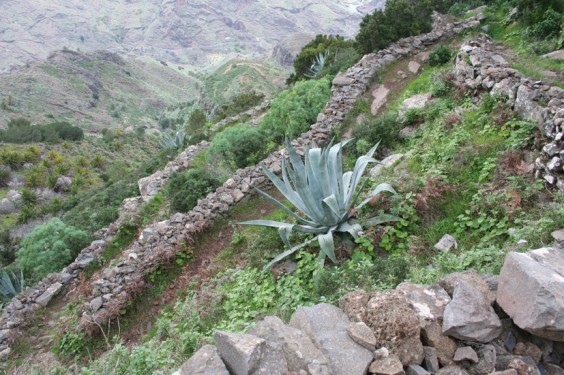
The landscape is volcanic, but rather than being barren the slopes are covered with arid-loving plants on most of the island. Euphorbias grow in profusion along with Agave – these get very big and the ones we saw had impressive flower stalks left over from the last season.
The predominant trees on the lower slopes were palm trees, but around the main peak of Garajonay is a unique rainforest habitat and I have to say I was smitten at first sight.
This high central area of the island is usually covered in mist even on the hottest days, giving a microclimate in this one area of permanent moisture. In fact, on the day we walked through, the forest was dry, but this was unusual and we were told that the trees drip with of water most of the time.
Laurisilva or Laurisillva is the name given to this specific type of laurel forest. The trees are instantly recognisable as laurel from the evergreen leaves, although the species growing here had a finer leaf than our garden varieties.
Many of these laurel hardwoods can grow up to 40 metres, but in the poor soils of the laurel forest they grow in contorted, twisted shapes that give the whole forest a mystical quality.
Added to this, the trees are covered with the most beautiful lichen, hanging down like a lace curtain. The lichen, like the trees, must be very old and indicates very clean air quality.
These indigenous forests only in exist in the Mediterranean area – another example is in Madeira. The one on La Gomera is a unique example for this landscape.
These sub-tropical rainforests were thought to exist over the whole of the Mediterranean millions of years ago, and were reduced during the ice age.
Further exploitation occurred as trees were cut down for hardwood and these forests are now protected as world heritage sites to ensure no more deforestation occurs.
Although my Spanish didn’t improve much in the time we were there, I wouldn’t have missed the privilege of walking in such a stunning landscape, especially in good weather during January.
I find most woodland inspiring and this one really felt as if you were walking through a living fossil; it was utterly beautiful.
An experience like this encourages me to source any wood I buy ethically, particularly hardwoods, so I can do my bit in helping to preserve unique habitats like this one.
It may also mean I have a tendency towards designing rainforests for my next few clients!
