
Ian and Rachel Hayes track down more details of a fascinating old Alvechurch industrial site.
Way back in February 1999, in the early days of The Village, we published a few notes on the long-gone Alvechurch Rectory Mill which once stood in Old Rectory Lane.
We described how it started off as a corn mill, powered by the River Arrow and probably dated from the 13th century. In 1851 it had been converted into a needle scouring and pointing mill by the Chambers family. It had 28 scouring runners making it comparable in size to Forge Mill at Redditch.
A series of tenants, including Shrimpton and son, occupied the mill until 1896 when it was sold to Jarrett and Rainsford, later famous for Lady Jayne hair grips. The premises were finally sold in 1912 to Dunkleys, also known as the Alvechurch Light Car Co.
The mill eventually burned down and, apart from the mill stream systems, survives only as a series of grassy humps on the Old Rectory Lawn.
Since 1999 more information has come to light. In the early 19th century the miller was one Abraham Hopkins, but by 1842 he had been replaced by Thomas Averne.
The Averne family worked Edgbaston Mill, near the Cricket Ground, from 1873 onwards but that mill suffered from chronic water shortage so that when Rectory Mill became vacant the Avernes moved to Alvechurch. Thomas held the mill until it was taken over by the Chambers family and converted for needle production.
Of the various tenants, the most unsatisfactory appear to have been the Shrimptons, who were called upon to repair the roofs and windows and clear rubbish from the interior. The Shrimptons refused to maintain the stream system but, in spite of this, after their departure in 1896 the overshot water wheel was still capable of producing 12hp.
While the premises were sold to Jarrett and Rainsford, who produced pins and hair grips, part of the mill was rented to one Henri Guillaume, a Belgian racing cyclist who settled in Alvechurch and who, with his assistant Gules Gobiet, used the scouring machinery for producing bicycle wheel spokes. The finished machines were known as Varsity cycles.
By 1901 Guillaume had moved to Unicorn Hill, Redditch, and by 1910 he had set up a small factory in Clive Road, Redditch, making fishing tackle. In 1917 he moved to Alcester, establishing a needle works which was finally closed and demolished in 1989.
Henri himself died in 1954. Gules, meanwhile, had been “head-hunted” by Albert Eadie and was instrumental in producing the very first Enfield motor cycle. A contemporary picture of Msr Gobiet suggests that he looked not unlike the Suchet version of Hercule Poirot, but in overalls. He is believed eventually to have returned to Belgium.
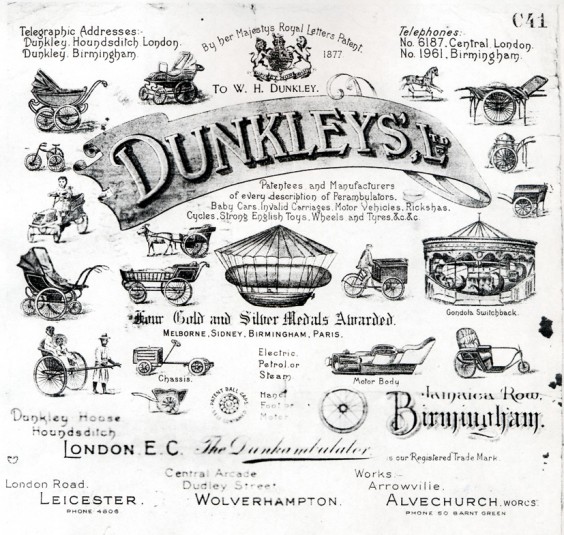
The sojourn of Dunkleys at Rectory Mill lasted only about a year. With the mill renamed Arrowville Works, the firm appears to have been an autonomous branch of the main factory in Birmingham as, when Arrowville went into liquidation in 1913, the main factory continued to trade for at least another ten years.
While the main production at Alvechurch was prams, the letterhead shows that various other contrivances were produced.
It would be interesting to surmise what would have happened had the Alvechurch works survived, as Dunkleys in Birmingham went on to produce some outlandish machines including a motorised pram powered by a 750cc engine.
The sight of one of these charging up Bear Hill would have been a little intimidating, especially as they were reported to have been very difficult to control.
The long history of Parsonage or Rectory Mill came to an end in 1913. Old needle mills are filled with incendiary rubbish and metal fillings and were notorious fire risks: Rectory Mill was no exception.
