
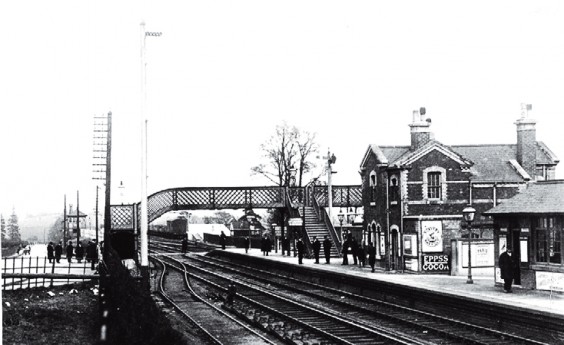
Barnt Green arrived 50 years after its railway station . . .
This article by Margaret Mabey, the well-known local historian who died two years ago, was first published by The Village in 1998.
Most people think, if they happen to think about it at all, that Barnt Green is just a railway village and that it only came into existence when and because the railway arrived.
Well this is true, but only to an extent.
It is true that if the Gloucester to Birmingham railway had taken a different route in 1840 (and it nearly did because of fears that the Lickey incline was too steep to be practicable) then there would probably never have been a Barnt Green village.
But the railway station called Barnt Green sat peacefully among fields for nearly half a century before any houses were added to the landscape.
We know from the diary of William Partridge, the Alvechurch schoolmaster, that Barnt Green station opened in April 1844, a welcome amenity for Alvechurch folk.
But it was much more important to Redditch, a booming industrial town in urgent need of an up-to-date method of sending its needles out into the world.
Within a few weeks there was a horse-bus running from the Unicorn Inn to Barnt Green station and wagonloads of needle-bales were trundling along the lanes.
But 15 years later Redditch got its own branch-line and station and although it was now a junction with a stationmaster in a top hat, Barnt Green station continued to be surrounded only by fields, a few farms and Barnt Green House which was occupied by the land-agent of the Windsor estates.
The Windsors (not related to the Royal Family) lived at Hewell Grange, Tardebigge, and owned much of the land in the area including most of Redditch and the Lickey Hills.
They had asked for Barnt Green station to be made and probably used it themselves but they had no plans at the time to develop the land surrounding it.
By 1884, however, young Lord Windsor did have a coffee-house and Temperance Hotel built at the end of the sandy lane which would one day become Hewell Road. It was presumably meant for any carriage-folk who wished to “put up their horses” while they took a train trip to Birmingham.
The Windsors were much more concerned with the dangers of drink and it was some years before it was licensed for anything stronger than coffee (and about 70 years before it got a seven-day licence).
The Victoria Hotel (now generally known as The Vic) must have looked strangely out of place standing imposingly at the corner of Primrose Lane (now Sandhills Lane) and Hewell Road neither of which had any buildings in them at all.
Sometimes it did have distinguished customers. I have a bill to Lord Windsor for 10 lunches at one shilling and sixpence (about 7p). These are believed to have been eaten by a shooting party his Lordship had taken into the Lickeys for a morning’s sport.
But the Vic’s splendid isolation was soon to be ended. In 1889 the Windsor Building Estate issues a handsome sale catalogue offering for sale plots of land on the slopes of the Lickeys above Barnt Green station for the building of superior residences.
Lord Windsor’s land-agents were hoping that prosperous Birmingham citizens might be pleased to rear their families in the “fine and bracing” air of these wooded hillsides while they themselves commuted daily on the train (“17 to 20 minutes journey””) from the station which had been waiting all these years for them.
It was of course the train-service that made the scheme practicable. The Calthorpe Estate had provided the genteel development suitable for a pre-railway age and was now being encroached upon by Birmingham’s less agreeable growths. Now it was possible to escape even further from the city’s grime.
The sale catalogue makes it quite clear that this was to be high-class residential development. The houses had to be of good quality – minimum values were laid down and there must not have been more than one lodge for an employee (such as a coachman).
The owners were also forbidden to “set up any public-house, beer-house, tea-garden or public strawberry-garden or any place of amusement”. Surely they would not be likely to do any such things?
Well, no: but parts of the Lickey Hills had already been given to the people of Birmingham and they would have been delighted with such amenities. They would, however, have to do without them.
Lord Windsor’s agents did realise that these prosperous new households would need gardeners, grooms, washer-women and so on, living within easy reach, so down below the railway in what is now Hewell Road, some small plots of land “suitable for cottages” were also offered for sale.
So great was the demand for these that by 1900 there were terraced houses along both sides of the road, whose occupants were nearly all dependent in some way on the big houses on the hillside of which there was now a sizeable colony.
These humble terraces were the beginnings of Barnt Green village. They would never have been built if the “up the hill” dwellers had not needed the services of their inhabitants, some of whom were soon shopkeepers.
It looked at the time as if Barnt Green village was going to stop there – just an unpaved road lined with terrace houses, existing only for the convenience of the gentry on the right side of the tracks . . .
