
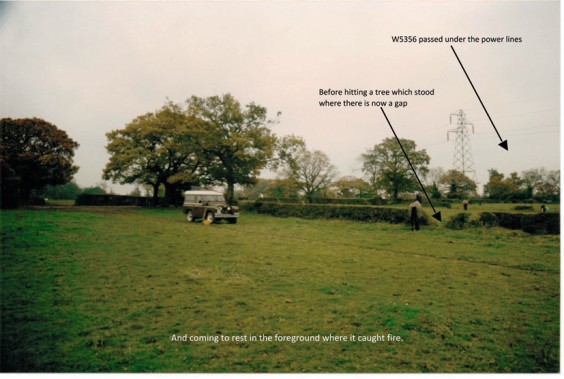
Following his report last year on the Blenheim bomber crash in Cofton Hackett, Delwyn Griffith of the Midland Aircraft Recovery Group describes another wartime accident, this time in Wythall.
The Battle of the Atlantic was the longest campaign of the Second World War, beginning with the fall of France in June 1940 when the German Navy gained control of French ports and only ending with the surrender of Germany itself.
It is usually associated with the campaign against U-boats – we saw in last July/August’s issue of The Village how Blenheim T1892 was lost during a raid on the U-boat pens at Lorient in March 1941 – but surface raiders also posed an enormous threat.
By the beginning of 1942, the U-boat menace was reaching its peak, but the German surface fleet had been driven to take shelter in various ports. The battlecruisers Scharnhorst and Gneisenau were hiding in the port of Brest and the RAF made every effort to ensure they stayed there.
While Brest took the brunt of Allied attacks, all the other French ports received the attention of Bomber and Coastal Commands.
During January 1942 alone, Bomber Command despatched 838 individual sorties against the French ports; from these 23 aircraft were lost with 68 men killed, 18 injured and ten made prisoners of war. This is how one of those sorties ended.
The primary target for January 9 was again Brest, with 151 aircraft despatched there, while in a smaller raid, 31 aircraft attacked Cherbourg; amongst these was Wellington II W5356 of No.12 Squadron.
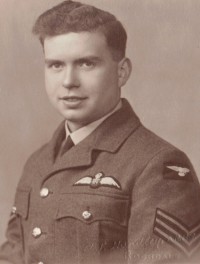
W5356 had left its base at Binbrook, Lincolnshire at 04.38 hrs, piloted by Sgt D Butterworth (picutred below). With him were Sgt H B Cable, co-pilot; P/O A N Breck, W.Op/AG; P/O W H Burnham, navigator; Sgt C E Morrey, W.Op/AG; and Sgt B Franklin, gunner.
Two days prior to this, Butterworth’s best friend on 12 Squadron, a Canadian, Sgt W G Yorke, had been posted missing from ops on Brest. His aircraft was shot down in flames into the sea.
It seems likely that, over the target, W5356 was hit by enemy fire causing damage and casualties. The exit route from Cherbourg was due north, bringing aircraft quickly away from German defences and taking them up the ‘spine’ of England toward the Midlands before turning east to their home bases.
Sited immediately to the south of Birmingham was No.6 Barrage Balloon Command Centre at Wythall. It was equipped with radio and acted as a primitive air-traffic control centre for the area.
It may be because of this that W5356 homed in on the Centre for, at 09.00 hrs, it appeared overhead with its port engine stopped. The Balloon Centre had no runways and the Wellington was forced to fly over and attempt a landing straight ahead.
At Highfield Farm in Wythall, ten-year-old John Nash was getting ready for school when the sound of a low-flying aircraft made him run outside.
He was just in time to see a Wellington bomber, with its left wing low, fly across Clewshaw Lane (which runs just to the north of what is now Kings Norton Golf Club) and pass underneath the power lines that run east to west a few hundred yards to the north of the lane.
Almost immediately, the port wing struck a large oak tree which caused the aircraft to swing round and crash to the ground facing back the way it had come. The aircraft’s back broke and it burst into flames.
Two men staggered from the wreck and, with the aid of an off-duty airman who had been cycling down Clewshaw Lane, managed to drag their four colleagues clear.
Help was soon on hand from the Balloon Centre three-quarters of a mile away and all the crew were taken to the Station Sick Quarters.
Two of the men were pronounced dead on arrival and a third died at the SSQ. P/O Burnham was grievously ill and was transferred to Hollymoor Hospital at Rednal where he succumbed to his injuries on January 11.
Those who died were:
Pilot, Sgt Douglas Butterworth, from Rochdale, aged 20.
Wireless Operator/Air Gunner, Sgt C E Morrey, from Barnsley, aged 20.
Wireless Operator/Air Gunner, Sgt Brian Franklin, from Gloucester, aged 21.
Observer (navigator) P/O William Burnham, from Hawke’s Bay, New Zealand, aged 21.
The fire in the aircraft was limited to the centre section which was entirely burnt out, but the wreckage stayed where it had fallen for the next six weeks. During that time it was visited by numerous souvenir hunters, some of whom arrived on horseback!
This was despite the wreck being under 24-hour guard by a section of eight soldiers who took their duty in shifts four at a time. Those off duty shared their meals with the Nash family at the farmhouse on those cold winter nights, the soldiers providing the food for Mrs Nash to cook.
The Battle of The Atlantic went on. The following month Scharnhorst and Gneisenau escaped from Brest in the now infamous ‘Channel Dash’. The RAF continued the campaign but no more of its bombers would be lost on operational flights in North Worcestershire.
In October 1993, John Nash took me to the spot where the aircraft had crashed.
A scattering of small parts was picked up by the metal detector, the only identifiable ones being exploded cartridge cases, a piece of engine casing and a plate from a front turret ammunition box.
If any readers of The Village remember this incident or can add any information I should be glad to hear from them, particularly if they still have a souvenir or even, maybe, a photograph.
Delwyn Griffiths can be contacted via The Village magazine.
