
As HMP Hewell prepares to open the gardens of Hewell Grange in Tardebigge as part of the National Garden Scheme charity, we continue the story of our stately home.
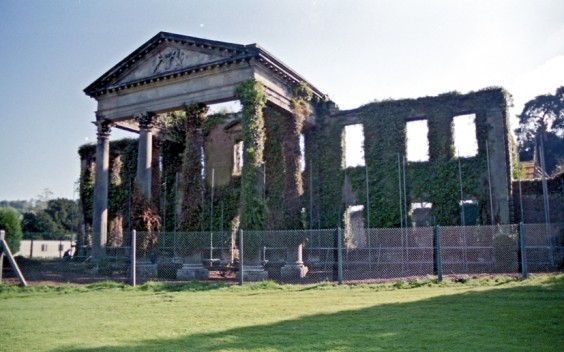
One of the most remarkable sights of the Hewell Grange estate is hidden away from the main building, down towards the lake (pictured above).
It rises out of the ground like a skeleton frame from a nuclear blast, but its scale and classical lines tell you as soon as you round the corner that this was the old hall, abandoned by Lord Windsor when he decided to build the Grange.
It was built by the second Earl of Plymouth in about 1712, although the most stunning feature to remain is the Corinthian portico, added about 100 years later and reputedly brought to Hewell from Cofton Hall, Cofton Hackett.
It might have survived, but when Lord Windsor surveyed it, he discovered it in such a poor state of repair that “the estimates for this work were so large all idea of restoring the old house were abandoned”.
He turned his attention to the grand, new property on slightly higher ground, but there is still a wealth of history down by the lake.
The old hall was built around a courtyard in the Queen Anne style, but the second earl was only to enjoy a few years in this magnificent house before his death in 1725.
The third Earl of Plymouth was to die aged 25 in 1732, with his son becoming the fourth earl at the age of 18 months.
Extensive improvements were carried out during his lifetime, with the suggestion that he was advised by Capability Brown on the landscaping.
It was the sixth earl who commissioned landscape designer Humphrey Repton and architect Thomas Cundy Snr who, between them, recommended and implemented the portico and the covering of the central courtyard of the house.
It was also at this time that the real tennis court was built during a revival of the game. It later became a gymnasium for the prisoners but at the time it had hot water heating and was thought to be “one of the finest private tennis courts in the kingdom”.
The tennis court building still stands intact, but the old hall is now an ivy-clad shambles, apart from the portico, with the Plymouth arms cut into its apex.
We’ll probably never know why it was unable to stand the years – with tales of fireworks accidents and subsidence caused by the lake – but it is thanks to its fallibility that we have the marvellous “new” Hewell Grange today.
The last great Victorian home
Hewell Grange is considered to be the last great Victorian country house – and there is unlikely to be anything like it built again.
The world changed quite suddenly in the aftermath of the First World War. As Lady Plymouth herself wrote: “Had we any idea how quickly the circumstances of life in this country . . . would change, I do not think we should have dreamt of building a house of that size.”
It was reported to have cost at least a quarter of a million pounds, yet 30 years after the first foundations were dug, the war had begun and life there was never to be the same.
The workshops built for the craftsmen working on Hewell Grange and given to the people of Tardebigge as a village hall around 1911 were used as a military hospital to treat more than 1,200 sick and wounded men. It is now the Tardebigge pub.
During the Second World War, the Grange and estate were used as an ammunition dump, with the house partly boarded up. Nissen huts were put up and many troops accommodated.
The Plymouth family had already moved to Oakly Park, near Ludlow, and death duties made the sale of Hewell Grange in 1946 inevitable.
The buyer was the Crown and so began Hewell’s long stint as an institution of penal reform, a move that has happily provided the workforce necessary to maintain such a grand house and estate.
The Windsors of Hewell
For 400 years they owned most of the land around here, having come reluctantly after Henry VIII conned Lord Windsor into giving him a very fine estate in Middlesex in return for the lands of Bordesley Abbey, recently seized by the king.
The Windsors are not in any way related to the Royal Family. A 17th century Lord Windsor was made Earl of Plymouth as reward for winning sea battles against the Spaniards when he was an admiral and governor of Jamaica.
When the 6th Earl, who is commemorated by the monument in the Lickeys (pictured), died in 1833, he left no son to inherit the earldom so it lapsed. His sister, Lady Harnet Windsor, inherited the estates and the Barony of Windsor.
She was married to a grandson of Clive of India, so from then on the family name has been Windsor Clive.
Their grandson inherited the lands and title and was the Lord Windsor who built Hewell Grange. In recognition of his many public services, the Earldom of Plymouth was revived for him in 1905. (The family never owned property in Plymouth).
The present Earl lives on the family’s remaining estate near Ludlow in Shropshire.
