
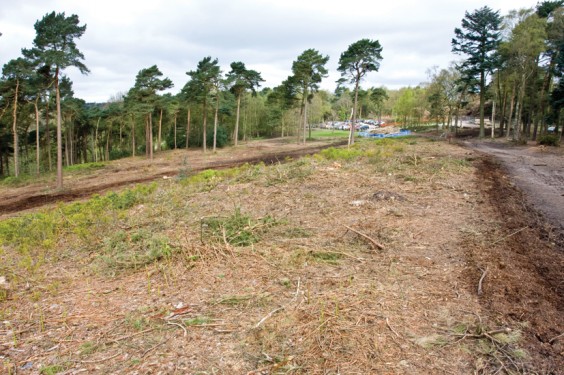
Concerned readers have been asking why so many trees have been cleared on the Lickey Hills. Head Ranger Steve Hinton explains that it is being done to preserve a very special habitat.
You may have noticed large-scale tree works being undertaken across the Lickey Hills. We do this for two very important reasons: not only are we trying to preserve and keep our heathlands, but we are also fighting the threat of a plant disease currently affecting our park.
Our heathlands at Lickey Hills are special and unique places, containing flora and fauna that are restricted to this habitat. Heathlands nationally are a threatened habitat; they have been undervalued for a long time as they had very little economic value.
If you think of the place names locally – Kings Heath, Druids Heath, Walkers Heath, West Heath – they show that much of our area would have been covered in heathland in the past.
The heathland at Lickey Hills is even more special due to our geographical position, as our heathlands more closely resemble the upland heaths of the Cairngorm Mountains than our nearest lowland heath located at Sutton Park.
The plant that makes our heathland special is bilberry. Bilberry is normally associated with rugged coast lines and upland environments rather than with our lowland position.
Sadly, our heathlands were planted up with coniferous trees more than 80 years ago as a cash timber crop. In the normal scope of forestry, this crop should have been harvested years ago and would have been if our primary focus hadn’t turned away from economic forestry to recreation and nature conservation.
The planting of trees on our heathland was done before anyone understood the fragility of this type of habitat and how little of it remains within the UK, and the habitat within the Lickey Hills has become fragmented and degraded by the planting of trees on it. Once-common species have disappeared or are now under threat.
We have been carrying out heathland restoration work for nearly 30 years across the hills. In the past these works have been on a smaller scale and less noticeable. Sadly, we have had to increase the scale of our works due to the new threat of Phytophthora ramorum.
There are lots of plant diseases out there that affect trees and plants in our parks and gardens; most of the time they live their lives unnoticed. Occasionally something will travel from further afield which has a dramatic impact on our natural environment.
Dutch elm disease had a pronounced impact on our landscape, as ash dieback will in years to come. These diseases and their consequences have been heavily publicised, but have you heard of Phytophthora ramorum?
Nationally, Phytophthora ramorum is having a major impact in our parks, forestry, woodlands and gardens, and it is having a dramatic impact locally too.
In 2011, Phytophthora ramorum was identified on the Lickey Hills by a routine survey from the Food and Environment Research Agency. It was initially identified in rhododendron and bilberry and later in larch and sweet chestnut.
A Statutory Plant Health notice was issued. Under the terms of this notice the park is required to manage the outbreak on our land.
To manage the outbreak, infected plants and plants of the same species nearby were treated with herbicide, cut down and burnt in situ. For the Lickeys this meant the removal and destruction of 362 mature larch trees, six acres of rhododendron, and about 100 square metres of bilberry.
The pathogen Phytophthora ramorum that causes so much destruction belongs to a group of organisms known as the oomycetes.
Until recently oomycetes were believed to be fungi as they have many characteristics, such as spores and hyphae, which are also shared by fungal species. However, they are actually more closely related to algae and are now in their own taxonomic group, Chromista.
Phytophthora ramorum can infect a whole host of species, although the species of concern are bilberry, rhododendron and Japanese larch, as it readily sporulates in these species.
There are more than 20 species of native Phytophthora that live alongside our plants which don’t cause massive problems. The potato famine was caused by a Phytophthora, Phytophthora infestans, which gives an indication of how devastating they can be.
We are continuing to work with the Food and Environment Research Agency, The Forestry Commission, Department of Environment, Food and Rural Affairs, and the Animal and Plant Health Authority to manage the outbreak.
This will mean the further removal of infected plants in some cases, and the opening up of more of the heathland, as Phytophthora doesn’t like bright, dry, windy conditions.
We will also close some paths through high infection areas, and alter where you can ride your bike and horse and where you are able to let your dog off the lead.
The current work we are carrying out has nearly finished on Rednal Hill, although we will have to go back in to remove some larger larch trees and remove some of the larger pieces of timber. We may have to carry out further work on Cofton Hill at a later date.
There will be further work undertaken in September and through next autumn and winter, especially across Bilberry Hill, which is suffering badly from the Phytophthora ramorum infection.
Additionally we will be carrying out some preventative work on our sweet chestnuts to reduce the risk of infection over the summer as well as trying to remove larch trees before they become infected.
We would ask that you help us and support our work in trying to stop the spread of this disease by observing any closures and by cleaning your shoes, wheels, and dogs’ paws so that this disease isn’t carried off site.
In order to reduce the impact of Phytophthora, there are big changes happening in how the hills look and are used.
Sadly, if we don’t take these actions, what makes the Lickey Hills such a unique place will be lost forever.
