
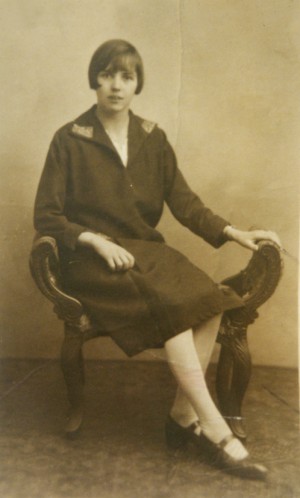
By popular demand, here is another extract from Norah May, the memoirs of a woman born in 1905 in Alvechurch – in this chapter, Norah has to face war, extreme poverty and even the odd ghost….
The war was the next event to bring yet another change to our lives. One day we had a visit from Granny Hartells, not the usual one that we looked forward to.
This time she brought Bert’s calling-up papers, which had gone to her address.
Mother took them straight into Redditch to Bert (who was working that day). He did not come home, but went immediately to the station to catch a train to take him to his unit. He left saying, “Don’t worry, it’ll all be over by Christmas.”
We never saw him again. Granny Hartells brought the news as she had his papers. Mother saw her coming and went to meet her; they met at the stream and I can see them now, sitting weeping, one on each bank, neither of them seeming to have the strength to cross to the other for comfort.
Mother sent me to tell Granny Finch in Alvechurch and I broke the news to her while she was washing, standing on a little stool so that she could reach the sink and scrub the clothes.
Back at Icknield Street, it was still a struggle for our mother to look after us. She had had a hard life ever since I was born. Granny Finch would give me a loaf of bread or some vegetables to take home sometimes after school, always well-received.
Our landlord was a Mr Andrews, a haulier from Birmingham, and he used to bring some of his horses down to pasture to give them a rest and a taste of fresh grass.
Mother kept an eye on them, giving them water when they needed it. He was a regular visitor, collecting his rent and seeing to the horses.
He came at night sometimes and our mother would say, ”He is absent minded! He forgot to pay me for looking after the horses,” and she would have a brown ten-bob note in her hand.
It was a long time after that I realised just what service she had done for him. I could never judge her, because I realised later that when it comes to feeding three hungry children, morals come a poor second.
That Christmas, with my nuts and oranges, Father Christmas brought me a beautiful doll’s bed. I thought I had never had anything so wonderful.
Life went on and I have memories of wandering the fields that surrounded the house, with never a thought of anything bad happening to me. Something you’d think twice about these days.
We had a little dog, it must have been a stray that adopted us, and we used to go looking for rabbits. I don’t remember ever catching any; if we did have rabbit it was probably brought by one of Mother’s visitors.
Many a Sunday, Freddie Brazier and Aunt Nance would come with Aunt Gert and bring some meat, Mother would produce some vegetables and we had a good Sunday dinner.
Afterwards Freddie would say, “Come on, young Nuk, we are going for a walk,” and leaving Aunt Nance and mother together, Freddie, Aunt Gert and me would set off.
It used to amaze me how soon they got tired and would have to lie down “for a rest”. I had to lie with them with my back right up against Aunt Gert’s back.
There used to be a bread man come along Icknield Street, and it was no mean feat to persuade someone like him to bring his cart along such a poor track. One day we saw him coming, and our mother said, “Don’t you leave me today.”
He came up to the door with his basket and chatted a while, saying several times to me, “Aren’t you going out to play?”
“No, not yet,” I replied every time. Eventually he went away. I reckon he was looking for something our mother wasn’t prepared to give him that day.
Christmas came round again, and Mother told me there was no money for presents that year; that she could just about manage something for the boys; that I was growing up and could understand.
“Never mind,” she said, “I can buy some apples and oranges and we’ll put them by your bed.”
“And I’ll put my doll’s bed there as well and pretend he’s brought it again.”
She raked some money up from somewhere and sent me off to Redditch for something for the boys’ stockings. I settled for two cheap clockwork engines; all the edges were sharp and the springs stuck out underneath with no sort of a guard at all. Everything just waiting to damage little fingers.
We put a new penny in the toe of each stocking, an apple, an orange and nuts in the leg, leaving the engines sticking out of the top.
Needless to say, I had eaten my apples and oranges before Christmas; the lads had woken early Christmas morning and by the time we got up there were apple cores, orange peel and nutshells all over the floor and the springs of the engines were broken into the bargain.
Money always seemed short, even though a brown ten-bob note would occasionally find its way into a jar in the cupboard. If our mother was out I used to look in the jar, because I used to think if she left the money she wouldn’t leave us. It was one of her visitors that I overheard saying one day:
“What! You don’t have anything? Write to Mr Hodges, you ought to have something for them little lads. You write to Mr Hodges.”
Mother must have taken him at his word because we did get an allowance and it was paid through Gaunts. I had to collect it every week and always I had to tell the boys’ birthdays before I got paid.
I was too young then to know what was meant by being “On the Parish”.
In some ways it was a bit of an eerie place to live, especially in the dark weather, perhaps it was because we were a bit isolated. I always had some sticks to start the fire with and make our mother a cup of tea, and one time I was just doing that when I heard footsteps outside.
They came up to the house and round the back, and I heard someone knocking the snow off his shoes and coming to the door.
I didn’t wait to see who it was, I shot upstairs to our mother. Nobody knocked, nobody came in and when we looked outside there was no sign that anyone had been there at all.
I’ll never know what it was, but I know what I heard!
There was another time when we had gone to bed and we heard a tap, and a bit later another. We looked out of the window: nobody! Another tap. Mother shouted,” Who’s there, what do you want?”
No answer, another tap. We watched and waited, but all we heard was a single tap at regular intervals. It was a long time before we traced it to the clock.
The only clock we had was a big old alarm which we took upstairs every night – as it worked, the winder turned, dropping down as it reached the top and tapping the back of the clock.
One night we were woken by a series of explosions. We stood together looking out of the window to see Zeppelins in the air; they were bombing the Austin.
It looked as if the bombs were thrown out by hand, as if some sort of a trap-door was opened and the bombs pushed out. We didn’t get much sleep that night, which we spent cuddled together in our mother’s bed.
It wasn’t long after that when I woke one night and called out, ”Mother, there’s something in my bed!”
“What is it?”
“I don’t know, but it feels like an elephant.”
“Come on in here then.”
I knew she thought I was still frightened of the Zeppelins, but when morning came we found the cat had had kittens in my bed.
Look out for more extracts in a future issue of The Village. . .
