
Local historians Ian and Rachel Hayes report on a strange sighting under Cofton Hall.
Cofton Hall is situated on the eastern slopes of the Lickey Hills. One of the best views can be had from the railway, a little to the north of Barnt Green station, where the hall appears as a three-storey 19th century house.
However, behind the main front is an impressive late mediaeval “hammer beam” hall, more or less all that is left after the Royalists set the old house on fire in May 1645 to prevent it falling into the hands of the Parliamentarians.
There has always been speculation about the cellar system at Cofton Hall, in that it extends way out beyond the present range of surface buildings, possibly giving some indication of the layout of the pre-1645 house. In addition there was reputed to be a stream flowing through the cellars, possibly for cooling purposes.
We were very pleased, therefore, when, in 2000, we were allowed permission to examine the cellars. These proved to be every bit as interesting as we had anticipated.
Broadly the system consists of more than 200ft of corridors and chambers, only about 40 per cent of which are under existing buildings. However, to us, the really interesting feature was the stream system. We had come across examples at Beoley, but the Cofton system was on a much larger scale.
From a source at the north end of the cellars, possibly a natural spring in the sandstone, the “streams”, generally one brick wide and one brick deep, flow round the edge of the three chambers feeding a cooling system under the remains of raised slabs.
Another stream approaches from near the main stairs and joins up with the former before being channelled under the floor to a sump at the south end. The total length of the water system, or as much as we could find, is about 160ft.
The sump appears to drain into a diverted brook, almost a moat, around the garden about 100 yards from the house.
As regards the alleged link to Barnt Green House (now the Barnt Green Inn) the door generally believed to lead to the passage in fact gives access to a set of steps leading up to the lawn. The nearest part of the system to Barnt Green is the Prayer Room, and here there is absolutely no evidence of a passage.
There appears to be some likelihood in that part, at least, of the cellar layout is mediaeval in origin, in which case the little watercourse system could be of some antiquity.
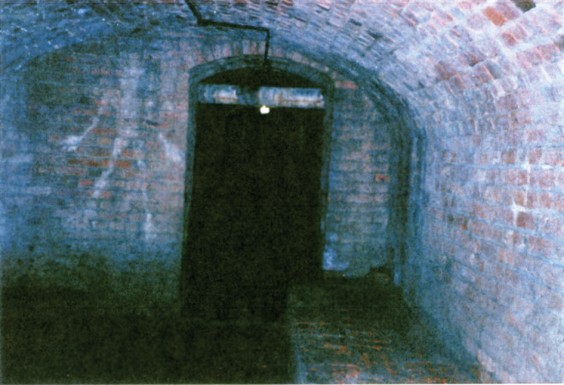
One final point. We were able to do a fairly comprehensive photo survey of the system, but only after the photographs were developed did we find that the north east corridor appeared to have a figure depicted on the wall. We did not notice it before we took the shot.
It is not salts in the brickwork but could be graffiti. It would be interesting to see if it is still there – but we are not sure we want to find out!
