
Edward Humphreys explains how shares can help you keep pace with or beat price rises.
What effect is inflation having on your savings?
Inflation is a growing peril that erodes the real spending power many of us have worked hard to accumulate through savings, pensions, ISAs and other investments. The real value of people’s wealth is under attack in a way rarely seen before, whether through higher food prices or higher energy costs.
Little help is afforded by the Coalition Government, who have now raised VAT to its highest standard rate of 20%! The rising cost of many goods is, in many instances, unavoidable as they affect the most basic and essential things.
As we began 2011, we were met with almost apocalyptic warnings of a world food price shock in 2011 by the United Nations. Whether you believe the CPI (Consumer Price Index) or the RPI (Retail Price Index), both are rising and worryingly so. For 40 of the last 49 measurement periods, inflation has exceeded the Bank of England’s target. So in the face of rising unemployment and wage freezes, what can be done about it?
To buy a traditionally ‘low risk’ investment such as a Government Bond (Gilt) will result in a redemption yield of about 3.5% or thereabouts over 10 years. Rates of return of National Savings Certificates, with shorter dated maturities are even less. What good are these returns if the annual cost of living is rising by 4.7% (RPI)?
Investors can buy what are known as ‘index-linked gilts’ which reference to the RPI. In inflation adjusted terms these investments are currently offering equivalent real returns of less than 1% and more worryingly, planned new index-linked certificate issues appear to have been pulled. Put simply, real returns of less than 1% are not going to see any of us retiring any day soon.
The reality is that the majority of us do not have the good fortune to have index-linked pensions and index-linked salaries. Even then, index-linked pensions in both the public and private sectors will now reference to the CPI rate, which over the last 20 years has been 0.55% a year less than the RPI.
Over 20 years, this could make over 11% difference to the value of someone’s pension fund and at the end of 30 years, over 17% difference.
Why are equities attractive as an insurance against inflation?
The attraction of equities is twofold. Firstly, many blue chip companies will pay attractive and rising dividends to shareholders.
Take the example of the well-known mobile telephone giant Vodafone. In the period 1992 to 2010, the Vodafone dividend increased approximately 11 times in value. Did your bank increase the interest they pay on your savings by that amount!? By comparison, the Retail Price Index showed an increase of only 67% in the period 1992 to 2010.
Secondly, the value of shares can increase in value, although the role of shares in planning your long-term security can be misunderstood. As of January 2011, the value of Vodafone’s shares are approximately 20% lower than where they were 10 years ago.
This is where the role of a professional wealth manager is vital in helping establish your tolerances and helping explain how professional investment expertise can help mitigate the risks. The risks are mitigated by creating a basket of investments.
Assuming an investor had put an equal amount of money into a basket of blue chip shares (shown in graph), the net return was +114.7% (dividends and capital growth), an average of slightly under 8% a year. By comparison, the rate of inflation was barely 3% per annum.
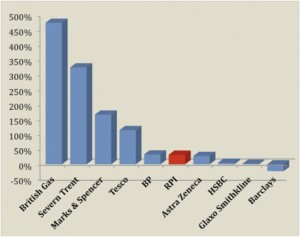
In order to show these investments have not been conveniently chosen, the FTSE 100 as a whole has returned +733% on a total return basis since the beginning of 1987, whilst the RPI rate of inflation rose by only +127%. Clearly, the role of equities should not be underestimated but are for the longer term.
Additional risks
The dividend income from shares cannot be guaranteed. Likewise, the value of a share can fall, sometimes sharply, and therefore would not be suitable for a short-term investor who is not prepared to consider a diversified basket of equity investments within a diversified portfolio of assets. Please speak with a professional financial planner to explore how you can face the challenge posed by inflation.
This article is market commentary and should not be deemed as advice on how to invest. Please contact AFH Wealth Management for further information.
Edward Humphreys is Head of Direct Asset Research at AFH Wealth Management in Bromsgrove. To arrange an appointment with an adviser, call 01527 577775 and ask to speak to a diary manager.
