HomeNewscrimeMurdered on duty

Murdered on duty

-

Police chief pays his respects at the spot where PC James Davies was killed in 1885.
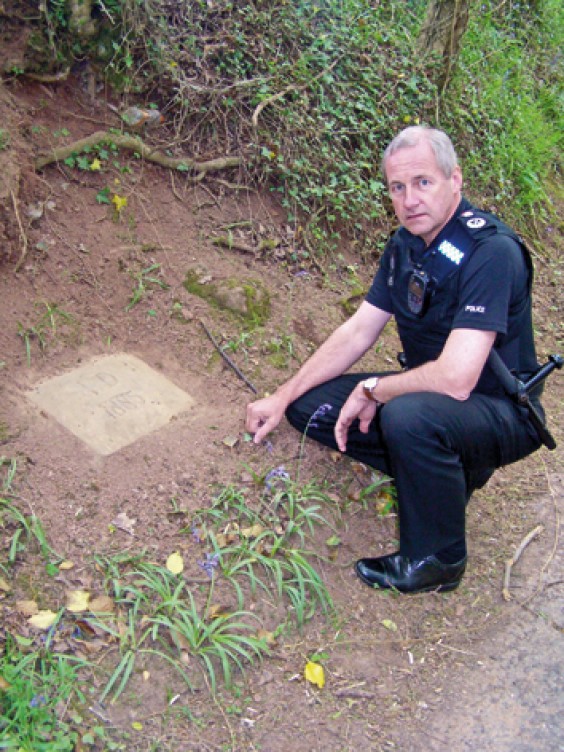
Chief Constable Paul West at the memorial to PC James Davies in Weatheroak<br />
” width=”564″ height=”752″ /></p>
<p>125 years since the murder of the only Worcestershire policeman to be killed on duty, the county’s top policeman paid a special visit to the roadside memorial in Weatheroak marking the spot where his body was found.</p>
<p>Paul West, Chief Constable of what is now called West Mercia Police, also visited the grave of the officer, PC James Davies, at St Leonard’s Church, Beoley, the village where PC Davies lived.</p>
<p>While there, the vicar, Canon David Rogers, showed him a framed dedication inside the building which includes a cap badge worn by the officer.</p>
<p>PC Davies, a member of the former Worcestershire Constabulary, was stabbed to death in Icknield Street in the early hours of February 28, 1885. </p>
<p>The body of the 33-year-old officer was found in the country lane, about a mile south of the Coach & Horses pub, later that morning by a farmer on his way to work in Weatheroak. </p>
<p>Moses Shrimpton, a well-known poacher who had previously served seven years for attacking another policeman, was subsequently arrested and sentenced to death. </p>
<p>The following May he became the last person to be hanged at Worcester Gaol. </p>
<p>Officers based at Wythall Police Station have helped to maintain the memorial stone, although it is also looked after by a member of the public whose identity is unknown. The same mystery person is thought to be responsible for leaving flowers at PC Davies’s grave.</p>
<p>The roadside stone was replaced by staff at Redditch Police Station around 20 years ago after it was vandalised and police at Wythall Police Station continue to keep the policeman’s memory alive by ensuring new recruits are taken to the memorial and made aware of its history. </p>
<p>The Chief Constable’s visit was made after he received a letter from a former Worcestershire Constabulary officer about the 125th anniversary year of PC Davies’s death. The officer, now living in Suffolk, had been stationed at Bromsgrove during the 1960s and had recently made a trip to the memorial while staying in the area.  </p>
<p>After visiting PC Davies’ grave and the memorial stone Mr West said: “West Mercia Police and its constituent forces have a lot of history that we are very proud of and keen to retain.</p>
<p>“It’s touching to see that although PC Davies died 125 years ago local people are clearly still aware of the story and take care and pride in maintaining his memory.” </p>
<p>Mr West added: “He paid the ultimate price while serving his community and even though it was a long time ago it is a sobering reminder of the risks still faced by police officers today.”</p>
<p><strong>Is there a twist in the tale? Graham Mellor revisits a theory that questions the accepted facts . . .</strong></p>
<p>The story of what happened in the early hours of February 28 1885 in the parish of Alvechurch is widely accepted. After all, a 65-year-old man swung from the gallows at Worcester for the crime of murdering PC James Davies. But could there be a twist in the tale?</p>
<p>This stretch of road is steeped in history stretching back 2,000 years to when the Roman army was pushing north during its conquest of Britain and built a road from Alcester to their fort at Metchley – now the site of Birmingham University – and on up to join Watling Street at Wall.</p>
<p>The section from Beoley through Weatheroak and up to the Peacock pub at Forhill is called Icknield Street. </p>
<p>If you travel south along it from the Coach & Horses crossroads, you will pass the entrance to Alcott Farm on the right after about one third of a mile. About the same distance further on, the road rises up sharply before dipping down under the motorway.</p>
<p>On the left hand side just as the road begins to rise you will find, cemented into the bank, a tablet of stone with the inscription: “JD 1885”.</p>
<p>This stone marks the spot where the slashed and bloodied body of PC James Davies was found on a cold February morning of that year. PC Davies remains the only Worcestershire policeman to be murdered in the course of duty. </p>
<p>The 33-year-old constable, who lived with his wife and four small children in Beoley, was last seen alive at 2.15 on the morning of February 28 when he and PC Whitehouse, of Wythall, made their routine contact on their beats.</p>
<p>According to the accepted version of events, they compared their watches, as they always did, and as they parted PC Whitehouse said: “Take care of yourself, chappie, I shall see you tomorrow night.”</p>
<p>At 8.30am John Twigg, of Rowney Green, on his way to work at a Weatheroak Hill Farm, found PC Davies lying face down in a pool of blood, foully murdered, and with many terrible knife wounds.</p>
<p>Twigg notified the police and in the afternoon the body was taken to a wheelwright’s shed nearby to await the inquest. Supt Jeffrey, of Bromsgrove, notified all local police stations of the murder and the investigation was underway.</p>
<p>When PC Davies left PC Whitehouse he was making for Seecham Farm, his 4am checkpoint with PC Shepherd of Alvechurch. But PC Shepherd was at home ill, so Davies was not missed as early as normally he would have been.</p>
<p>During the night a chicken house in a farm nearby had been broken into and six birds stolen. PC Davies, it was assumed, had come upon the thief as he made his way to Redditch police station.</p>
<p>No one can ever be sure exactly what happened, but because PC Davies’ handcuffs were still in his pocket it was believed the thief had gone quietly for the 200 yards from where the policeman’s whistle was later found before turning on him with a knife. Another possibility is that the thief was disturbed by PC Davies, tried to run away but was caught after 200 yards.</p>
<p>Whatever happened, PC Davies’ hands were cut terribly as he defended himself, before finally succumbing to a gash across the throat. No cries were heard at Newbold’s Farm, the nearest dwelling, although the dog had barked furiously between 3.30-4am.</p>
<p>Among the police notified of the crime, Supt Tyler, of King’s Heath, at once suspected a notorious poacher, Moses Shrimpton, the terror of East Worcestershire despite his 65 years, who had already committed a brutal assault on a gamekeeper and served seven years’ penal servitude for attacking a policeman.</p>
<p>Recently released from jail, Shrimpton was living with a woman named Mary Morton at 9 Bartholemew Street, Birmingham, and there, on Saturday night, Supt Tyler found him in bed with cuts on his face and asked him: “Moses, how did you get those scars on your forehead?”</p>
<p>“I got them a week ago, falling down drunk in Ludgate Hill,” was Shrimpton’s reply.</p>
<p>His woman friend was ordered to dress, each garment being searched beforehand, and in her skirt pocket was found a large knife with two blades, sharply pointed.</p>
<p>It had been newly washed and cleaned in earth, but it still bore traces of blood, as did Shrimpton’s clothing. Inquiries proved him to have been out all the previous night.</p>
<p>Shrimpton and Morton were taken to Moor Street police station, where he was charged on suspicion of murdering PC Davies and she as an accessory after the fact. Shrimpton was then taken to King’s Heath police station and Morton to Balsall Heath police station, which in those days were both in Worcestershire.</p>
<p>The pair came up before the magistrates at King’s Heath, and were ultimately committed for trial at Worcester Assizes. Meanwhile, PC Davies had been buried – on Thursday March 5 – in Beoley churchyard, on a hillside overlooking the countryside he had tramped on his beat.</p>
<p>The <em>Birmingham Daily Post</em> reported: “The funeral was made the occasion of a demonstration highly creditable to the force to which the deceased belonged and the semi-military pomp with which the obsequies were conducted was not unbecoming in the case of a man who fell while bravely doing his duty.”</p>
<p>Birmingham Police Band led the cortege from the wheelwright’s shop at Beoley to the church three-quarters of a mile away. Eighty members of Worcestershire Constabulary and many from Birmingham were in the sad procession. Crowds flocked in from far afield, many brewers’ drays having been chartered by parties.</p>
<p>Shrimpton and Morton were tried before Baron Huddleston at Worcester Assizes on May 6 and 7, his lordship grumbling that his sleep in Worcester had been disturbed by the crowing of a bantam cock.</p>
<p>Mary Morton was acquitted and discharged, but the case against Shrimpton was said to be incontrovertible.</p>
<p>His boots corresponded with footprints beside PC Davies’ body; the policeman’s watch was traced to him; George Parsons, a carter, of Summer Lane, Birmingham, deposed that Shrimpton told him on February 27: “I’m going round Beoley tonight.”</p>
<p>John Whitehouse, of Hay Mills, licensee of the White Lion, Portway, from 1829 to 1833, gave evidence that Shrimpton, a frequent customer there, once said as PC Davies passed: “There goes that ***** teetotal ******. If ever I was to meet him I’d be a match for him.”</p>
<p>Shrimpton stoutly protested his innocence – but he was sentenced to death, and hanged at Worcester Jail on Whit Monday, May 25. The last execution at Worcester before this one had been years before; there have not been any since. A story goes that a confession was found in Shrimpton’s snuffbox.</p>
<p>PC Davies’ widow was granted the maximum gratuity allowed by law – £60 18s 8d –but the public were more generous and subscribed £1,408 1s 8d to a fund for the murdered constable’s dependents.</p>
<p>And that is the story of a brave policeman dying in the course of duty. He has not been forgotten; in the 1970s the police force replaced the original, vandalised stone tablet on Icknield Street and renovated his gravestone. To this day, volunteers still put flowers by his grave. </p>
<p>Moses Shrimpton’s name, meanwhile, has been vilified. But was he the murderer?</p>
<p>Although 125 years old, this case is one which still provokes a great deal of interest. One of those who is not entirely convinced by the accepted version is Mrs Val Lewis, founder of Wythall History Society, although she now lives in Studley.</p>
<p>What baffles Mrs Lewis is how a man of 65, only recently released from jail and who had suffered many years in the penal system, should be able to take on and kill a policeman who was only half his age.</p>
<p>“I think he was there,” she says, “but did he have somebody else with him?”</p>
<p>Mrs Lewis sketched out this theory to me more than 15 years ago, while she was thinking about writing a book on the mystery.  </p>
<p>Shrimpton’s accomplice, she believed, could have leapt from the side of the road to kill PC Davies. </p>
<p>This could have been the case whether Shrimpton was running away or going quietly with the arresting officer – although some say it would have been very unlikely for a PC not to have handcuffed someone known to have attacked a policeman before.</p>
<p>So who might have been the real killer? And why might Moses Shrimpton have taken the blame for someone else, even sacrificing his own life? He said he was innocent, right to his end; there was, unusually, no gallows confession on the threshold of his meeting with God.</p>
<p>“He just got up there and was hanged,” said Mrs Lewis, who thinks the reason he might have taken the blame would have been to protect somebody close to him.</p>
<p>But was there such a person? Well, Mrs Lewis told me, he had a son, George, who had previously been caught poaching. . .</p>
<p>Mrs Lewis has still not found the time to write the book, but when I spoke to her last month she said her investigations over the years had continued to convince her that the accepted story just did not make sense.</p>
<p>Her most startling discovery was when a descendent of Moses Shrimpton came to see her with a family tree and the family photograph collection.</p>
<p>“When I saw the picture of Moses, he was such a small and very frail man. How could he have overpowered a young policeman?”</p>
<p>We will never know, but the fact of the murder of a brave police officer remains and his memory lives on strongly 125 years later.</p>
</div></div><div class=