
ADVERTISEMENT FEATURE
Get your thinking cap on to tackle tax changes, writes Terry Reed.
In his pre-budget speech, the Chancellor, Alistair Darling, announced radical alterations to the Capital Gains Tax (CGT) rules, which means that the tax treatment of investment assets sold before and after April 5 2008 will be significantly different (unless he changes his mind, of course!).
If you have investments, will you be a winner or a loser?
Firstly, for most people “investments” for CGT purposes include shares, unit trusts and, significantly for many people, buy-to-let or other investment properties.
Tax is due on the difference between the price paid and the price sold, except that at the moment some allowance is made for the effects of inflation.
Assets bought before April 1998 are indexed to that date using appropriate inflation factors from a table, so such increases are not taxed.
After April 1998 “Taper Relief” was introduced. This allowed the gain in an asset held to be “wound down” by 5 per cent per annum after a two-year initial period.
The maximum discount is 40 per cent, so only 60 per cent of the profit would be taxed if held for long enough.
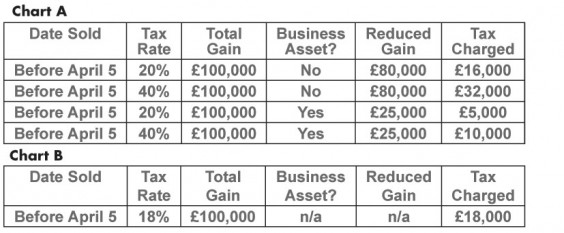
Business Assets (eg private company shares or AIM shares) attract a higher level of relief, so that only 25 per cent of the gain is taxed if the asset is held more than two full years.
As an example, non-business assets held for eight years with an overall profit of £100,000 would be taxed on a notional gain of £60,000 whereas business assets would be taxed on just £25,000. These important inflation factors will go from April 5.
To sweeten the pill, the Chancellor has introduced a new flat tax rate of 18 per cent across the board, which might seem to be better for some taxpayers. We are currently charged at 10 per cent, 20 per cent or 40 per cent, depending on other income.
Chart A (below) gives some examples of the winners and losers. After April 5 there will be no differentiation – the charge is the same for all (see Chart B).
These are only examples and you should carefully explore your own circumstances.
Of course, even if you may want to sell a property before April 5 you may not be able to find a buyer, but the message is clear – if you want to dispose of an asset do your sums now.
Terry Reed is Technical Director at AFH Independent Financial Services in Bromsgrove. Tel: 01527 577775.
