
Alvechurch resident and Folly Fellowship trustee Elizabeth Waters explains how buildings bring people together.
After the BBC programme series Restoration started a few years ago a lot more people became aware of follies. We have a few of these “buildings” in our area, but what are they?
Well, it depends upon who you ask; we all have our own ways of describing them and of course we all say our definition is right.
International charity the Folly Fellowship resists attempts to define the term, but relents sufficiently to allow that if you believe it to be folly then folly it is.
Apart from our thrice-yearly magazine we also produce a yearly, more academic journal as well as organising trips around the country and some times abroad.
Our annual garden party, this year is to be held at Wentworth Castle, Yorkshire – yes, as featured on Restoration.
The restoration work is under way and so we shall be wearing our hard hats and seeing what has been done this year when we visit in July.
Before that a small group of us are going over to Holland to see what delights are to the north of Amsterdam.
Later in the year I shall be taking members to see the gardens of Kyre Park, Tenbury Wells, Worcestershire, and if you would like to come on this trip or would like to join our merry band – as our Chairman keeps reminding us, “Fellowship” is our second name – then do drop me a line care of The Village at the usual address or email me at .(JavaScript must be enabled to view this email address)
In the following article, which first appeared in the spring 2005 issue of The International Magazine for Follies, Grottoes & Garden Buildings, Derrick Green looks at two follies in the Lickeys.
The Lickey toposcope folly is situated on Beacon Hill in Monument Lane. It was built after the Cadbury family donated the hill to the City of Birmingham in 1923 and was rebuilt and increased in size in 1987-8 to give the overall look of a castle.
A toposcope is usually a round plate showing directions and distance to places that, on a clear day, may be seen. Beacon Hill is 297 metres above sea level – 13 old counties can be seen from here.
There are two plinths on the folly to take two toposcopes but only one has a plate mounted on it, due to problems with vandals. The original brass plate was prised off and was replaced with a plastic one that was damaged by fireworks.
The third one is made of stainless steel and is still in position at the time of writing.
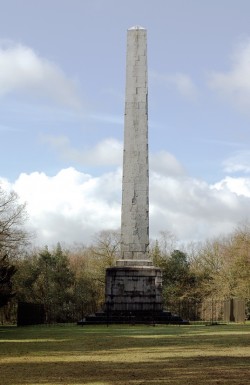
Also in Monument Lane is an obelisk that had its first stone laid in May 1834 and was built in commemoration of the 6th Earl of Plymouth, who owned most of the Lickey Hills in the nineteenth century. He lived at Hewell Grange, Tardebigge.
The obelisk (pictured) was built from the same Anglesey marble as Birmingham Town Hall and at the same time, allegedly with the marble that was left over.
The centre of the obelisk is hollow and occasionally a stonemason has to be lowered down the centre on a bosun’s chair to inspect for cracks, but doesn’t linger too long due to the nest of cockroaches at the bottom!
The pyramid lead cap has recently been replaced after being dislodged by high winds.
