
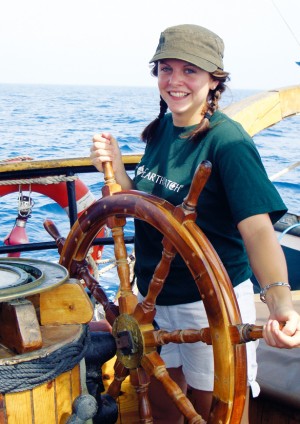
20-year-old Katie Adams, from Cofton Hackett, is just back from a very special expedition.
In March I was introduced to the idea of an Earthwatch expedition via an e-mail from Newman College of Higher Education, where I am studying to become a primary school teacher.
Like many people I had spoken to, I had not heard about Earthwatch and the work that they do.
Earthwatch engages people worldwide in scientific research and education to promote the understanding and action necessary for a sustainable environment. It is a registered charity committed to conserving the diversity and integrity of life on Earth for current and future generations.
There are more than 280 Earthwatch scientists working tirelessly to protect the world’s richest biological and cultural heritage. Volunteers – people with vision, commitment and enthusiasm – are critical to the success of Earthwatch.
The daily demands of our lives keep us from really living; seeing the sights we long to see and experiencing a diversity of cultures and environments.
Earthwatch expeditions offer the chance to explore parts of the world you might not otherwise see, amaze yourself by the things that you can do and get your hands dirty in the name of making the world a better place.
I chose to go on the Spanish Dolphins Expedition in Almeria. The trip focuses on the common dolphins in the Alboran Sea, which are not as common as they once were.
Over the past few decades these wonderful mammals have experienced a dramatic decline. Protecting critical habitat, such as the nutrient-rich waters off the beautiful southern coast of Spain, could mean the difference between their survival and extinction.
Biologists Ana Canadas and Ricardo Sagarminaga van Bruiten were chosen by the European Commission and Spanish agencies to create management and monitoring schemes for protected areas in the Alboran Sea, after four years of Earthwatch research.
I spent my time in Spain aboard the Toftevaag, a beautiful 1910 Norwegian vessel built for fishing herring in the North Atlantic. Modern research equipment has been integrated into the ship, offering you a trip back in time.
Every hour, following the rhythm of the ship’s bell, each volunteer would change watch, discovering all aspects of the research project.
The hourly jobs included steering the ship, looking out for cetaceans, listening on the hydrophone for dolphin whistles, analysing the sea every 20 minutes for salt, oxygen and chlorophyll, checking the fish finder and echo-sounder, filling in notes, entering data into the computer and plotting positions on the chart.
We were in the company of common, striped and bottle-nosed dolphins as well as fin whales and pilot whales most days. The dolphins were very playful and loved to bow-ride the ship, especially the common dolphins. They were intrigued by our presence and we gained good photo identification of the individuals.
I enjoyed every aspect of my expedition and met some fantastic people from all over the world. I am planning to do a different Earthwatch expedition next year. A huge thank you to my parents, family and friends for their support and help in fundraising.
I received sponsorship from Barclay’s Bank, who matched pond for pound the money from my fundraising party and gave a donation of £750.
Thanks also to LA Fitness, Barnt Green Inn, BRMB, Sainsbury’s and Morrison’s for the raffle prizes they donated, and to Newman College’s principal and staff for support.
