
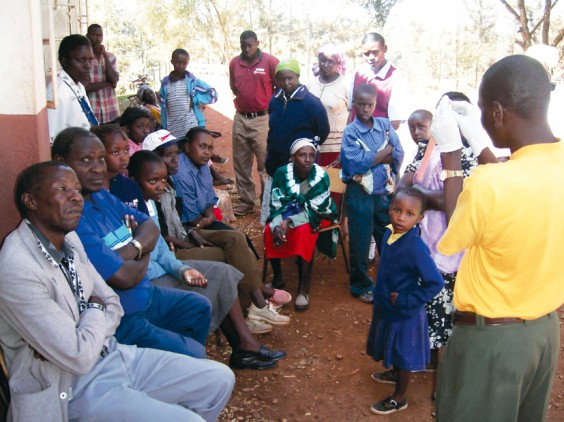
Jan Denning explains why she and dentist husband Pat devote their time to helping people in rural Kenya – and urges Village readers to support a Rowney Green event raising funds for African children orphaned by AIDS.
“Why are you going back to Kenya?” our friends and family ask. Well, Rotary Volunteer dentistry at a small African mission hospital has lots of attractions – it’s a great way to escape an English winter and get out of our family’s hair!
Over the past five years, my husband Pat and I have spent time in dental clinics overseas helping the local people to receive much-needed dental care that is usually not available or affordable to them.
Each year, we complete two volunteer stints in northern India or Kenya.
We work under the auspices of Rotary International and there are dozens of programmes desperate for volunteers for health-related projects, building, teaching, administration – the opportunities are limitless.
The great thing about the short programmes requiring four to six weeks’ work is that, however good or bad the project might be, it is not too long to become dispirited, or too short to be of value.
Rotary pays our air fares and gives a small daily subsistence allowance. Patrick is the dentist and I’m there as the fixer! We truly look forward to returning on every occasion to be part of an efficient team.
In Kenya we live and work in Thika, about 80kms northeast from Nairobi. We stay in a village called Kilimambogo, or Buffalo Mountain, at the Immaculate Heart of Mary Hospital.
We have a convenient and comfortable house, located in the hospital compound.
The hospital is in a semi-arid area, at times with very poor rainfall. When we first went in 2002, there had been no rain for over two years and the whole area was brown, dusty, dry and unproductive.
This year, there has again been poor rainfall and the maize crops are failing, so there is little money to spare.
The village is at a height of over 4,000 feet on the edge of the Great Rift Valley, so there is stunning scenery, with a climate that makes it feel like an English summer day, every day.
Adapting to life over there is relatively easy as soon as we relax to the slower pace of life and recognise that “manyana” is a statement of urgency.
The people are small-scale farmers with the majority working as casual labourers in the Del-Monte pineapple farms, others as coffee pickers – except recently, the crops have not been picked as the farmers are unable to sell the beans at a realistic cost.
Most people we treat are warm, friendly and appreciative of the work that is being done for them. Patients pay a small amount of money for their treatment.
Because we are the only muzungus – white-skinned people – in the area, we are easily recognised and the locals call us the “yellow bananas” as we are usually seen in our bright yellow clinic uniforms.
Two assistants work alongside us in the clinics. They are terrific young men and are the glue holding this project together. They adapt to the regularly changing needs of dentists who replace one another every five to six weeks.
The dentists come from all over the globe and so Michael and Bernard have learned five languages in which they can converse. Our limited Swahili is really not good enough!
We work in the base clinic of the Mission Hospital on Mondays and Fridays. For the rest of the week, we drive to rural outpost clinics, transporting the equipment in our four-wheel drive Toyota.
Sometimes, we are driven for two or three hours on poorly-maintained roads. In the rainy season, driving is a nightmare and we are spent before work even begins.
The equipment is sound and last year Pat was given a fantastic portable drilling, scaling and suction machine. This will work in the bush from batteries; in the clinics where we have electricity, it can be plugged in.
The machine has hugely improved the quality of work offered and, slowly, our patients are understanding the value of saving teeth. Much of the work is extracting neglected teeth that are beyond repair.
Regularly, we arrive at an outpost clinic to find 60 to 80 people waiting. We do not go home until the work is finished.
Our regular visits to Kilimambogo mean that we have become involved with other issues – especially now we are known in the area.
As in the the rest of Africa, the number of orphans is increasing at an alarming rate because of HIV/AIDS. The stigma has tended to break ties that existed in African culture of extended family responsibility.
Orphans are expected to work at menial tasks, but the money they receive goes to their guardians. Many orphans have lived with ailing parents and have witnessed agonising deaths.
Most face discrimination and rejection from society, with many dropping out of school.
Horrendous problems exist all around us in our village. For the last three years, Sisters in the Mission Hospital have been providing for 123 local orphans with staple food to help reduce malnutrition.
Education is a long-term need for the orphans, especially uniforms and fees for those who have completed primary school. Most have little clothing and walk around in rags. The Sisters are desperate for money to continue with this project.
Because we have seen a very real need and a worthwhile use of resources, a fundraising event has been organised in aid of these children.
On June 12 at 6.30pm, an open-air performance of A Midsummer Night’s Dream will be staged by the Festival Players Theatre Company on the Rowney Green playing fields, behind the Peace Hall.
Tickets are available in advance (adults £12.50; children £6; family ticket: 2 adults+ children: £30) or on the night (£15/£8.50/£35). Call 01527 882416 (Jan Denning) or 01527 585227 (Maggie Moore).
We are returning to Kilimambogo in October and look forward to donating the proceeds of this event to the Sisters to improve these children’s lives. Please help to make this a successful venture.
