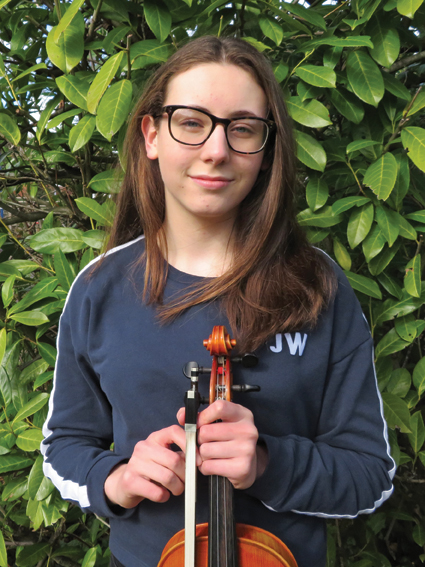
A young Alvechurch musician has won a place in the National Youth Orchestra of Great Britain and will perform at Symphony Hall this month.
Violinist Megan Grainger, aged 16 and a pupil at King Edward VI Five Ways School, is taking part in her second tour with the NYO, which brings its Voice of Americas programme to Birmingham on Sunday April 14. The concert starts at 3pm and includes music by Copland and Gershwin. Tickets are £5 for under 25s.
Megan remembers being amazed by the NYO in Symphony Hall when she was 10 (then a pupil at Alvechurch Middle School), which inspired her to practice hard and eventually audition.
“I want young people to know that thanks to the NYO Inspire programme, following your dreams is now much more achievable for people from all backgrounds and I would encourage all aspiring musicians to get involved,” she says.
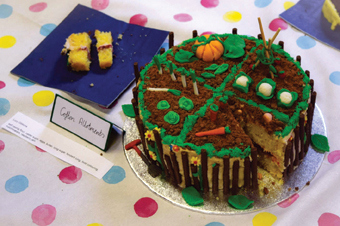
The event, which also included a raffle and a tea party where visitors could taste the cakes after judging had taken place, raised £400. This will go towards furnishing and kitting out the new Cofton Community Centre, which is due to be completed this summer.
The organisers would like to thank everyone who helped to make the event a success.
Keen baker Jen Morris, of Rowney Green, creates a vegetable quiche that’s bound to be a hit with the whole clan.
My family represents a motley crew of dietary requirements: vegetarians, pescatarians, lactose-intolerant, gluten-intolerant, shellfish allergens . . . the list goes on. Oh, and my Dad, who eats anything.
So, when we get together at Easter, it will be a buffet that solves my catering conundrum and this quiche is enjoyed by (almost) everyone. You can double the recipe if you have a large clan; just bake it lower and slower.
Ingredients:
3 large onions
25g butter
1 tbsp olive oil
250g ready-rolled shortcrust pastry (or make your own)
½ tsp sugar
2 eggs
142g single cream
100g mature cheddar, grated
1 tbsp fresh chives, chopped (optional)
Method:
1) Thinly slice the onions and fry them over a low heat, in the oil and butter, for 20 mins until they are soft.
2) Pre-heat your oven to 200 C / 180 C fan / Gas 6.
3) Line a flan tin with the pastry, then cover with baking parchment and baking beans (or dried pulses) and “bake blind” for 12 mins.
4) Meanwhile, stir the sugar into the onions and raise the temperature of the flame to moderate, while they caramelise and turn light brown. Remove from the heat to cool slightly.
5) After the 12 mins baking time, remove the baking beans and parchment from the flan case, then bake the case for a further 5 mins.
6) Whisk together the eggs, cream, cheese, seasoning and chives.
7) Remove the case from the oven and turn down to 190 C / 170 C fan / Gas 5. Put the onions in the pastry case and pour in the egg mixture.
8) Bake for 30-35 mins until set. Remove from the oven and leave to cool for 15 mins, before serving.
Keen baker Jen Morris, of Rowney Green, suggests pretty ‘daisy cakes’ as a simple gift for Mothering Sunday.
Mothering Sunday falls on the fourth Sunday in Lent – this year on March 31 – and historically was a time when children who lived and worked away from home would visit their home church and their family, taking a gift for their mother.
Traditionally it is said that the gift would have been wild flowers picked from the hedgerows. Much better that we leave the flowers to grow where they are and instead take homemade daisy cakes as a gift.
These are also good if you are looking for a fun activity to do with children on Mothering Sunday; the decoration requires a little concentration, which might provide a few minutes of quiet and calm!
Ingredients:
200g butter, cubed and softened
200g marzipan, cubed and at room temperature
75g caster sugar
275g self-raising flour
5 eggs, beaten
2 tbsp milk
200g glace cherries, halved
200g sultanas
25g flaked almonds, for decorating
Method:
1) Pre-heat oven to 150C / Gas 2. Put 20 muffin cases into 2 x 12-hole muffin tins.
2) Beat together the butter, marzipan and sugar with an electric whisk, until pale and fluffy.
3) Add the flour and eggs and beat together. Stir in the milk and vanilla extract; the mixture should have a soft dropping consistency.
4) Reserve 20 cherry halves for decorating, then stir the remainder, with the sultanas, into the mixture. Spoon mixture evenly into the muffin cases.
5) Arrange the flaked almonds in flower shape on the top of each cake and place a cherry half in the centre.
6) Bake in the pre-heated oven for 20–25 minutes until golden brown.
Two former Bromsgrove school pupils have won a BAFTA for their short film.
Alex Lockwood, who attended South Bromsgrove High School and now lives in Stourbridge, and Oliver Walton, who went to North Bromsgrove High School and now lives in Catshill, won Best British Short Film for their documentary, 73 Cows.
With Alex (left) as director and Oliver as cinematographer, the film tells the story of a Derbyshire farmer who became a vegan and decided to send his beef herd to an animal sanctuary instead of the slaughterhouse.
73 Cows was also nominated for Best Local Film at the 2018 Birmingham Film Festival.
Alvechurch Dramatic Society present Noël Coward’s classic comedy Blithe Spirit as their spring production, performed at Alvechurch Village Hall from Thursday April 11 to Saturday April 13.
Subtitled “An improbable farce”, this much-loved play follows the comic mishaps of writer Charles Condomine, who invites eccentric medium and clairvoyant Madame Arcati to his house to conduct a séance, hoping to gather material for his next book.
But the scheme backfires when the séance accidentally summons the ghost of his first wife, Elvira. Unseen by all except for Charles, Elvira proceeds to spread chaos in her attempts to disrupt his marriage to his second wife, Ruth. But to what lengths will she go to win him back for good?
This clever play displays all of Coward’s trademark wit and invention – theatre critic Charles Spencer said that “…with Hay Fever and Private Lives, Blithe Spirit strikes me as being one of Coward’s three indisputable comic masterpieces.”
Last performed by ADS in November 1964, the group are delighted to be able to bring it back to the Village Hall stage. Presented by special arrangement with Samuel French Ltd.
All performances start at 7.30pm. Tickets £7 (£6 concessions), available from The Lounge, Alvechurch, or on 07984 570763 or ads.alvechurch@gmail.com
Above, L-R: Jo Bestwick (Ruth), Martin Salter (Charles), Leah Yendell (Elvira), Sue Resuggan (Madame Arcati), Rosie Pring (Edith), Craig Osborne (Dr Bradman), Emma-Louise Hodgson (Mrs Bradman).
Bromsgrove artist Richard McIlwraith encourages readers to visit a contemporary lace exhibition at Artrix.
Intricate, involved, elaborate, enmeshed, Fine, precise, flowing, smooth, Winding, restless, shifting, soothing Warmth of tone, tinge of webs.
98Lace is a fellowship of UK lacemakers with varied textile backgrounds who use traditional techniques to create lace for the 21st century. United by a common goal of bringing modern lace a lively public profile, its members produce original work, breaking through classical boundaries.
Throughout March at Artrix in Bromsgrove, you can immerse yourself in an intriguing exhibition of lace work from this talented national group. Expect the experimental. Witness the individual artists’ journeys from customary to contemporary. The complexity within the works is staggering.
I visited the exhibition on the evening of the Young Picasso screening in February and there are evident similarities between the creative new directions the famous artist pursued and the unique courses followed by the members of 98Lace.
Tradition is stepped past and you see wire, silk paper, wool, felting, grids, patterns, William Morris and Celtic designs, perspex rods, paper yarns, shadows, images hidden, paint, technological themes, architecture, nature, weather, landscape, fractals and a tea-cup!
Just being there releases your imagination. Just consider what jolt of creative energy is liberated in the patient and resilient hands of these master lacemakers.
This exhibition is well worth viewing. Its strength is its attention to detail. The textures are selected carefully to give a particular emotional impact. Take your time and peruse the message in each piece. Take Rothko’s advice when he was asked how far back an observer should stand to most fully engage with his famous colour-field paintings: “Right back,” he replied, “about 18 inches”.
Go to www.98lace.org.uk to find out more about the fellowship. The exhibition runs until March 31 and can be viewed on weekdays 9am to 2pm; Saturdays 10am to 2pm; and on performance evenings.
There is a cafe on site and I have always found the staff and volunteers to be extremely welcoming. Artrix is on Slideslow Drive, Bromsgrove, B60 1GN.
Please get in touch if you would like me to write about an art event near you: richard@galleryart61.com https://www.galleryart61.com
Hannah Genders looks forward to another busy Malvern Show.
Last May I was too unwell to run the feature I had helped set up at the Malvern Spring Show. I was extremely grateful to friends who took over and did a brilliant job of running it for me – in fact they did a better job than I could have done, so I want them back with me this year!
I did manage to get along briefly on the Thursday, and it was great to see everyone.
The feature is called The EGG which stands for Eco, Green and Growing. It will be running again this year and it’s all about promoting community groups who are growing food and helping people improve their lives.
The idea is that the show provides a platform for people to come and tell their story, share information on gardening and generally help us all realise that there are some great people out there doing some inspiring things in our communities.
I want to tell you about some of the groups who are being represented this year, such as Tim Dixon and his team from Colwall Community Orchards, who were there last time and are keen to come back.
The Colwall Community Orchard, just over the other side of the hill from Malvern, covers about seven acres. It’s all managed by volunteers and is about teaching people practical skills to keep the orchard thriving.
The fruit is shared, and they have managed to do up an old packing shed on the site where school children and groups can learn about local diversity and our wonderful fruit heritage in this area of the country.
In addition to the orchards, the group set up allotments for people in 2011, covering about two acres. The whole site is gardened on organic principles and the plots are deliberately smaller in size than standard-sized allotments, which most people find too large to manage.
As the orchards and allotments are all about community and bringing people together, there are plenty of events to encourage the social side of community gardening.
I personally believe that this is the best way to learn about horticulture – it is such a practical subject and it was how I learned on my first allotment during the time we lived in south Birmingham.
My boys were little, and I was missing my rural upbringing so much that I took on an allotment near me. I learned so much from the “old boys” (there were hardly any women then).
My first lesson was being shown the right way to plant leeks; I’ve never forgotten it. I loved it down there and I remember seeing so much wildlife on my visits, including an old dog fox lying on the roof of my shed early one morning!
The Eco Birmingham project is also returning to Malvern this year. Jackie and her team are a charity that is now city-wide and has grown from a small project in Northfield.
They run a number of community gardens in inner-city areas, helped by the Royal Horticultural Society.
Most of the projects revolve around growing food. The principles they follow are organic and permaculture-based (permaculture is the development of gardening ecosystems intended to be sustainable and self-sufficient).
They also run cooking programmes to encourage healthy eating on a low budget.
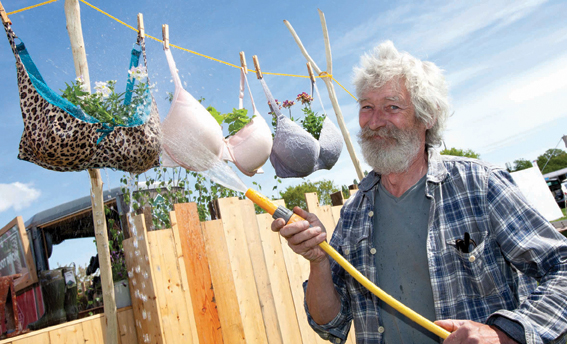
Last year Jackie’s team created a really fun display, with a recycled bed complete with planted bedspread of flowers and a clothes line with planted bras! It’ll be fun to see what they come up with this year.
The EGG feature is laid out with a central tepee and there is a running programme of talks, demonstrations, and music.
The talks are from the contributors who set up the projects, celebrities and visiting speakers, but we also have lots of demonstrations taking place, everything from grafting fruit to running community seed swaps and hedgerow herbalism.
Around the tepee are planted beds with vegetables and fruit. We are fortunate to have Frank Matthews, a well-known fruit nursery in Hereford, helping us again this year.
They provided some amazing trees last time in large apple boxes, and there will be a yurt in this “orchard” part of the feature with will weaving workshops throughout the show.
I am also hoping to sign up a fabulous charity who are doing food growing projects in Malawi.
As I seek out these people and projects to invite them along to the show, it reminds me there are some great things going on all around us – it’s inspiring and positive.
RHS Malvern Spring Festival May 10–12 (May 9 is for press and RHS members only). We will be in the Grow and Know section. https://www.rhsmalvern.co.uk/whats-on
Mary Green praises ‘good’ hedges and the birds that use them.
The title this month comes from an old folk song. I can’t find any traditional songs for Candlemas, which happened last month, but there is a well-known piece of weather lore about it.
Candlemas Day this year was definitely “fair and bright” (and very cold) so in theory “winter will have another flight”.
However, it soon turned milder and wet afterwards, so maybe we will be spared a ”blackthorn winter” (late cold spell) this spring. So far, some things are delayed, some early and some on time this year. I have seen cherry plum blossom at the time of writing, but no blackthorn yet.
Many people who are interested in the wildlife of the planet lament the decline and loss of species. They all know that “destruction of habitat” is the most common cause. But some of them will happily go out the next day and destroy habitat.
One of the key habitats for insects and birds in this country is hedges and other patches of shrubby and thorny growth, especially now we have lost a lot of our woodlands.
Yet hedges are routinely flailed even in the growing season, and brambles and self-sown trees called “scrub” and cut down.
Hedges are human-made and have always been trimmed, and this can be done in the late autumn or winter without harm when they have finished fruiting.
However, branches need cutting carefully, not with a mechanical flail, and it only needs doing every three years or so if done properly.
The best possible way is to cut one third of the branches each year, so you always have growth. Hedges should never be cut to a flat top.
In recent years we are also learning that hedges and bushes are vital for our own health. Hedges or other groups of small trees and bushes are vital for cleaning the air of pollution, especially diesel particulates.
Tall trees very near the road are not so useful because they form dense canopies and trap polluted air under them. Flailed hedges are not much use, being too low and not leafy enough.
But a good medium-size hedge or group of shrubs or small trees will do the job. There has even been research into the best trees for this – birch, elder and yew are especially good.
Most of our familiar garden birds are woodland-edge birds. When we enclosed the land for sheep farming, we created hedges to divide the land into newly-created fields. This was at a time when our native woodland was decreasing.
Luckily, we continued the woodland habitat in long strips across the countryside, and birds and insects thrived, with woodland plants growing under and up the hedges.
Hedges were properly laid and trimmed so they grew to a good height and bore flowers and fruit. They became an asset as well as a barrier, their wood, flowers and fruit being used for household purposes.
Trees like elder and holly were especially valued, as I explained in my articles last year. And fruit trees were planted within the hedges, as well as growing there by chance from bird-dropped seeds.
You can walk along an ordinary hedge around here and find a wonderful range of trees. An old hedge will always have a diverse range of tree species. Good planting of new trees will also have this variety – for example the new hedge a few years old half way up the field path from Withybed to Foxhill.
One of my favourites, easily accessible, is the road hedge between the canal bridge and Cooper’s Farm, just outside Alvechurch on Cooper’s Hill.
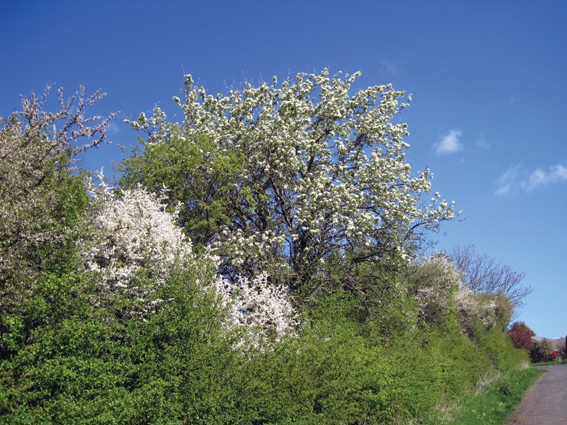
The hedge near the canal bridge is a relic of old woodland with large oak trees, cherry-plum and holly. Bluebells flower here in April and May. The next part alongside the M42 embankment must be around 40 years old, so is relatively new, but very diverse.
It has a great range of trees. You will find oak and ash, field maple, alder, apple, hazel, cherry plum, wild cherry, elder, hawthorn, blackthorn, guelder rose, birch and holly, just in a few yards.
The flowering starts with hazel, alder and birch catkins, then cherry plum, blackthorn, cherry, apple, hawthorn and guelder rose blossoms. There are a few non-native pines as well.
Almost every tree I wrote about last year is there. There’s a habitat for you! And yet this is just an ordinary stretch of road you might drive down frequently.
Parts of the canal also have wonderful hedges like this, though they are often flailed and don’t flower as well as they should. Many are as old as the canal, two hundred years, and some have trees older than that if they followed existing hedge lines, as near Alvechurch marina.
In my walks along canals, roads and paths, I often see wrens in the hedge. They have curious habits. They never fly high, going low along hedges and near the ground. There is mythology attached to this.
The wren was believed to have been implicated in the death of the first Christian martyr, St Stephen, commemorated on Boxing Day. Its punishment was never to fly towards the heavens.
Another legend has it that the wren hitched a ride on an eagle to fly the highest and become “king of the birds” so was cursed to never fly high again.
An old British tradition pitted the wren, the bird of darkness, against the robin, the bird of light, in the contest to be king of the birds. The robin had to win. The custom was to hunt a wren on Boxing Day and sacrifice it.
In more recent times the wren was not a real one, but the ritual went on, with a song called The Cutty Wren describing how it is caught, killed, cooked and eaten and the food given to the poor. A giant of a little wren indeed!
But the reality is just as odd. Wrens’ nests are unusual, and not only in Dudley! It is the cock bird that makes the nests, not the hen. He makes several, and then shows his prospective mate round them till she chooses the one she likes best and moves in.
After her eggs hatch the female looks after them on her own, which is also unusual in birds. Meanwhile, the cock finds another hen to take up another choice of nest – and then another, and so on till they are all used. The last mate presumably gets the worst nest. Wrens therefore produce a lot of young.
Wrens build their nests in all kinds of places and are well-known for liking to nest in old clothes or former nests of other birds. They are not just a hedgerow bird, living in wilder areas on cliffs and even in caves, giving them their Latin name Troglodytes.
They sing loudly for a small bird, all the year round like the robin. In winter they often huddle together in large numbers in a small space, like an old nest or box or hole in a tree.
Wren lives are very short: they rarely live for a year. They are so small and light that they often die of cold in bad winters – up to 80 per cent of them in a bad year. But the way they breed means that they can replace themselves in a year, and even grow in numbers in a good year.
An odd little bird, but a successful one. You may not have seen one on your Great Garden Birdwatch as they don’t often come to bird tables, but you may well see one flitting along a hedge as you walk past.
I was talking to some neighbours recently about the lack of yellowhammers, a bird many of us grew up with, knowing its song of “a little bit of bread and no cheese”.
This little bunting likes open arable land, but it also likes tall hedges – and very few arable farmers let their hedges grow to a proper height these days.
It likes winter stubble, a practice not used so much by farmers these days. In the more rugged western parts of Britain it has a different habitat, gorse scrub near the sea, and its Welsh name means bird of the gorse.
We may need to go west now to see the yellowhammer, as we have removed its inland habitat.
I heard the first chaffinches and greenfinches of the year as I walked along a canalside hedge in February, as usual. We could lessen the decline of our “garden” birds if we all kept our hedges high, flowering and fruiting.
I wrote this poem in January after the lovely annual event that takes place at The Crown in Withybed.
Mummers We stand in soft drizzle, crowded up close
The dancers leave and the play starts. I know
These people, was dancing with them last night
But here they have dark faces and coloured wigs
Become someone else. Some of them have been here
For centuries: St George, the Turkish Knight, the Doctor
The dragon, with its yards of children’s legs,
And I remember men now dead who played them with me
In a different town fifty years ago. I was Molly
And Molly is here today, a local man in dress
And wig, deciding not to be a trophy of St George.
Some of them are different each year. We have
Billy Brexit appearing, resigning, coming back
A different but identical politician
We have the property developer, getting the loudest boos
And the Russian poisoner who does for St George.
We laugh and whoop and boo and clap, and drink
And chat and see to the children and comment on the actors.
They act their parts, take care to fall dead on to the carpet,
Speak to the audience, pose and quarrel and fight.
It is true drama though. Not like the film and TV
Where we pretend the people are real, and every detail
Has to be right, the scenery, the period, the accent.
Here we know we are in a pub car park
And that that is Chris in that wig, and Molly is really a man
But it doesn’t matter. The play speaks of community
Of the struggle of light against the forces of the dark
Of an old year cut down by Father Time, a new one born
Out of all of us. We are all mummers. We play our parts
Put on the dress and wig, but underneath we are ourselves
Our knobbly, various, beautiful, middle-England selves.