Hannah Genders advises on garden jobs to tackle in August.
August is a strange month in the garden – it’s a “between” time where most summer plants have stopped growing and are waiting for autumn to come. Ornamental grasses and annuals are doing a wonderful job in bridging the gap in the flower garden at this time of year.
The Vegetable Garden
Watering is probably the most obvious thing with your vegetables and regular watering is very important. Beans will still be coming thick and fast, hopefully, and need to be kept as moist as possible.
I always grow my courgettes under the bean plants and these need plenty of water and a regular feed with an organic foliar feed or blood, fish and bone. Pick the courgettes when they are still small and sweet, and you can use the flowers which are wonderful fried in a tempura batter.
I’ve also grown some flowers in the vegetable garden which look wonderful and encourage all the bees and beneficial insects to hang around and pollinate my plants!
The greenhouse will need regular watering and it is vital to water tomatoes about the same amount each day – erratic watering will result in the fruits splitting and although they will still taste good, they look unappetising.
The tomato plants will need regular feeding, which can be done with a watering can and a specialist tomato feed added to the water about once a week.
Tomato plants also need the side shoots removing to encourage the plant to put its energy into the fruit rather than growing leaves. The side shoots grow between the leaf node and the main stem and are easily removed with a finger and thumb.
If the plant has put on lots of leaf growth, I often remove the lower leaves to let the sun get to the ripening fruit. Remember to always clear away your leaves and weeds from the greenhouse floor as any decaying matter encourages disease.
Wildflowers
If you have any areas of wildflowers (I have just one area near the pond) now is the time to cut back the flowers that have finished to get them to seed down for next year.
Cut the grasses and wildflower stems back to the ground and leave the cuttings for a few days to let the seeds fall out for next year.
Pruning summer shrubs
Large shrubs like Philadelphus, Spirea and Weigela have now finished flowering and benefit greatly from a summer prune. August is the ideal month to do this, and the result is a neater shrub and better flowers next year.
All these shrubs flower on the new wood, so the pruning technique is to trim back the old branches that have just flowered to the new growth (which will be flowering next year).
If the plant has become leggy and too tall, cut back to the lowest branch of new growth. Using sharp secateurs, trim to just above the growth point of the new branch.
If there are some very old branches that overcrowd the shrub, these can be removed to ground level to tidy up the plant, but only remove up to one third of the shrub in total, and it’s a good idea to keep standing back and checking the overall shape.
Once you have finished the pruning the shrub should be reduced in height, less congested and will flower well next year.
Climbers that have finished flowering can also have a trim at this time of year; rambling roses often put on a lot of growth after flowering and throw out long stems that need a trim back, while wisteria is also a climber that needs an August prune – trim back the long, new stems so the plant keeps a tidy habit.
At the end of this month or the start of September, trim back your lavender; mine has done amazingly well this year and is full of flower. Once these have faded, trim back the plant to where the flower meets the main leaves.
Never cut into the old wood as this will kill the plant. Use the lavender for drying and scenting drawers and wardrobes!
Watering
An obvious one really, as August is one of our driest months. Try using rainwater as much as possible when watering the garden and pots, as it’s much more sustainable and has fewer chemicals than tap water.
We uncovered our well here last summer, so I am managing to use much less water in the whole garden. I think the well is around four hundred years old and still working!
Relax
We spend all year in our garden doing jobs, so this is the month to sit and relax. My friend Kaaren is up from London and has spent most of her time relaxing in my garden!
We forget, living in a village, how fortunate we are to have green space, so get out there and enjoy it.
Amateur astronomer Brian Watkiss peers into the Village night sky.
August, this year, will be taken over by the two giant planets of our Solar System – at least the evening skies will be. As soon as the sky starts to darken, which will be quite late for most of the month as the Sun doesn’t set until nearly nine o‘clock, the first object to become visible will be Jupiter, low in the south.
This is a colossal planet. If your average aeroplane could fly around the world non-stop, it would take about two days. To fly around Jupiter would take nearly three weeks.
Not that it could, because Jupiter is mostly hydrogen gas – although the visible surface is made up of clouds of ammonia which, due to the planet’s high spin rate, swirl into huge storms with wind speeds of nearly four hundred miles per hour, as revealed in wonderful close-up by the probe Juno recently.
The Moon flies close by on the 9th, though, and it has the bright star Antares just below.
Further east (or left because remember you are looking south) is Saturn, almost as bright because it is nearly as big as Jupiter but, bizarrely, only has about a quarter of its mass.
Its surface appears quite serene by comparison and it has those beautiful rings, a must-see for anyone with even a small telescope. This planet has also been photographed in exquisite detail by the Cassini probe. The Moon trundles by on the 11th and 12th.
This is around the time of one of the best meteor showers of the year. It is caused by the Earth passing through the trail debris left behind by the comet Swift-Tuttle and although they peak on the 13th, they can be seen a few days before and after this.
They are called the Perseids because the point which they all seem to come from is in the constellation of Perseus. This doesn’t mean that the this is best place to spot them. You can, in fact, spot them anywhere in the sky; just find the biggest patch of sky that you can and keep looking because the moment you stop, there will be a big bright one that everyone will be talking about.
While you are out, take a moment to look to the north and admire the glow from the lights of Birmingham. Just above it you should see the Plough, and this time of year it’s the right way up and looking a bit like an old-fashioned horse-drawn plough.
This month should see the launch of a new space craft capable of carrying people. It’s the Boeing Starliner and this will be an unmanned test mission to the ISS. It may be visible in Alvechurch so check https://www.heavens-above.com for sighting times – and anyway, this is a great time of year for spotting the Space Station.
Village art exhibition features local scenes plus portraits and seascapes in oils.
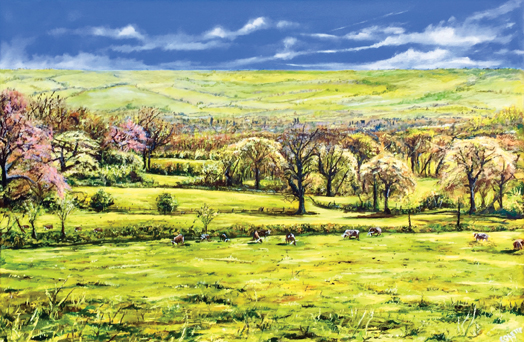
An exhibition featuring oil paintings of Alvechurch and the surrounding area comes to Alvechurch Village Hall in September.
Artist Colette O’Brien was born in London and lived in Ireland for many years where she became one of the country’s best-known artists. Working predominantly in oils and sculptures, she is also recognised as a leading mosaicist with exhibits on permanent and public display in County Kilkenny and County Waterford.
Colour and vibrancy are the key elements to Colette’s work. While visiting friends in Alvechurch she was attracted by the colours and contours of the local panorama and has produced a number of landscapes. These will be on display at the exhibition, together with portraits and seascapes from Colette’s travels in Spain and Ireland.
Her technique in oils involves two distinct stages. The first is the spontaneous creation of a dark base which is then wiped with a dry cloth to produce shapes and highlights, followed by the second stage of meticulous focus on the finest detail.
The objective is to incorporate many different styles and mediums, occasionally transcending from the traditional to the abstract with the ethos that nearly every material or object can depict something beautiful so that the observer is left with an enduring but individual impression.
The exhibition is open during the afternoons of September 13–15, with the works available for purchase.
More of Colette’s art can be viewed at https://www.coletteobrienart.com, while original oil paintings can also be commissioned and mosaic workshops booked on 07440 699964 or icefirewater61@gmail.com
Keen baker Jen Morris, of Rowney Green, makes a fruity treat.
This cheesecake is so easy I’m not sure it counts as baking, but if you need a dessert for a crowd that showcases our beautiful British raspberries, it will do nicely.
The biscuit base is made of a 50/50 digestive and amaretti mix. The flavour is deliciously almond-y and works well with the fresh raspberries and the sharp lemon in the topping. If you don’t like almonds, use a full digestive base. For the cheese, I use a mix of ricotta and mascarpone, but normal cream cheese works fine.
The quantities below make a large cheesecake; you can easily slice it into twelve. If this is too large, simply halve the quantities and use a smaller tin.
Ingredients for the base: 200g melted butter
200g crushed amaretti biscuits
200g crushed digestive biscuits
Ingredients for the topping: 600g full fat cream cheese
2 tins condensed milk
Juice of 2 lemons
Fresh British raspberries, to decorate
Method:
1) Line the base of a 23cm springform tin with non-stick baking parchment.
2) Crush and combine the two types of biscuit, then add the melted butter and stir together.
3) Tip the mixture into the tin, even the surface and press down so that it compacts into a firm base. I use the back of a large spoon, but I have seen people use the base of a pint glass!
4) Refrigerate the base.
5) Put the cream cheese and condensed milk into a bowl and whisk together by hand. Add the lemon juice and continue to whisk by hand, and you will feel the mixture thicken as it combines.
6) Pour the cheesecake topping on to the base and put back in the fridge, for a few hours or overnight if possible.
7) When the cheesecake is set, spring the tin open and slide the cheesecake on to a plate or stand. Decorate the top with the raspberries.
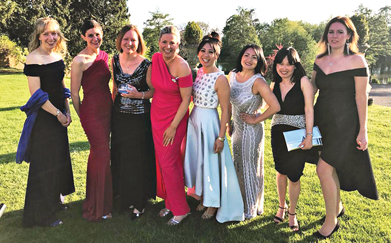
The Blackwell May Ball, held at Grafton Manor in Bromsgrove, raised more than £8,000 in aid of Blackwell First School.
Guests enjoyed a three-course meal, live music from “2 Weeks Notice” and a dance performance by the “Supreme Showgirls”. There was also a silent auction with prizes including signed golf and football shirts, holidays and a special “bake to order” cake by the school cook!
The event organisers were delighted with its success and would like to thank guests, sponsors and everyone who donated prizes for their generous support.
Local artist Dennis Hill is advised on some finishing touches to one of his paintings for the exhibition by tutor Pam McGregor
Dave Morgan looks ahead to the annual art exhibition in Alvechurch.
How do you paint the Moon? For kids it’s usually just a blob of white – but what if you are trying to paint man’s first landing on the Moon?
That was the challenge laid down to members of Pam’s art classes in Alvechurch and Droitwich, who take part in an annual competition arranged by local nursing home owner Kamal Khan to produce artwork on a specific theme. And the reason for the challenge? 2019 is the 50th anniversary of that epic first landing.
The initial reaction of the amateur artists was not of enthusiasm but of a feeling that with the grey of the moon’s surface and the blackness of the sky, there wouldn’t be a lot of colour.
Therefore two alternative themes were added: a picture to commemorate the 75th anniversary of the D-Day landings (also in 2019) or even a painting in the Georgian style, similar to the challenge from two years ago. Slowly but surely the artists started to get enthusiastic at such a wide choice of subjects and the creative juices started to flow.
Art tutor Pam McGregor commented: “It’s quite surprising that although the initial reaction to both the Moon landing and D-Day landing subjects was subdued, as time went on several of the artists actually chose those subjects as they thought more about what they could produce and the result is a wide variety of pictures.”
The winners of this year’s challenge were due to be announced at the summer fete at Tutnall Hall care home as we went to press. All the entries for the challenge, together with up to 100 other new and original images, will be on view in Alvechurch Village Hall for the annual Art Exhibition from July 25 to 27.
Many of the paintings will be for sale at prices that should make them attractive investments, especially as purchasers will be able to buy an original work of art that no-one else owns.
Over the past few years the exhibitions have received excellent reviews by visitors and the intention is always to improve on the standard of work. So all the pictures in the main exhibition will be art that has not previously been exhibited and that has been created during the past 12 months.
The exhibition will be open from 10am to 6pm (10am to 5pm on the Saturday). Entry is free and refreshments will also be available. More details about the art classes can be found at www.pamsartclasses.co.uk
Above: local artist Dennis Hill is advised on some finishing touches to one of his paintings for the exhibition by tutor Pam McGregor.
Amateur astronomer Brian Watkiss peers into the Village night sky.
Imagine a vehicle weighing two thousand tons. A small ship perhaps? Now imagine that this vehicle can actually fly! The stuff of science fiction, you’d think, but these things actually existed more than fifty years ago, built by NASA and called Saturn V (five) and this month marks exactly fifty years since one launched to land men on the Moon for the first time.
Neil Armstrong, Buzz Aldrin and Michael Collins took off on July 16th, and on July 21st (20th in the USA) Neil and Buzz walked on the Moon while Michael Collins became the loneliest man in the universe as he went round the back of the Moon in the Command Module and out of touch with the rest of the world.
So, where did they land? Yes, on the Moon, of course, but exactly where? Well, the Moon is new on the 2nd so you can’t see it at all until about the 4th, when it will be a very thin crescent, very low in the west for a short while during sunset. This is a great time to try and spot the Moon; it feels completely different when it’s this skinny and Mercury is just below it this month too.
The 9th sees first quarter when we actually see a half Moon and we can start to find the Apollo 11 landing site. You should be able to make out a series of darker patches down this part of the Moon, the top one being the Sea of Serenity which merges into the next one down, the Sea of Tranquillity.
Site of “Tranquility Base”
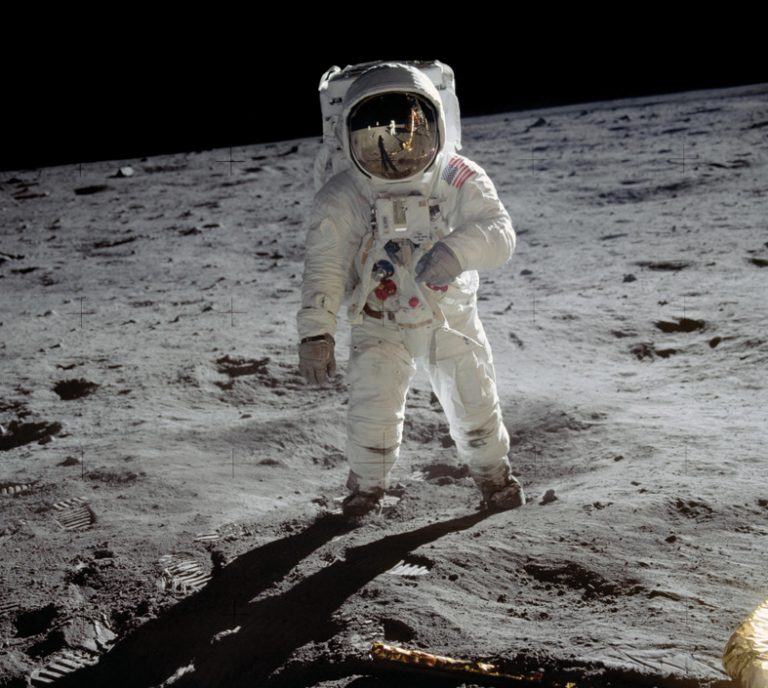
It was at the bottom left-hand corner of this patch where they set up “Tranquillity Base” all those years ago and Neil took that famous picture of Buzz. Incidentally, there is reputed to be only one photo of Neil on the Moon and he’s got his back to the camera in that. This is because he hogged the camera most of the time – the same reason there are very few pictures of me on holiday!
As the days go by, the Terminator, the line that divides the light part of the Moon from the dark part (as opposed to the time-travelling robot), moves further left until it is full on the 16th. It also rises later and towards the end of the month it can only be seen during daylight.
Now you will have been seeing a really bright “star” in the evenings during the past few weeks. This is, in fact, Jupiter, the largest of all the planets and really dominating the sky at the moment. It will be with us all summer and because of the time of year, it will never get very high in the sky.
It will be joined by Saturn, which rises a couple of hours later so may be a little too late for most people to see – but could be something to look out for if you’re wandering home after eleven at night for any reason.
Hannah Genders visits two Chelsea show gardens with an educational message.
It was another wonderful show at Chelsea this year, with many strong messages behind the gardens – particularly on the theme of well-being and gardening. The garden which got the most press on this was the RHS feature garden called “The Back to Nature Garden” which had been co-designed with The Duchess of Cambridge and gave a clear message of getting children involved in the natural world.
This is a subject close to my heart and having done this with my own children I am now keen to engage my grandchildren with the natural world and a love for wildlife as much as I can. Research now shows us that children who are allowed to play outside and in the natural world grow up with a love for the environment and better mental health.
But for me as a keen vegetable grower there were two gardens that at first glance appeared completely different, but actually at their core had a similar message and it was about our future, and the future of food-growing and education.
The first garden, which was in the “Space to Grow” category, really stood out for me. Designer Jilayne Richards and her team had created a classroom and a vegetable garden from Zimbabwe. It was beautifully executed with a small, simple classroom at the back and an outside play space.
To the front of the garden were all sorts of recycled containers, like brightly-painted oil drums, with vegetables growing in them and the red soil that is so associated with Africa.
The garden was for CAMFED (Campaign for Female Education), this being their 25th year. On the Monday that I was at the show, I spoke with two Zimbabwean ladies, both businesswomen and farmers in their own country. They had benefitted from schooling and were now paying to educate their own children.
This little garden was not a romantic notion of Africa but was very forward-looking. The beans, for example, were biofortified, having extra iron, and the maize was enriched with vitamin A. Often the children are living on one meal a day, so it is recognised that there needs to be as much nutritional content as possible.
The raised bed at the front of the garden, made from recycled bricks, was built with a reservoir underneath, so the water sits below the crops – this means less evaporation and encourages the plant roots to spread downwards and not across the surface, making the plants much more tolerant to drought.
The crop rotation in this bed was similar to what we could do here, encouraging the right nutrient uptake from the plants. I was interested to see a few plants growing that I had not seen before, including sorghum which is a staple of the Zimbabwean diet.
Solar panels powered the water pump, as they are essential to many communities not connected to any grid.
This was a beautiful and practical garden, and the connection to women growing food and educating the next generation of farmers and gardeners was inspirational. The garden won a well-deserved gold medal and the People’s Choice Award in its category. The whole garden will be rebuilt at the Eden Project in Cornwall after the show, so it lives on to tell its story.
Right at the opposite end of the spectrum was the IKEA garden, which was in the Show Garden category and designed by Tom Dixon. It was the first time the RHS had sited a show garden in the floral marquee (actually it took me quite a long time to find it).
The concept of the garden was an underground growing laboratory and a wild area above. I would agree with many other people’s comments that this was more like an educational installation than a show garden, but that aside it had some really interesting things to show us.
For me the “wilderness” area was not really wild enough; it was hard to engage with the planting and have a sense of wilderness as it was all behind a handrail. But the laboratory area, I loved. It showed salad crops, herbs, medicinal plants and fungi growing under artificial LED lighting. It has its own beauty although it was hard to photograph well because of the light conditions and being in the marquee.
Some of the plants were growing hydroponically – this is without soil, where water containing nutrients is pumped into the roots of the plant. With this system the plants crop early and use 20 times less water than traditional growing.
The vertical columns of vegetables on display were growing with aeroponic technology – basically grown in air, with the roots sprayed regularly with nutrient-rich water. This method uses 90 percent less water and 90 percent less land than traditional growing methods.
The whole feature was showing a transformative way of growing these crops that could be used in our cities. It is very sustainable, cutting down on water, land and food miles. Both these systems encourage leaf growth in the plants over root growth and so are perfect for these type of salad crops.
With the future of food growing and sustainability as its core message, this garden was challenging us to look again at how we grow food in our cities. It also had the best title, in my opinion: “Gardening Will Save the World”. I agree – and it won a silver gilt medal.
So, two gardens, which looked so different but had the same message about sustainability and the future of growing our food, were both very inspiring.
Mary Green explains why ‘the answer lies in the soil’.
Some of my neighbours are lamenting the sudden lack of goldfinches in our gardens where there are usually dozens (a “charm” of goldfinches). Their regular nesting site was in some trees which were cut down in late spring – quite the wrong time to do it. I’ve seen major hedge cutting too recently.
Apart from real emergencies, and hand-pruning of some garden shrubs, no-one should cut down trees and hedges at this time of year. Not only are birds destroyed, but our vital insects and of course the plants themselves which should be trimmed in winter if needed. Contractors should know this, but I suppose they can’t turn down work.
Meanwhile, also nearby is a roadside hedge that someone forgot to cut this winter. Although some of the neighbours found it a bit inconvenient as it doesn’t leave so much driving space, it is a delight. It has flowering hawthorn, field maple, dogwood, ash, hazel, elder – and some beautiful elm, and all the insects that feed on them. I walked past it in May, and it was just jumping with baby birds cheeping.
When I was young there was a radio programme where a comic country character kept saying “I think the answer lies in the soil.” The joke was on the rest of us, though, because he was right. Underlying all our plants, animals, insects and all the other things that make up our countryside habitat is the soil, the earth itself.
We haven’t collectively given it enough attention, and are in danger of a time coming when it no longer supports all our natural life. Or, looking at it another way, maybe we have given it too much attention and messed it around and ruined it, when we should have left it alone.
In the cycle of nature, the soil is constantly replenished and provides the nutrients for plants – which as we know then support all other life. Decaying plant and animal matter is taken down into the soil by worms and other small creatures, worked on by them and by fungi, creating a rich humus.
Not only that, but in this process, carbon is locked up in the soil and our atmosphere is kept in balance. One of the contributors to global warming is the fact that so much soil is ploughed up all the time and the carbon released into the air instead of being absorbed into the cycle of growth.
The roots of plants carry tiny rootlets and have fungi and bacteria associated with them. The roots, fungi and bacteria affect the chemistry of the soil, often feeding other plants, and carry messages between plants. For example, alder adds nitrogen to the soil, and oaks use their root structures to warn each other of disease and predators.
There is a big movement now for no-dig gardening and minimal-cultivation agriculture to solve the damage to the soil. Food plants can be planted directly into the soil and have the advantage of the natural fertiliser provided by the earth full of broken-down matter, as well as keeping the carbon in.
Yields are good, but it is hard to shift a farming tradition. We have been ploughing and harrowing for centuries, not recognising that the soil is gradually depleted so that we have to use more and more added fertilisers.
Even worse, these fertilisers may be chemicals which then leach out of the soil and pollute streams. Even organic fertilisers like animal manure need to be used carefully or they will pollute streams, rivers and the oceans. Our own river, the Arrow, and Bittell reservoirs are polluted from nearby farming.
When you think about it, digging and cultivation are not natural – in the wild, plants establish themselves and survive in the already plant-rich environment.
When land is developed (and when gardens are made for Chelsea) people are careful about some individual species but rarely think of the composition of the soil and all the structures and organisms in it. That’s why somewhere like Eades Meadow is so special, as it hasn’t been dug or artificially fertilised for centuries.
Not many things are named after the earth, perhaps because it is so taken for granted. But there is a beautiful but poisonous fungus called earth star, and of course earth worms and ground beetles. There is a bugle-like plant called ground pine and a ground thistle, which grows low down.
Ground ivy is a spring flowering plant with a lovely blue flower, used as a herbal tea. Ground elder is a member of the cow parsley family with similar pretty white flower-heads. It is hated by gardeners, except me, but used to be a prized herb, also called goutweed because of its herbal use. I use the leaves in salads. Groundsel, a little member of the dandelion family, is a very nutritious chicken food.
Ground ivy and groundsel, like most of our most successful edible and medicinal plants, are called weeds. Contrary to the common phrase, a weed is not just a plant in the wrong place. A weed is a plant in the right place – it’s our garden plants that are in the wrong place. Weed was originally an Anglo-Saxon name for herb, so let’s restore it!
Earth, air, fire and water were seen in ancient times as the four key elements of the world. When we move to water, its effect on wildlife is a bit more obvious. We have many plants and animals that live specifically in or next to water. Living near a canal, river or lake makes such a difference to the range of wildlife you see.
Plants range from those growing fully in water – like water-lilies, out in full glory now – to those on the edges, like water plantain, arrowhead and water bedstraw, to others that like to grow in damp places, like purple loosestrife and meadowsweet, along all our waterways this month.
Unfortunately in some places the edges of canals and even sometimes rivers are mown throughout the year so there’s only grass. Good maintenance can involve one mowing in the winter. Water benefits from plant life and algae – it shouldn’t be artificially cleared.
All plants need water, and as soon as we get a dry spell, gardeners start bucketing or hosepiping. In nature, of course, plants survive without being watered by us. They have ways of maintaining their water content, which may include having a speeded-up flowering season in a dry year, but they come back fine the next year.
So wild flowers have been abundant and lovely this year despite the drought last summer. Our native trees have huge roots which mean they can find water in the soil even when it seems dry. The natural growth of our wild plants helps keep water within the soil. Clearing ground, and hard-mowing, makes things worse.
It’s harder for insects and invertebrates to survive if water is scarce, and in dry years we do see fewer of them. Even birds like swallows suffer in a drought because they need mud for their nests. We can all help as individuals by having ponds, and collectively by looking after our waterways and not draining wet areas.
Rivers need to be able to twist and turn naturally and to flood when there is too much rain. The sort of flood prevention we have done in the last centuries, damming and draining, just moves the flood problem somewhere else. At last action is being taken to help by creating settling ponds, rewilding rivers and restoring water meadows. Our habitat won’t survive without the balance of earth and water.
To the ancient alchemists, our early scientists, everything in nature was made of earth, air, fire and water. My last interesting plant name for this month is one with the Latin name Alchemilla or little alchemist. Its English name is lady’s mantle. It holds the dew on its leaves, and this was thought to be the purest water and was used in alchemy and herbalism.
The English name is a Christianisation, as it is Our Lady’s mantle, a plant of the Virgin Mary. You might have it flowering now as a garden plant, but there are wild varieties especially in Scotland. Plant names are full of old magic and science.
I wrote this poem a couple of years ago about the places I have lived.
Living I started life in a semi in Yardley
Born a child of peace and atom bombs
But nothing since has been so ordinary
All I remember is the bottom of the garden
Which had crazy paving, a phrase I liked.
Next was the childhood farmhouse
With an extended and uneasy family
The house built with local stone and sea sand
So when it rained it sweated inside
Perpetually cold, despite the elm logs
That came so bountifully, and painted
Uniformly brown and cream like a railway.
But who cared, with that view of sea and river?
A series of shared rooms and bedsits followed
Mostly without benefit of bathroom
(“The last gentleman used t’baths at City Station”)
Honing my skills of cooking on one ring
And sharing or hiding my comings of age.
Married, my first home was a flat
With outside toilet which froze in the winter
And a garden line for my stiff washing.
Then a rented house, a whole house
With a bathroom, though still heated
By a one bar electric fire we carried round.
Thanks to Barbara Castle, I got a mortgage
And bought our first house, old and tall
A weaver’s cottage, huge upstairs windows
And I fell in love with bricks and gold Bath stone.
Bought a new cooker and a fridge, did some painting.
Then life became liquid again, and again
The sharing and the bedsits intervened
And the city flat four storeys high
Where I carried grow-bags up the stairs
To have something green to remind me.
A long time ago now, thirty years and more
I came here. Red brick, old beams
Garden with apples, plum and damson
People around me but my place at last
Where somehow I put down my straggling roots
Like that rose I have under the apple tree
Planted in a big plant pot. When I came to move it
Its root had gone right down into the earth.
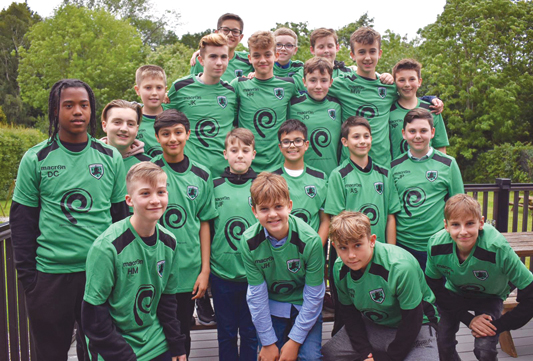
Barnt Green Hibs U13s celebrated another successful season in the Central Warwickshire leagues. Having won promotion the previous year, they enjoyed a solid season of consolidation in a higher division, securing a mid-table finish.
Their awards evening at Barnt Green Sports & Social club saw many awards presented, notably to Harry Hughes who won Coaches & Parents’ Player of the Year, while Jacob Kelly scooped the Players’ Player award along with the Golden Boot for his 28-goal season.
All the boys have done fantastically well and look forward to pushing for promotion next season. If any local business would be interested in supporting the team, contact Martin Pryor on 07961 162818.