Bromsgrove School believes pupils are happiest when they are succeeding. It offers an all-round education, combining academic excellence with a richness of opportunity.
Pupils engage enthusiastically with knowledge, embrace new ideas and are intellectually stimulated. The school prides itself on the outstanding opportunities available, whether at Nursery, Pre-Prep, Preparatory or Senior School.
Facilities at Bromsgrove have been improved beyond measure in the last decade. All sections of the school benefit from state-of-the-art teaching areas.
A world-class Performing Arts Centre, comprising a new live performance venue and theatre, a large drama studio and an entire suite of new music classrooms, recording studios and practice rooms was opened in 2017.
Music lessons start in Year 2 with the Strings Initiative and pupils go on to group and individual successes in music.
Outside areas are extensive with beautiful, landscaped grounds and dedicated sports areas blending seamlessly. There is Forest School for the younger children and pupils of all ages enjoy outdoors learning spaces.
But don’t be distracted by the breathtaking facilities, nestled in over 100 magnificent acres. The heart of Bromsgrove’s success is its people.
More than 1,600 pupils, boys and girls, day and boarding, national and international, aged three to 18, are what give the school its vibrancy, with a staff of some of the nation’s finest educators, coaches and caregivers – passionate professionals, as invested in your child as you are.
The school welcomes individual visits so that you can see for yourself what Bromsgrove has to offer.
The happiness of the children lies at the heart of everything at Winterfold. Each child has the opportunity to excel academically and is encouraged to develop a sense of adventure and achievement in many different directions.
The excellent facilities at the school cannot fail to impress, while the family friendly feel is central to its ethos. The pupils are learning for life and the school aims to give them the opportunities and environment that they need to help them grow in confidence and become engaging, successful and resourceful young people. The children love coming to school and are very proud of their achievements.
Winterfold is a non-selective school and there are no formal entry requirements or tests. Children are accepted at any age, provided there is a place available. The school believes that it has a duty to educate any child who wishes to attend, if it is felt that they will benefit from their time at Winterfold.
Winterfold takes pride in the fact that the staff truly know every child and ensure that they achieve their potential in every aspect of school life. The children develop a sense of purpose, determination and confidence due to the wide variety of activities in which they take part. They leave the school as well-rounded individuals who have become good citizens of the future.
Contact the Admissions Manager on 01562 777234 to arrange a visit.
Winterfold House School, Chaddesley Corbett, Worcs, DY10 4PW https://www.winterfoldhouse.co.uk
Martin Pryor warns that pension rights can be overlooked when your assets are divided.
The transfer values of final salary pension schemes have been at record levels over recent years.
In a paper published last October, the Financial Conduct Authority reported that employee benefit consultancies were recording “the average size of transfer at over £250,000”.
The regulator’s focus has been on the wisdom of moving such final salary pension benefits to other pension arrangements. However, there is another aspect of large transfer values that is worth thinking about: the role they can play in divorce settlements.
A final salary pension benefit could be the single most valuable part of a financial settlement in a divorce. Yet there is anecdotal evidence that pensions are sometimes overlooked when agreeing a settlement, perhaps because their value is not fully appreciated, or it can all seem too difficult when more immediate practicalities are the primary concern.
UNDERSTAND THE OPTIONS
In the UK, there are currently three main ways of dealing with pensions on divorce:
Pension sharing With pension sharing the ex-spouse/civil partner’s pension(s) are shared (as the phrase suggests), with a percentage (or specified amount in Scotland) allocated to the ex-spouse/ partner. The shared element is either retained in the existing pension scheme or transferred to the ex-spouse’s civil partner’s scheme. In practice, schemes often insist on a transfer being made.
Pension offsetting
This avoids disturbing the existing pension and instead in-volves offsetting its value against other assets. For example, one spouse might gain a larger share of the family home in exchange for receiving no pension benefit from the other spouse. However, calculating the appropriate level of offset can be difficult, not least because of the tax calculations involved.
Pensions attachment orders(pension earmarking in Scotland)
Under these arrangements, the ex-spouse/civil partner receives a specified proportion of the pension and/or lump sum when the divorced member starts to draw benefits (in Scotland, it’s just the lump sum that can be earmarked).
A potential drawback is that the ex-spouse/civil partner may not receive any benefit if the other ex-spouse/civil partner dies before any benefit has been drawn.
Each option has its advantages and disadvantages and it is possible that the divorcing couple will see different routes as offering the best solution. For example, pension sharing and pension attachment orders/earmarking both require a court order to take effect, but this isn’t necessary for offsetting.
SEEK PROFESSIONAL HELP
If you are ever involved in a divorce, make sure you get expert guidance on your pension options. There may well be more than one pension involved and it might be difficult to obtain the relevant data, so the sooner you seek advice, the better. Contact us now and we can:
* Explain how each of the options would work for you;
* Assess the transfer value that has been calculated for any benefits;
* Advise on any pension transfers required; and
* Explain how you can improve your financial position at retirement.
The value of your investments, and the income from them, can go down as well as up and you may not get back the full amount you invested.
Past performance is not a reliable indicator of future performance. Investing in shares should be regarded as a long-term investment and should fit in with your overall attitude to risk and financial circumstances.
Occupational pension schemes are regulated by The Pensions Regulator.
* Contact Pryor Portfolio Management for more information: Tel: 07961 162818 martinpryor@ppm-ifa.co.uk https://www.ppm-ifa.co.uk
Alvechurch amateur weatherman Phil Thomas records the changes.
August was a slightly warmer month than normal, with some higher temperatures in the first part of the month helping the values. It was also a fairly changeable month with spells of heavy rain at times.
There was 24.3mm on the 8th, 10mm on the 14th and 12.1mm on the 16th. At the time of writing, the outlook remained changeable, possibly getting a little warmer.
August 2019 (to the 20th)
Mean Max 21.4C 0.1 above average
Mean Min 12.6C 0.9 above average
Mean 17.0C 0.5 above average
Rainfall 77.7mm 149% of average
Sunshine 87.7 hrs 58% of average
July saw the second highest screen maximum of 33.2C on the 25th. The only higher temperature was 34.1C on 18th July 2006. (Records locally go back to 1989.)
After a very dry start to the month, with only 0.2mm of rain up to the 17th, the monthly total was 75.3mm. Most of this was made up of the 39.1mm that fell between 12.30pm and 6.30pm on the 30th.
July 2019 Mean Max 22.5C 0.9 above average
Mean Min 12.7C 0.5 above average
Mean 17.5C 0.7 above average
Rainfall 75.3mm 123% of average
Sunshine 156.8 hrs 101% of average
Outlook Confidence remains rather low, but there are signs that high pressure will increasingly dominate the weather across the UK. Southern areas are most likely to see the driest and sunniest weather at first, perhaps with some lingering wet and potentially windy conditions affecting the north.
However, longer spells of dry and sunny weather may occasionally develop across all parts. Temperatures are generally likely to be warmer than average, although there is little indication of anything exceptional at this time.
More information at https://www.alvechurchweather.metsite.com
You can see an improved HD weather-cam, updated at one-minute intervals, at: https://www.alvechurchweather.metsite.com/webcam_alvechurch.php
Alvechurch FC make steady progress at the start of the season.
Alvechurch finished their pre-season campaign on a high with an entertaining 3–3 draw at home to Evesham United; Taylor Morrison ensuring the point late on with a 25-yard effort.
Unfortunately the opening day of the new season did not bring such rewards as ’Church suffered a 3–0 defeat at Royston Town. They struggled to create a real chance and were undone by Royston’s smart set-plays in what was largely a midfield battle.
Alvechurch then claimed their first point of the season in a 2–2 home draw with Barwell Town. They took the lead after two minutes via Kyle Rowley’s header, but the visitors responded quickly and were level just five minutes later.
Brady Hickey, who scored a brace at Lye Meadow in March, then ghosted in unmarked to head in for Barwell, before ’Church were denied a blatant penalty. But shortly afterwards Josh Ezewele’s cross/shot deflected into the net to level the game at half-time – and that’s how it finished after a sloppy second half.
Things could only get better for AFC, who continued their upward curve with a 5–0 demolition of Hitchin Town. They took the lead after seven minutes, with Kyle Morrison getting on the end of Jamie Willets’ knock-down to score.
Winger John Atherton then picked up the ball just past the half-way line and dribbled past a number of Hitchin players before slotting in for a stunning solo goal in front of the Lye Meadow faithful.
Just two minutes into the second half, ’Church were three goals to the good as Jordan Goddard led a brilliant counter-attack and played through Nesbitt who dinked the ball over Mollison and into the net.
Nesbitt then finished superbly from a tight angle to make it 4–0. And when Kyle Rowley saw his header cleared off the line by Jay Dowie’s deliberate handball, the Hitchin man was sent off and Nesbitt converted to complete his hat-trick for 5–0.
Alvechurch are due to travel to West Midland Premier side Wolverhampton Sporting CFC in the first round of the JW Hunt Cup on September 3, ahead of the qualifying rounds of the FA Cup.
* Due to an injury to first-choice keeper Lloyd Ransome, Church have signed loanee Niall Clayton, an ex-Oxford United and Wales youth keeper who started his football career at Wolverhampton Wanderers.
Darren Byfield has also secured the loan signings of forwards Ryan Nesbitt and Ben Usher-Shipway from National League side Solihull Moors.Ryan was a prolific scorer for Sutton Coldfield last season while on loan.
Other new additions are Dean Fisher, who impressed playing for Littleton in pre-season, defender Kyle Rowley and pacy winger Jordan Smith Williams. Ex-Halesowen midfielder Aaron Gilpin will play alongside the experienced Jordan Goddard who has played at a higher level.
Fan favourite Babucar Sauane has returned to the club, while Ben Cassidy has progressed through the Alvechurch ranks and has been promoted to the first team.
* Alvechurch FC are delighted to be able to offer boardroom hospitality for the forthcoming season. The offer includes: Raised decking viewing area; 10 free match tickets; Free drink; Free food; Match programme and website advertising; Man of the match photo. For more details of the deals available please contact the club.
* For more info or sponsorship enquiries, please contact Trevor Ball at saintsarehot2@btinternet.com or visit www.pitchero.com/clubs/alvechurch
Follow the club on Twitter @Alvechurch1st
Amateur astronomer Brian Watkiss peers into the Village night sky.
September, the month of the equinox – which is on the 23rd at 0850, to be precise – and of lengthening nights with sunset coming as early as ten to seven by the end of the month.
What can we see in these ever-darkening evenings? Well, soon after sunset, Jupiter is still there, low in the southwest and only hanging around for a couple of hours before it follows the Sun over the horizon.
Saturn is visible to the left, due south at a similar elevation to Jupiter. Being farther east, it doesn’t set until after bedtime. The Moon comes cruising by on the 5th, passing Saturn on the 8th.
As the sky gets darker, right over in the west, a little higher than Jupiter is the brightest star in the sky at the moment, Arcturus. It sits at the bottom of a kite-shaped constellation named Bootees. Indeed, this star is so bright that its light was used to help open the Chicago World’s Fair in 1933!
It is just about one and a half times bigger than our Sun but one hundred times brighter and is considered to be a red giant. It will one day blow away its outer layers and recede into a white dwarf. That’ll teach it!
Now, turning 90 degrees leftward, looking south above Saturn, you should find another bright star sitting at the top of an inverted triangle of stars. This is Altair and the constellation is Aquila, the Eagle.
This is the nearest star you can see although it has still taken 17 years for the light you are seeing to have reached us here in Alvechurch. Well, I suppose we are a little out of the way.
Turning 90 degrees again, you should spot a square of stars, although it’s a bit tipped over and looking more like a diamond at the moment. This is the great square of Pegasus with its brightest star at the top.
Named Scheat, it is a red giant about two hundred light years away and it actually pulses, getting bigger and smaller over about 43 days, shedding gas and dust out into space as it does so. It too, will one day go supernova.
Now, why have I brought you over to this part of the sky? Well, during September, a comet slides across the bottom corner of Pegasus, brightening as it does so, reaching peak brightness on the 25th.
I know comets are very unreliable and usually fail but it may be worth a look, especially through binoculars or a telescope – but be aware that it will only appear as a fuzzy blob.
Those beautiful pictures you see are taken with a long exposure or nowadays lots of short exposures added together. This comet has the intriguing name of C/2018 W2 (Africano) but I’ve no idea why.
Also on the 25th is a launch of a crew to the ISS in a Soyuz spacecraft. You will need to check https://www.heavens-above.com to see if there is any possibility of it being visible to us.
A little earlier in the month, on the 10th, the Japanese will launch an HTV Cargo Vessel to take new supplies to the Space Station. So a lot to look forward to despite the shortening days.
Mary Green explains why wildflower meadows are so important.
There was a wrong caption on one of my photos last month – I hope you all noticed it! The first picture above the title should have been labelled “wild flowers in an old quarry” – mostly red valerian and moon daisies.
Last month I wrote about somewhere I visited on holiday, so this month I will stay at home. There is a lot to delight in where we live. In late summer one of the pleasures is flower-rich grass meadows. Nationally, we have lost 97 per cent of our native meadows in my lifetime, more than our loss of woodland.
People often ask me about “creating a wildflower meadow” in their garden. A meadow is a complex organism that takes years to become sustainable. It is an odd environment, as it exists with human agriculture: the flowers and grasses need to be cut for hay or grazed by animals otherwise native woodland will eventually take over.
Meadow-like spaces probably existed before human agriculture, though, as there would then have been native grazing mammals keeping some land open.
A meadow is open, without tree cover, with a mixture of perennial native flowering plants (those which continue to come up year after year) and grasses. Varied grasses are necessary for the insect larvae as well as flowers for nectar.
What it isn’t is a piece of ground that has been stripped of its native vegetation and rotavated, and sown with “annual wildflower seeds.” Annual wildflowers grow where the land is disturbed, so have developed along with arable farming (cereal crops).
They are often showy and colourful (poppies, cornflowers, corn marigolds), but will not survive unless the ground is cultivated every year (which, as I covered in my article in July, is not good for the environment).
While they provide good nectar for butterflies and other insects, and are good temporary cover for bare ground, they don’t last long and are generally not good hosts for insect larvae. Unfortunately, modern farming means herbicides killing the wild flowers that used to grow on arable land, so they are rare now.
It is possible to start a “meadow patch” if you are careful to choose local perennials suiting your soil, choose a range of plants that like to live together and flower at different times, have patience while they get established, and don’t expect them to be showy.
One way to do it is to use hay from an established wildflower meadow which will include seeds of flowers and grass. Don’t be surprised if some of the wildflowers are things you have been told are weeds. Eades Meadow starts the year with dandelions! Or you can plant a few local species as plants in existing grass.
When land has to be broken up and left bare, because of building or other infrastructure work, you can start a meadow from scratch. For this you can use seeds but buy them from a specialist supplier and get a perennial mixture customised to your soil.
For example, a company called Naturescape do a perennial mixture for clay soils with six native grasses and 19 native wildflowers. They also do mowable lawn mixes with short-stemmed flowers like self-heal and trefoil. (Other companies are available!)
You can sow seed on existing grass as well – cut it right down, rake it and sow, then tread the seed in. No need to rotavate or, even worse, weed-kill! Cut it once a year when flowering is over and ideally leave the cuttings a few days then remove them for compost.
Starting from scratch has been done recently in Alvechurch. If you look around the new marina at Withybed Moorings, you may not realise at first what has been done there. The big swathe of sloping land around it, and the surrounding flat sections, were bare earth two years ago. Now they are full of perennial flowers and varied grasses.
The farmer, Adrian Bytom, has used a mixture including vetches, moon daisies, camomile, stitchwort, clovers, trefoils and musk mallow. It looks as if it’s been there for ages. There are also some arable plants like weld and poppy near the paths. The area will be grazed in winter and should go from strength to strength.
Adrian was the contractor who planted the trees along the railway, which unlike many newly planted trees have survived well, and new hedges through his own fields in Withybed. His pasture fields have over the last few years been gradually becoming meadows.
I wrote about these fields about 11 years ago, describing them then as being “old and neglected and rather sporadically grazed.” Now they are a wonderful mix of wild flowers including orchids, helped by a hay transplant from Eades Meadow and a proper grazing and mowing regimen.
They are so lush they are hard to walk through, and make wonderful hay. The fields used to have spectacular buttercups, but they are less prominent now. Buttercups, especially creeping ones, are not especially good for hay, and can be a marker of not-very-diverse fields. His English Longhorn cattle which graze these fields are also loaned out to nature reserves to graze and maintain the habitat.
It’s a good omen for the future that some farmers are taking the sustainability of their land seriously, making a habitat for wildlife, producing meat from grass-fed native breeds, and contributing to the leisure industry too.
Added to my recent visit to Fruitfields Orchard near Barnt Green, it makes me think we can have a good environment around the Village area, and that maybe the country’s farms may take a future direction that balances food production with ecology and wildlife. Producing good food and maintaining the local habitat are compatible – in fact are better if done in harmony – we don’t have to choose between them.
I felt encouraged again when I took a walk around the fields behind the new housing development on the corner of Old Rectory Lane in Alvechurch. Apart from the part immediately by the River Arrow, these were at one time rather unremarkable fields. Now they are looking really healthy.
The grasses are varied and lots of local native flowers have come back. I saw knapweed, self-heal, lesser stitchwort, trefoil, hogweed, agrimony, dove’s foot cranesbill, red campion, meadowsweet and lots more. There was even a sudden patch of pink centaury, a plant which normally grows near the sea!
The presence of yellow rattle, the key flower of meadows, was helping the others to get established. Yellow rattle is parasitic on grass and so lessens the competition from grass and allows other plants to flourish.
I don’t know if someone has been helping these fields along or if the flowers have come back by themselves. There are good footpaths through, and local people were using them.
It’s so good that we can see good practice in habitat management close to home. Both here and in Adrian’s fields there were butterflies, bees and other insects everywhere, including common blue, marbled white and painted ladies.
I have had some more holiday, and one of the things I saw was churchyards with amazing old wildflowers. Churchyards are traditionally home to herbs and flowers – God’s Little Acre. They can have paths mowed through.
There’s even one on the North Yorkshire Moors which is grazed by sheep! Near here, Hanbury is a good example, where they now mow only once a year and have meadow flowers including ragged robin and lady’s bedstraw.
It’s such a shame our St Laurence church managers don’t take steps to allow wildlife to flourish but instead mow it to a green desert. There are lots of old flowers in the turf, and occasionally when they don’t mow they come up – pignut, goldilocks, sorrel, buttercups, speedwell, bistort.
But the tidiness brigade always wins. The church at the top of the hill would be a perfect place for wild flowers and their butterflies and bees.
Still, the Alvechurch allotments look wonderful. People have planted flowers as well as their veggies, which all helps maintain wildlife. The wild patch in the Wiggin Meadows is good again.
Someone in Bear Hill Drive has a gorgeous rim of wildflowers along the edge of their lawn which they let grow. The amazing old field by Scarfield Dingle on the Salt Way footpath is crammed with meadow flowers like agrimony and bedstraw. We’re not doing badly!
I wrote this poem a few years ago in the fields near here.
Hay
My legs ache with the effort
Of walking in the hayfield. Hay
Sounds gentle and soft, but these plants
Have grown long and strong this year.
Grasses of all kinds, clover, vetch
Lesser stitchwort and birds foot trefoil
Swathes of hay rattle, even the odd orchid.
Here is a patch where a deer slept
There the water-retaining pools
The field begins to have a story
The cattle love it and become beef
More flowers bloom every year
Meadow browns dance everywhere
The sun shines. We will all make hay.
I’ve known Rowan McOnegal for about 11 years now – we met when I first did an article on her garden and I was so impressed with her knowledge of plants. Rowan is a herbalist and has been practising for more than 30 years. She came and spoke at my Eco, Green and Growing feature at the Malvern Spring Festival this year and she was excellent.
The talk was entitled “Healing yourself from the hedgerow” and it really sums up her work: using native plants and herbs to create medicines and tonics and using them in a very holistic way.
One thing I had been intending to do and never got around to was to go on one of Rowan’s two-day herbalism courses; I managed to do it this summer and it was great.
Rowan lives in Herefordshire, not far from Ledbury and the Malvern Hills. Her home is an eco-house that she and her husband Pete helped to build. It is built of wood, and they found the right-shaped oak beams growing, felled them and transported them to the site.
The land they bought (one-and-three-quarter acres) was just grass and an asbestos barn, but now has an extensive herb garden, an orchard and a studio which is where she runs the course.
As well as using plants from her own garden, Rowan is into foraging and that morning before we arrived, she had been out to forage meadow-sweet (Filipendula ulmaria). This is a common wild herb and it grows in damp places; it has a white frothy flower and a distinct smell.
The plan that morning was to make it into a balm, which is good as an aromatic hand moisturiser and medicinally is good for aching muscles and joints. It contains salicylic acid.
————————————————————————————————- To make the meadowsweet balm:
* Pick the flowers and buds from the meadowsweet.
* Discard any flowers that have turned brown, and the leaves and stalks. I would estimate we had about a colander full of flowers by the end of this.
* Put half the flowers into a bain-marie. This is essentially a saucepan with water underneath. The contents of the pan are just heated through over the water. It is important not to let the water boil – the heat needs to be very gentle.
* Cover the flowers with organic sunflower oil and gently heat for approximately two hours.
* Strain the flowers out of the oil through a fine sieve or muslin.
* Return the oil to the heat and add the second half of the fresh flowers and heat again for a further two hours.
* Strain again after two hours and add one part beeswax to 10 parts of infused oil. So for 100ml of oil, you would use 10g of wax.
* Pour immediately into small glass jars. They need to have plastic or metal lids, but do not put these on until the balm has set and cooled. This avoids condensation. (If using metal lids, make sure you put a greaseproof layer under the lid.)
————————————————————————————————
During the course, while the balm was heating up, Rowan took us on a tour of her garden and introduced us to many more plants and their uses. The vast knowledge and skill in herbalism is so valuable, and it’s part of our heritage – during the Middle Ages the monasteries would have been the centre of medical learning and you would have gone there for treatment.
It seems to me such an important knowledge, but one that is undervalued. Plants are a vital part of our modern pharmaceutical industry but using plants in their raw state is often gentler and a more holistic way of treating people.
Most of the “herbs” used (and I use this as a very broad term as it covers what many of us would refer to as weeds or wildflowers) are the native form of the plant. Echinacea, for example, is a plant that has been bred as a perennial for our gardens, but it is the simple, distinct flower of Echinacea pallida which is used for medical purposes. Rowan uses Echinacea angustifolia and purpurea too.
As well as the balm, we also made and tried lots of herbal teas. Meadowsweet tea is not sweet but very bitter and most of us found it too bitter to drink, an indication of how much our Western diet has become so sweet.
Rowan in her garden
A bitter drink like meadowsweet or dandelion root tea would often be drunk as an aperitif half an hour before food to prepare the stomach for food. The French do this, of course, but with Pernod!
The fresh tea I did really like was peppermint and lemon balm. Take a handful of each herb, wash it and put it in a teapot, pour on boiling water and leave to stand. Herbal teas taste much better fresh from the garden and I will be making this one regularly.
It is best to use herbs at their seasonal freshest. Bees are often a good indication; if they are all over a plant it is at its peak.
As well as echinacea, I also want to make space in my garden for clary sage (Salvia sclarea). Not only is it a beautiful plant and good for bees, it is an essential oil that I use a lot of. I love the smell and it is a good relaxant.
The humble dandelion made into a tea has many uses; it is good for the liver, for immune problems and constipation, and increases urine production (do you remember the saying about picking a dandelion making you wet the bed?)
I also want to grow some elecampane (Inula helenium), again excellent for bees and beneficial insects. Inulin in the plant is a prebiotic that nourishes beneficial microbes in the intestines, something we are becoming much more aware of now and how important gut flora are to our overall health.
You may be able to tell from my enthusiasm; I loved this taster of herbalism and would like to learn more.
If you are interested in course with Rowan do visit her website for dates (the autumn ones are filling up fast).
Ring 01531 670075, visit https://www.hedgerowmedicine.org, or email rowanmconegal@hotmail.com
Village Book Review The Trials of Eldred Pottinger: Soldier, Spy, Hero. . . Coward? by Nigel Hastilow
Journalist and former Barnt Green resident Nigel Hastilow has created a fictionalised account of true events that reads like a novel but reveals a fascinating insight into a “shameful conquest”, writes Sally Oldaker.
It tells the tale of early-Victorian soldier Eldred Pottinger, an Irishman in the East India Company who is caught up in the British invasion of Afghanistan.
Initially celebrated as a hero, he is eventually stitched up as a scapegoat for the disastrous retreat from Kabul, and the book skips back and forth as Eldred recounts his earlier exploits and awaits court-martial.
The present-tense, first-person narrative device really thrusts readers into the heart of the story, with vivid descriptions of the confusing array of cruel and capricious chieftans and the exotic lands that quickly turn from paradise to nightmare.
Prepare for your blood to boil as Eldred is used as a pawn in the hands of his arrogant superiors with their hidden agenda – seeking regime change in order to protect their grip on India – and at the era’s less-than-enlightened attitudes towards women, servants and “natives”, especially Muslims.
You’ll be angry, you’ll be sad that the lessons of history have still not been learnt, but you’ll also be entertained by this well-written and researched book. Don’t Google Eldred’s fate – read this and find out for yourself!
The Trials of Eldred Pottinger is available from Amazon and all good bookshops.
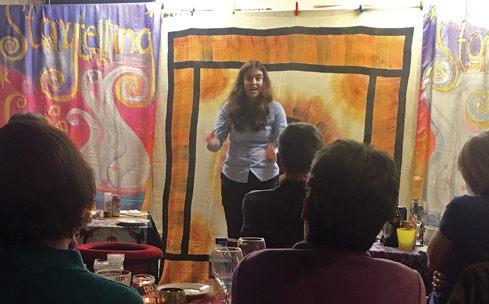
Storytelling is returning to Alvechurch this autumn, as Storytellers Studio presents three evenings of traditional tales at The Lounge.
Storytellers Studio are a group of local storytellers, affiliated to Birmingham’s Traditional Arts Team. Their mission is to bring storytelling back to adult audiences (although older children are welcome too!)
They perform stories from around the world – from folk tales to quest stories to myths and legends. Come and join them for an evening of tall tales well told!
Performances will be on the second Friday of each month – September 13, October 11 and November 8, starting at 7.30pm. Doors will open at 6.30pm, when food will be available. Tickets are £8 per person (profits are shared with The Lounge), and are available from the venue or by emailing chris.thestoryman@gmail.com