The NEW Ravens juniors, having played in several festivals of rugby league this past year (including a big London event and parading around Wembley before the Cup Final), recently represented the West Midlands in an origin series versus the East Midlands.
The two-match rugby league series was played in Derbyshire and at the Ravens’ home ground of Hopwood Park. The West Midlands put in very creditable performances in winning both matches, with several different players successfully opting to attempt conversions.
The last match owed much to the West Midlands’ defence which kept the East Midlands at bay. Easts showed massive game improvements since the last encounter and were rightly credited for their efforts.
West Midlands coaches Jason Spafford, Josh Liggett and Lee Knight praised all the players during the after-match refreshments and the East Midlands coaches presented medals to all participants, who played the games with tremendous sporting and respectful behaviour.
West Midlands would like to thank all the players, families and sponsors Cedar Invest, Focal Image and MSP for their generous support, and look forward to their next stages of development next season.
NEW Ravens play mixed indoor touch rugby every Wednesday evening from 7.30pm at Bournville College in Longbridge. All are welcome, with or without experience.
Further details from the website, https://www.newravens.co.uk or contact Gail on 07515 020844.
Alvechurch United U8s have secured their first trophy of the season by winning the Central Warwickshire Autumn Cup.
With the matches played over two weekends and against four teams, Alvechurch United secured a 100 per cent win rate, scoring 17 goals and only conceding three.
Over the past three months the boys have put in hard work learning their skills, shown great desire and worked brilliantly as a team.
Coaches Macky Lawlor, Tim Andrews and Nick Hyde would like to thank the parents for their support and the boys (Tate, Joshua, Toby, Lennie, Jacob, Sam, Jack and Jenson) for being amazing.
Action from a rare home win against St Ives (Photo/ Ian Macvie)
Alvechurch FC hope change at the top will bring better results.
Alvechurch have parted company with manager Darren Byfield after a run of poor results that has left them just outside the relegation zone.
The club said in an official statement: “It is with sadness that we announce the departure of Darren Byfield as First Team Manager [. . . ] It was always going to be a task of mammoth proportions assembling a new squad following the departure of most of the team from last season.
“We’ve picked up points here and there and although there are green shoots of recovery, the board felt it was time to move in a different direction. We would like to thank Darren for his efforts this season and wish him well for the future.”
Dean Holtham, who rescued the club from certain relegation in the 2011/12 season, has stepped into the breach until a permanent replacement is found. He will also continue his duties as the club’s Education Programme Director.
The last straw in Byfield’s reign was a defeat to Peterborough Sports in the first qualifying round of the FA Trophy. ’Church had put in a battling performance, especially as they had to play the last 20 minutes with ten men due to the harsh dismissal of Archie Brennan for handball.
In the sixth minute of stoppage time Alvechurch gave away a needless free-kick; and Cameron Johnson made no mistake finally beating Joe Slinn to send Peterborough through.
The loss came after defeats at the first hurdle in the FA Cup, JW Hunt Cup, Southern League Challenge Cup and Birmingham Senior Cup, and only one league win since August.
AFC must now navigate some tricky fixtures before Christmas, including high-flying Coalville Town and old rivals Stourbridge. There’s also an away match at Worcester Raiders in the Worcestershire Senior Cup quarter final – date to be confirmed.
* Before his departure, Darren Byfield had made several new signings, including the return of skilful midfielder Aaron Birch. Joining him in midfield are Paul Douglas, Fortune Maphosa and Ivor Lawton.
Three exciting young forwards have also been signed: Fin Thorndike from West Bromwich Albion’s under-18s and Stanley Asomugha from the under-23s, plus centre forward Kieran Miller from Wolverhampton Casuals.
In defence, Linden Dovey has joined from Stratford Town, while international clearance was required to sign Ryan Wollacott from Aberystwyth Town.
* Meanwhile, Courtney Richards has joined Stratford Town after a short stay at Lye Meadow, Josh Ezewele has joined up with ex-Alvechurch manager Ian Long at Stourbridge, Stuart McNaught and John Atherton have returned to Walsall Wood and Miracle Okafor has joined Highgate United.
Ben Usher-Shipway has returned to Solihull Moors, having completed his three-month loan at AFC. Ben won Player of the Month during his stay but a hamstring injury has put him out of action recently.
* Congratulations to goalkeeper Joe Slinn for winning Supporters’ Player of the Month for October. Recent signing Joe has become an instant favourite with the Alvechurch faithful thanks to his domination of the box, reflexes and brave keeping.
Goal of the Month for October goes to Mitch Botfield, whose individual run from the halfway line and finishing ensured the club secured a vital point away at Needham Market.
* The directors, management and players would like to wish all supporters a very happy Christmas and prosperous new year.
* For more info or sponsorship enquiries, please contact Trevor Ball at saintsarehot2@btinternet.com or visit www.pitchero.com/clubs/alvechurch
Follow the club on Twitter @Alvechurch1st
Find out how much you need for the life you want, says Martin Pryor.
The news, social media and press are great at telling you that you need millions of pounds to ensure financial security in retirement. These statements only serve to strike unnecessary fear and worry into people’s minds.
There are three types of client: those that do not have enough, those that have enough and those that have too much. In each situation, rarely do clients know which category they fit into until they have engaged with a lifestyle financial planner.
What if you already have enough? There is a great story of a Mexican boatman which defines relative success. The story goes as follows…
There was a high-powered management consultant on holiday on a beach in Mexico. Early one morning he saw a local boatman come up to shore in his little boat. Inside the boat was a large yellow fin tuna.
He got talking to the boatman and he asked: “Tell me, what you do with your life?”
The Mexican said: “Well, I go out fishing early in the morning and I catch a yellow fin tuna. I come back and sell it. I then go home and have breakfast with my beautiful wife. We chat a while.
“Most days we make love followed by a snooze in the afternoon. Then in the early evening I play with the kids when they get back from school, I have dinner with my wife and then I go down to the local cantina where I play guitar, sing and have a drink with my amigos!”
The management consultant said: “I think I can help you. Here is my advice: instead of going back so early, why don’t you stay out and fish a little longer and catch more tuna. That way you can make more money so you can buy a bigger boat.”
“Really?” said the Mexican. “Then what happens?”
“Well, then you can catch even more fish. Then what you can do is employ some of your amigos and set up a fishing fleet to catch even more yellow fin tuna!”
“Wow!” the Mexican said, “and then what happens?”
“Well,” said the consultant, “that is when the magic happens; eventually you can bypass the middle man altogether and have your own cannery! Over the years you can build a fantastic fleet and a marvellous business!”
The Mexican was fascinated by all this and he said: “That is brilliant, what happens next?”
“Well, eventually you will be in a position to sell, which is where we can help you do an IPO and make you millions!”
“Wow, millions?!” said the Mexican in awe. “Then what happens?”
The consultant then rubbed his hands and said: “Oh, that is the best bit! You can then relax, retire to a little Mexican fishing village and in the morning you can get up and go fishing for a yellow fin tuna and in the evening you can play guitar and have a few drinks with your amigos!”
The moral of the story is that you might already have the life you really want. So why work harder or longer than you really need to? Life is too short.
Research shows that the majority of people have no idea how much money they really need for the rest of their life. They may have income, assets and investments but no idea what it all means, or what sort of financial future awaits.
So, if you feel like this, you’re not alone! The big question is: are you going to run out of money? Or will you die with too much?
What we all need to know is how much is ENOUGH?
Having an insight into how much you actually need can be enlightening. It can put you in control. Knowing how much is ENOUGH will give you the freedom to live your life smarter.
After all, life is not a rehearsal; it needs to be lived to the max.
Contact PPM Financial Planning for an initial meeting to discover what your ENOUGH is. The meeting is at our expense with no long term obligations.
The team at PPM Financial planning would like to wish you all a happy Christmas and healthy 2020. Thank you for all the local support we have received throughout 2019.
Alvechurch amateur weatherman Phil Thomas records the changes.
November started quite wet but also mild, and very overcast with little sunshine in the first week. The second week became a little colder with night frosts but also a lot more rain, leading to local flooding.
The cause of these changes was due to the jet stream in the Atlantic dropping further south at times, introducing colder but very changeable weather.
The second half of the month turned much colder with some frosts, but also some grey, overcast and quite chilly November days.
Floods on Abbey Park golf course, by Paul Wilde
November 2019 (to the 24th)
Mean Max 8.4C 1.4 below average
Mean Min 3.5C 0.1 below average
Mean 5.9C 0.8 below average
Rainfall 130.1mm 167% of average
Sunshine 48.1 hrs 76% of average
There was a chilly start to October with ground frosts on the 2nd and 3rd. The weather then turned milder and quite changeable, with a further shift to colder anticyclonic weather towards the end of the month.
Rainfall was around normal until a period of heavier rain on the 25th and 26th; a combined fall of 32.2mm in 36 hours with local flooding.
October 2019 Mean Max 13.1C 0.8 below average
Mean Min 6.4C exactly average
Mean 9.7C 0.4 below average
Rainfall 112.1mm 124% of average
Sunshine 90.1hrs 98% of average
Outlook As the month changes we’ll see some settled weather in the east with rain, strong winds and possibly gales continuing in the west. Through early December confidence remains very low but there could be a period of more settled weather across much of the UK.
This will bring drier conditions for many but there will be a chance of frost and fog developing for many areas through the night. Temperatures look to be around average for the time of year.
More information at https://www.alvechurchweather.metsite.com You can see an improved HD weather-cam,updated at one-minute intervals, at: https://www.alvechurchweather.metsite.com/webcam_alvechurch.php
Mary Green takes a look back at the ups and downs of our countryside in 2019.
At this time, we often look back over the year, and I have found 2019 quite an odd wildlife year. The flowering of plants and arrivals of birds and insects have not been as expected.
It was a very mild start, especially compared with the previous year, yet the first signs of spring weren’t especially early. The start of spring was very warm and quite dry – I remember walking in shirt-sleeves in February – but the blackthorn, plum and apple blossoms came at the normal time and migrating birds like swallows seemed quite late.
We had an all-time record high temperature in late July yet it wasn’t really a hot summer. There was a good crop but a bad harvest for many farmers. And I’ve never seen the trees stay green as late as they did this year, with autumn colour not really starting till the end of October except on non-native species.
As I look out of my window I see a lot of bare trees, without having had the week or so of lovely golden leaves I usually see. But it was a good year for most native wildlife, from great blossom and fruit on our trees to good conditions for most nesting birds in this area. Finally in November we have some wonderful autumn colour, especially from our native oak and field maple trees.
Looking back to January, I remember the spectacular hazel catkins this year, turning the trees gold, and masses of snowdrops. By the end of the month I was hearing great tits, green finches and a green woodpecker.
When I did the Big Garden Birdwatch the birds all deserted my garden for the day! However, I did see a huge number of water birds on the canal – literally dozens of mallards and Canada geese and a few moorhens. Something else I noticed in January was a lot of winter fungi, including Jew’s Ear on elder, and the Birch Polypore.
In early February I found cherry-plum blossom and heard a spotted woodpecker hammering, with blackbirds and thrushes starting to sing, so I knew it was spring. I found flowers on something I have decided is a blackthorn crossed with a cherry plum.
The flowers were tiny like blackthorn but much too early, the branches were thorn-free and patterned like cherry plum. (In the autumn, the fruits are definitely sloes). It shows how plants in the same family produce cross-breeds. There were lots of lovely daffodils.
The weather became warm and there were chaffinches singing in my garden and coltsfoot and celandines along the canal. The Canal and Rivers Trust planted (mostly) native trees and climbers by the old bridge 64A. It was a record high temperature for February and there were wildfires in parts of the country. I saw a brimstone butterfly, really early.
March was an odd month, warm and then cold. Lungwort finally flowered – it’s usually earlier – and blackthorn came out. The plums blossomed about the normal time and there was a frost afterwards which damaged some, but the damsons were slightly later and weren’t affected.
I saw orange tips and peacock butterflies and some lovely sweet violets which taste like those sweets we used to eat as kids. There was lots of lovely new growth and I made soups and salads with wild leaves, especially garlic. Two geese returned to Withybed to nest, and a pair of swans settled further up the canal. I heard chiffchaffs arrive.
April started cold, with snow not far away, but that didn’t stop bluebells coming early along with wood anemones and wood sorrel. There were a lot of elm trees in leaf and blossom, more than usual. Cherry blossom and apple blossom were lovely and there was a lot of may blossom out long before May.
Mallard ducks were nesting in several neighbours’ gardens, as they do. It was warm by the end of the month. Oak came into leaf early, as usual in a warm spring, but the ash was out in leaf early too, which is more unusual. Cow parsley didn’t come particularly early but by the end of the month is was gorgeous everywhere. Orange tip butterflies did well in the sun.
In May there were bluebells even in places you don’t normally see them. I saw holly blue butterflies on holly flowers – quite hard as so many people cut holly back too much. I had the lovely experience again of watching Canada geese goslings emerge from their eggs by the canal, and heard the swans had produced cygnets.
Eades Meadow was as beautiful as ever with green-winged orchids and common blue butterflies, and I was shown early purple orchids in Dunnage Wood. But there weren’t so many swallows as usual round here for some reason – possibly the dry weather.
In June I had the good luck to see another part of the country, Portland, where wildlife was well-protected and the variety of plants, insects and birds was stunning. I’d never seen Adonis blue butterflies before, and it was unusual to see so many orchids everywhere. This was one of the places I saw and heard skylarks again, which had been missing in my life round here.
Nearer home I was excited to see the big new orchard planted near Barnt Green. I was impressed by how many insects there were along the canal vegetation and in other wild places here – bees, hoverflies, butterflies and dragonflies. They were enjoying the abundant flowers this year.
Even in Kings Norton Park I found common spotted orchids, and there was one on a nearby verge here for a while until it got mowed. Roses of all kinds, wild and garden, were quite late flowering.
July was the time for flowering meadows. The hay meadows here were thick with wild flowers and butterflies, and the grassed areas around Withybed Marina were also full of vetch, moon daisies, clovers and mallows. I saw a lot of red admiral butterflies and there was a veritable influx of painted ladies.
The canalside vegetation was especially good this year – the Canal and Rivers Trust did a good job with it. It was full of meadowsweet, vetch, figwort and marsh woundwort, and fragrant with bedstraw.
Later in the month it was very hot and I experienced invasions of thunderbugs and then hoverflies while up north. Both are harmless and I find them less annoying these days now I am grateful to still have insects!
On my holidays in August I noticed the difference in places where arable fields are managed with nature, so there are lots of arable wildflowers (poppies, wild radish, camomile, heartsease) and birds like skylarks. I heard and saw lots of yellowhammers for the first time in ages. I also saw giant hogweed close up – quite unmistakable.
At home the Canada geese started wheeling and calling without going anywhere, as they do every year, following some long-gone migration habit. As it was warm and damp, there were early mushrooms, especially a woodland-edge one which came in my garden too,
Blackberries came early and were a good flavour. The harvest was late because of rain. I didn’t have as many wasps as usual around my fruit.
In September came a heavy crop of damsons and a good one of plums. The new Barnt Green orchard had a great apple crop. It was mild and there were plenty of summer wild flowers still out. Mallard drakes were quite late getting their colours back after the summer drab season. Leaves were not turning expect on non-native trees and it still looked like summer.
This continued into October, which was also quite mild and wet. I noticed particularly that the ash hadn’t gone its usual golden yellow but that leaves had already fallen while still green. I’ve never seen ash still green in November before.
Quite a lot of trees seemed bare without having gone through the stages of colour. I don’t know why this was, but it doesn’t seem to be a good thing. The leaves turning colour means that the chlorophyll is being taken back into the trees for winter food, and I wonder if the tree suffers if they fall prematurely. We’ll see how they do next year.
It was a fabulous autumn for fungi. I saw fly agaric, cauliflower mushrooms, parasols, boletus and wax caps, as well as field mushrooms and the many woodland-edge types.
The trees that carry berries were full of fruit, especially hawthorn and the few hollies that are allowed to grow properly, and up to now I haven’t seen the flocks of redwings and fieldfares come to strip them. There should be plenty of food for birds this winter, and hopefully some berries for Christmas.
I should thank my nephew and his family for giving me a special wildlife diary to fill in this year, while I was in hospital at the end of last year. I have had to find something to write every day, and it makes you notice things – try it!
Have a happy Christmas.
I wrote this poem before I knew we had an election coming!
These divided times
They say we’re living in divided times
Families split apart and old friends silent
Two new tribes who can’t be reconciled.
I don’t see it. I haven’t fallen out
With any of my family, no more than usual,
And I know my friends hold different views from me
But then they always have: that’s how life goes.
I’m not part of any new tribe, and I don’t
Have to bite my tongue and not say what I mean.
During these years I have had bad times
But people have held me, helped me and healed me
And nobody’s asked me what I voted for.
We sing in harmony as we always did
Share food, ride narrowboats and make our poems
Sometimes we are difficult or mad or bad
Sometimes we move the mountain for each other.
I am a child of nuclear war, and I remember
Kids dying from measles, girls in backstreet fixes
And gays imprisoned. Life is not a game
Or sport in which you win or lose. In the end
There is no victory if other people fall.
Dave Morgan suggests extending the season of goodwill by supporting local gardens open for charity next year.
The Birmingham-based glam rock band, Wizzard, famously sang: “I wish it could be Christmas every day…”
Well, I don’t! If it was, by mid-January I would be as fat as a bacon pig, my liver would be well and truly pickled, my bank statement would light up the room with the amount of red ink and I would have enough pairs of socks to cover the feet of an army!
And as for the music – well, I love Christmas music, but once a year for a couple of weeks is enough. I feel sorry for shop assistants who have to work with Christmas music in the background from early November – and I pity those people who work in Christmas shops that are open every day of the year – oddly except Christmas Day!
But one of the best things about Christmas is the sense of “Peace on earth and goodwill to all people” that increases as Christmas Day approaches – even if in many households it has been put back in the cupboard for another year before Boxing Day dawns!
With the goodwill often comes willingness to be more generous – not just with family and friends but supporting charities, without which many people would suffer more than they do.
Supporting charities is something that happens right through the spring and summer months by members of the National Garden Scheme, as garden owners open their little strips of England or Wales and visitors pay a small entrance fee to see the garden. Most of the money raised goes directly to a number of charities, mostly concerned with nursing and hospice care.
Amazingly, the National Garden Scheme is the single largest regular annual donor to a number of charities such as Macmillan Nurses, Help the Hospices, Marie Curie and the Queens Nursing Institute (from which District Nursing originated).
Annually, just by garden owners opening their gardens to visitors, more than £3 million has been given to these and other charities, and because it exists solely to share the love of gardens and to raise money for charity, about 80p in every pound that is paid on the door as visitors enter a garden goes directly to these wonderful organisations.
And within Worcestershire we do our bit to help. Over the past five years we have raised an average of nearly £74,000 a year directly for the NGS and more than £6,000 a year for other local charities (income from refreshments is often given to local charities by the garden owners). But what has this to do with Christmas, you might ask.
Well, as we all look forward to spring and warmer weather, and the first buds and flowers of the new season, perhaps Christmas really does exist every day – especially in relation to supporting those who need extra help and care.
The season of “Peace on earth and goodwill to all people” exists in the generosity of the garden owners themselves and all the hard work they put in to make their gardens wonderful places to visit, the volunteers who help make and serve refreshments and, of course, the visitors, without whom none of this money would be raised.
Gardens will start to open again in February 2020 for the National Garden Scheme in Worcestershire, so why not make a New Year’s resolution to visit as many gardens as possible to raise even more funds for the charities that need it? You’ll enjoy the friendly welcomes, the amazing gardens, the excellent refreshments and you may pick up a plant bargain as well.
And by helping to raise more money you will be keeping the goodwill of Christmas alive throughout the year.
Amateur astronomer Brian Watkiss peers into the Village night sky.
December, the month of dark, dark days – no, I don’t mean the 12th. The Sun sets at around four in the afternoon and doesn’t peep back over the horizon till eight in the morning and it never rises very high in the sky, even at noon.
Winter Solstice occurs in the early hours of the 22nd and then, very slowly, the hours of daylight start to increase. This is why our ancestors decided to have a big celebration at around this time every year, and good for them!
This means, of course, that we can start sky-watching as soon as everyone is home from school. So, don’t take your coat off but get out and find a really good view of the southwest horizon and look at the glow of the sunset.
Jupiter is there briefly, almost impossible to spot but you should see that brightest of planets, Venus. You will have to be quick though because apart from being very close to the horizon, it’ll be gone by about quarter past five.
Saturn should start to become visible then, just a little higher, but it too has vanished by six-thirty. As the days go by, Saturn gets lower and lower and is gone before the end of the month.
That quirky little planet Venus, though, has other ideas. It actually gets higher in the sky and passes by Saturn on the 11th. By the end of the month it will be the bright evening star that we know and love, and on the 28th will look spectacular next to a very slim crescent Moon.
The Moon is full on the 12th and, for a few days either side, keep an eye out for a rather special effect. This time of year often produces those hazy clear nights when you can see the stars but they look sort of misty.
This is due to very fine ice crystals high in the atmosphere and they can do something unusual to the Moon. They can refract the Moon’s light and create a halo around it – and if conditions are right, a slight rainbow effect can be seen.
It can happen any time of year but I find it more common during these late autumn/early winter nights. It can happen to the Sun too, but less often.
Unfortunately, that bright full Moon will tend to drown out the meteors of the Geminid shower which peak on the 14th, but the Ursids on the 23rd are more favourably timed. Just keep an eye on the darkest part of the sky for a few moments whenever you’re out after dark.
In the world of space travel, the 4th should see a launch of a SpaceX Dragon cargo vessel to the ISS and just possibly, the 17th might, at last, see the launch of Boeing’s Crew carrying Starliner craft, albeit without a crew. Only time and https://www.heavens-above.com will tell.
I wonder if heavens-above will track that famous reindeer-hauled craft on the 24th? Happy Christmas.
Bromsgrove artist Richard McIlwraith shines a light on an exhibition of vibrant paintings.
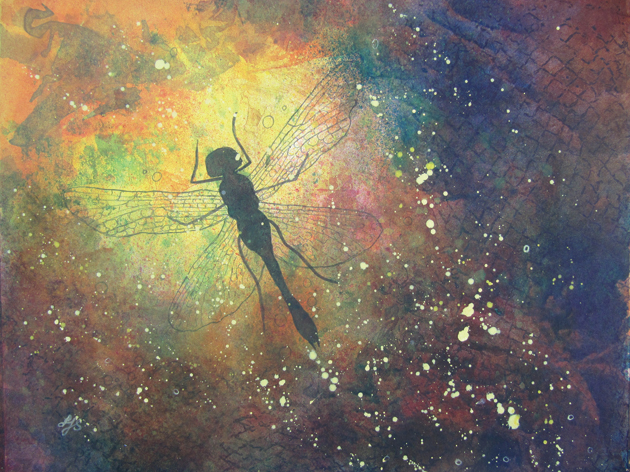
Trapped in a moment of time. A deep stillness – dormant, eternal, quiescent. An illumination – vivid, rich, incandescent. A silence – becalmed, transfixed, spell-bound. The dragonflies, in radiant delicacy, have much to say to us – in our own flitting and fleeting existence.
What are those precariously-perched sparrows thinking? What has snagged their attention? Danger – food – noise?
The wandering rhino is surprised by what exactly, out of the picture frame?
The exhibition at Artrix may not provide all the answers but it will be sure to draw you closer to the images. The succulent colours and atmospheric textures will welcome and seduce you. Be prepared.
These images are examples of the work displayed in an exhibition at Bromsgrove’s Artrix arts centre, by Kathleen Watson and Lynne Sawyer – running until January 5.
Kathleen and Lynne graduated from Wolverhampton University in 2000. They have exhibited together on a number of occasions across the Midlands. The two artists may be found regularly out in the field, sketching from nature.
They both enjoy pushing the boundaries of art with alternative and experimental materials to produce stimulating figurative and abstract work in a wide range of media. This exhibition explores, and is inspired by, the incredible natural world – in a celebration of texture and colour.
Admission is free and the exhibition is open 9am to 2pm Monday to Friday; 10am to 2pm on Saturdays and on performance evenings. The Artrix Café is open Mondays 9am to 2.30pm and on Tuesdays to Saturdays 10am to 2.30pm.
Please get in touch if you would like me to write about an art event near you: richard@galleryart61.com https://www.galleryart61.com
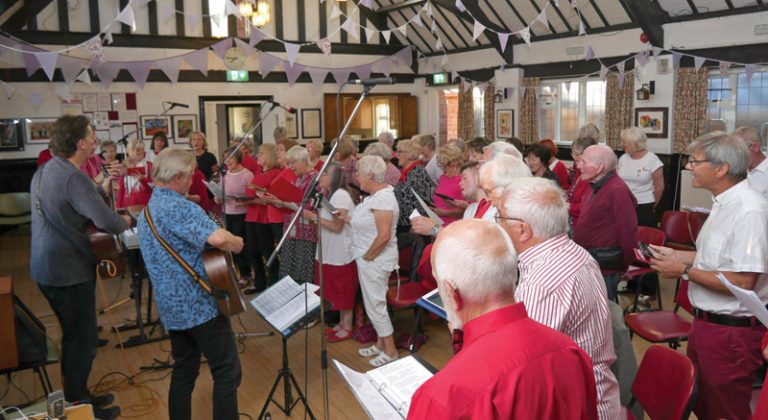
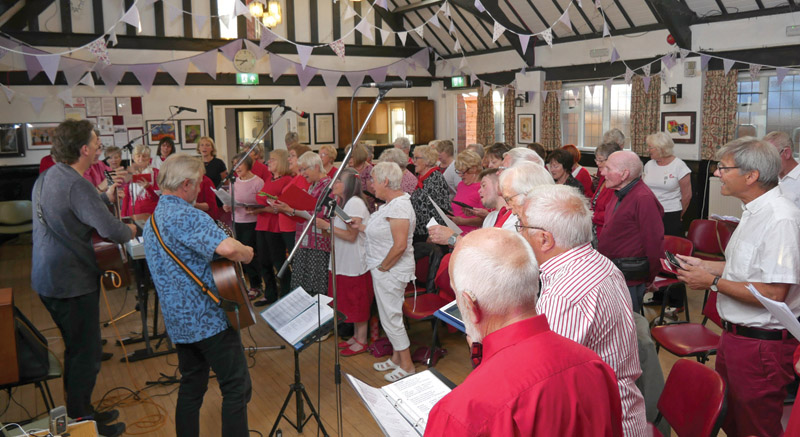
Alvechurch Community Choir has just launched a new website, https://www.alvechurchcommunitychoir.org.uk
It’s been updated to show what the choir is doing these days, and made easy to use. The choir hopes newcomers to the village (and other people who think they “can’t sing”) will have a look and see what a joyful group it is.
The choir enjoyed singing in the rain at the Pumpkin Festival and are now getting ready for their busy pre-Christmas period. Catch them at the Alvechurch Switch-on of Lights on December 6, on several Sundays in the Barnt Green Tea Shop, or join then in The Crown on December 9. New members are always welcome.






 Amateur astronomer Brian Watkiss peers into the Village night sky.