
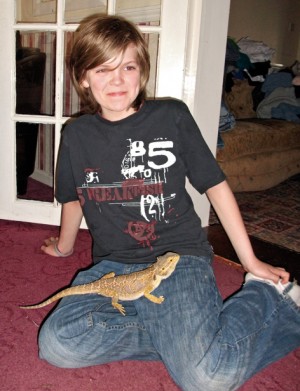
Joe Green, who helps his nan to deliver The Village, introduces us to his pet lizard.
Hi there! When I read last month’s feature on unusual pets, I thought you might like to know about my pet – a bearded dragon.
At first when I got him I thought he would be vicious, but I soon found out that if you handle and play with them enough, then they soon become big softies. He’s a lovely scaly little thing with a long tail and brown eyes. I’ve had him for two years, and in that time Mr B has grown a lot.
I’ve spent hours having fun playing with him and I will have around six to eight years with him, as bearded dragons can live for seven to ten years.
His diet consists of mostly green leafy vegetables and insects like crickets or locusts, with the occasional pinkie or fuzzy (pinkies are newborn mice and fuzzies are baby mice just starting to grow fur, hence the name).
Mr B loves to hide in the fake leaves, or climb up the branches in his vivarium. He seems to respond well to Toffee, my chocolate Labrador – he lets her sniff him.
Dragons usually spend the hottest part of the day burrowed, and then come out in the morning or afternoon basking on the rocks or branches. I can’t wait until the summer when I can play with him outside and he can enjoy the warm sunlight.
You can walk a bearded dragon with specialist leads, but I wouldn’t recommend walking them on paths as this could scratch their delicate stomachs. It’s fine to walk around the garden.
I’ve adored reptiles for years, but didn’t think they would be such fun, and so much work! Bearded dragons cost around £125 – £250, but Mr B is good fun and I love him.
Bryn Morgan of Townsend Veterinary Practice offers some general information on bearded dragons:
Bearded dragons are lizards that inhabit the inland desert areas of Australia. The beard is actually a throat pouch covered in spines that can be inflated as a defence mechanism – and fortunately for vets and owners, they don’t breathe fire!
As reptiles’ body temperature is dependent on their environmental temperature, it is important that a heat source is provided. The preferred body temperature for bearded dragons is 35C, but you should provide a range of temperatures so that your dragon can regulate his temperature by moving to warmer or colder parts of his vivarium.
Dragons should be given 10-14 hours of light per day depending on the time of year. It is also important that light sources contain UV light, needed for production of vitamin D.
Putting small logs in the vivarium along with rocks to bask on and places to hide will help provide environmental enrichment. Although in the wild most dragons live on sandy soils, in captivity they may eat this – so shredded paper may be better.
It is important to make sure your dragon has water available at all times. This is best provided in a small shallow bowl that can’t be tipped over. Dragons often feel this also makes an acceptable toilet and so water should be changed every day!
Young dragons like to eat a variety of small insects, but once they reach maturity (this starts at around 12-18 months) they switch to a largely vegetarian diet, with insect feed offered 2-3 times a week. Appropriate greens include salad leaves, dandelions, broccoli, courgettes, peppers and apples.
Male dragons can be kept in groups with one or more females but if kept with other males they often fight.
If your dragon becomes inactive and listless, fails to lift his body when standing, or stops eating, these are signs that he may be sick and it is best to take him to visit your veterinarian.
