
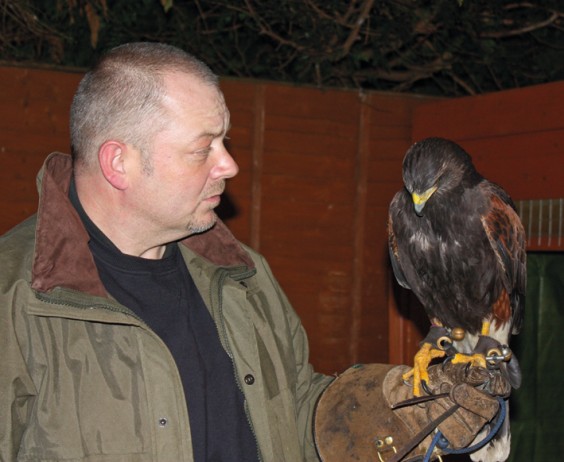
Darren McFerran of West Heath explains how he teaches his Harris hawks to hunt their prey.
We take birds from their parents at around 16 weeks old and fit with anklets, jesses (thin leather straps used for tethering) and a leash. We begin the “manning” process the following day, which involves sitting the bird on your fist for short periods of time, and continue this until the bird starts to feel comfortable.
Then we introduce food on the glove, so the next time the bird feeds it is from your glove. Once the bird is feeding confidently, we introduce the training perch and get the bird to step up on to the glove for a titbit.
Over the next few days we increase the distance that we’re asking the bird to cover, randomly offering it bits of food but with no set pattern. The distance is increased with the aid of a long line called a creance, which is tied to the birds via a swivel and its jesses.
Once we’ve got the bird coming the full length of the creance, which is about 50 meters, with no hesitation, then it’s time to set her free. This is always the most nervy bit, but also the most satisfying.
The bird is then flying free, but we always attach a piece of kit called telemetry to the bird so that it can be traced if it becomes lost for any reason. This consists of a transmitter and a receiver.
The next step is to decide on what quarry you intend to hunt, and start to train the bird to catch it – you would use a dummy bunny if you wanted your bird to catch rabbits. After this stage you’re ready to go hunting! However, you can’t just hunt anywhere; you need permission from the owner of the land.
Over time we will build a bond with the birds as they get fitter and more experienced. The birds will always associate us with food and that’s why they keep coming back.
This is just a basic overview of what’s involved in training a bird of prey and by no means set in stone – other training methods can also be used. You need a lot of time and dedication to own and look after birds of prey properly, so please don’t go running out to buy one thinking it sounds simple, because it’s not!
Katie Jackson, head nurse at Townsend Veterinary Practice, offers some hawk tips:
Harris hawks originate from the south-west USA and from the Mexican border south to Chile and Argentina. They are gregarious birds that can live and hunt in large groups, unlike other birds of prey. This makes them ideal for falconers as they can be flown in large groups, which makes it a very social pastime.
In the wild their diet mainly consists of small mammals such as squirrels and rabbits, and on occasion they will also take birds and lizards.
These birds are usually ideal for beginners as they are very intelligent and quick to learn and once tamed they are easier to handle than most other birds of prey. The life expectancy in captivity is around 20-25 years, so a Harris hawk really is for life.
Plenty of research should be done before acquiring your first bird – there are many clubs, falconry weekends and “hawk walks” where you can gain advice and hands-on experience.
Make sure you are fully prepared for your new arrival and have all equipment and materials needed.
Birds should come with a certificate of captive breeding and have a closed ring around one leg; this can be removed if causing trauma but then a microchip would be advisable.
Townsend Veterinary Practice
168 Birmingham Road, Bromsgrove, B61 0HB Tel: 01527 831616
North Street Estate, Droitwich WR9 8JB Tel: 01905 772002
95 New Road, Rubery, B45 9JR Tel: 0121 453 5828
https://www.townsendveterinarypractice.co.uk
.(JavaScript must be enabled to view this email address)
