
There are plenty of sources that can provide information on your ancestors, writes Janey Hewitt.
A recent meeting of Lickey Hills Local History Society saw members and guests sharing anecdotes and artefacts.
The evening was led by George Gascoyne, who gave an interesting talk on researching family history, advising on the myriad available sources, how and where to search and pitfalls to avoid.
George listed parish registers, the census from 1841 onwards, wills and photographs as valuable sources of information – “If only people had dated and named family photographs” is a common complaint most researchers have.
Oral history is also important, with tales from relatives being a rich source. Ships taking people to the New World kept registers of passengers, so it’s worth checking out immigration lists if you’re looking for a particular name.
George reminisced about how at the age of five years he started school and received a certificate from the King for his contribution to the war.
He became interested in researching family history 15 years ago when his son, then aged 13, was set a school project on family history. George and his son interviewed Granny, and George caught the “researching family history” bug.
He studied English Local History at Birmingham University where he graduated with an MA.
He wrote a dissertation on Chadwich which involved researching as far back as the seventeenth century, involving visits to Christ Church College, Oxford.
George is currently researching information on WW1 prisoners of war hoping to trace more ancestors, and working on a talk relating to the Lickey Hills.
He believes it is crucial for researchers to join a family history society, where they are likely to meet distant cousins.
The society’s chairman, Brian Gould, brought along a record of his family history, which was greatly assisted by the family bible.
Published in 1789, it has been passed down Brian’s family and lists many of his ancestors. Brian was able to trace his ancestor William Gould (1713 – 1749). What a treasure!
Brian has a rich store of memories as he has lived in Rubery since 1967 when he joined Rubery History Society.
He has been part of Lickey History Society since 1992 when the two Societies amalgamated and he was appointed chairman around ten years ago.
Other contributors to the evening included Joan Macarthur, demonstrating that history is not just about looking back, but looking forward and recording the present for future generations.
Joan talked about her father, Jack Pemberton, who was head warden at Handforth, Cheshire, in the Second World War.
This was 12 miles south of Manchester, with Woodford close by making planes, and the airbase at Ringway airport near Handforth in the flight path of enemy targets.
Joan displayed her war memorabilia, including photographs of a certificate signed by Queen Elizabeth (wife of King George VI) sent to Joan’s mother.
Queen Elizabeth sent a certificate to the lady of the house of all households who took in evacuees.
There was also an identity card which was issued to Air Raid wardens. The wardens were known as the ARP (Air Raid Precautions) who were formed along with home guards to defend civilians.
Responsibilities included assembling at their post at the sound of the air siren and checking houses to make sure there were no chinks in the blackout, alerting residents where necessary.
ARP wardens were on hand in case of bombing, when they would co-ordinate operations, fight fires and provide First Aid, working alongside the Home Guard, police and ambulance people.
Joan has also kept a letter that she wrote at the age of eight, to her father in 1944 when he went to London as a relief bank clerk during the time of flying bombs. Although her father was only 34, Joan thought of him as “quite old”.
Only since then has she come to appreciate how young many of the men and women involved in the war actually were.
Dr Cath Elliot showed us an oil painting of Chadwich painted by herself around 30 years ago. Readers will see that this was before the M5 was built.
Cath copied the painting from a black and white print, which was used as a cover for the Bournville works magazine, and had to guess the colours.
The original watercolour, painted by a Mrs Hoyland in the 1930s, used to hang in Mr Edward Cadbury’s office.
* Chairman Brian Gould is currently writing a chapter on “the development of Rubery over the years” as his contribution to a local history book, which is being compiled by me.
If readers are able to contribute photographs and memories of Lickey and the surrounding area, please contact me on 0121 453 2310 or email .(JavaScript must be enabled to view this email address)
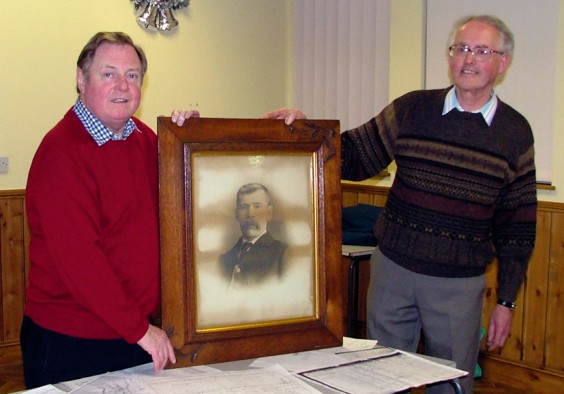
Above: George Gascoyne and Brian Gould with George’s family heirloom.
