
Mike Bannister shares some more childhood reminiscences from his ‘Dandelion Days’ spent in 1940s Cofton and Alvechurch.
Church-going to St Michael’s and All Angels meant adventures, not always theological. At the end of Chestnut Drive, there was a walled garden with a wooden door.
A rough path, The Stocken (we all said ‘Stocking’), led out from under a ‘spreading’ chestnut tree, south along a causeway between the Cofton Pools, known to us choirboys as ‘Big Rezza’ and ‘Little Rezza’.
Beside that track, the German bombs had come down in the night, leaving craters and holes with sandy sides for sliding. There we mined, with careless hands, ugly shards of deadly steel shrapnel, which we took for trophies.
In that small wilderness, we were free, for an hour or so, to sing and shout, throw stones, play games, take risks, and make small mischief.
In 1942, winter hung on, with deep snow. Our ‘Little Nanny’ Priscilla Rollason (five foot nothing of whirlwind and uncompromising discipline) came to stay. Our dear sister Judith was born on a Monday – Cub night.
Marcella, whose heart was never strong, had ‘Done her Best’, had lived through an ordeal, and brought a magic gift. Everyone was mightily relieved about this, and happy to be five.
One Sunday I came in very late from Miss Chaffer’s Sunday School, my short green trousers not quite dry, after a tricky voyage across the Little Rezza aboard a waterlogged door, in the company of a tall kid called Kenny.
I little realised that Elsie Marcella had already walked out to look for me, had observed my daring adventure from on high, and was waiting for me with a gale of questions.
She began with, “Have you any idea how to swim? Do you happen to know how deep that pool is?” It ended with a belting, some tears, and early bedtime.
Another time Dave and I, after Morning Service, came home with news so thrilling we could not keep it to ourselves. We had found a grand CAVE, not twenty feet below the Rezza dam.
It was to be our new ‘Camp’ and we needed to think of a name for it. Charles looked thoughtful, and said perhaps he should come to see it for himself.
We set out, bubbling with the excitement of it all, only to find the entrance to our ‘cave’ guarded by a very solemn-looking, fully-armed soldier. The military guard talked at some length to Dad, who then walked us home very quietly.
The ‘cave’, Charles explained, was the point of entry of a bomb, which in the soft clay of the dam had failed to detonate. It would be better, he thought, if we did not venture there again, until the high explosive was removed.
That night we lay awake, whispering in the darkness, brothers in alarm, thinking, differently, of The Green Hill Far Away….
How close did we come to ‘the enemy’? Pretty close. Over the following months, the sky seemed always full of aeroplanes. By day they grumbled and moaned from north to south, never very high, it seemed to me.
Ours, the friendly ones, had circle targets painted on their sides. If they were very close, we ran to and fro, cheering and waving. Once a friendly fighter-pilot rocked his Spitfire, side to side, as if to return our childish salutations.
At night it was a different story. First the siren droned its banshee drone, warning us of danger. Then, faintly at first, came an angry little noise, like cornered wasps, this time south to north. The whole effect was fearful.
One special time in broad daylight, Mom had just served up a rabbit stew, with potatoes and greens and gravy. Suddenly the wasp noise was very near; we ran outside.
There, within a ‘stone’s throw’, a huge plane, not with a circle but with a cross – an ‘enemy’ plane – came trailing black smoke, so near, so very clear. We could make out the pilot’s anxious face, peering overside, as if to seek some smooth landing place to put his aircraft down.
Uncanny it was to see men in danger of almost certain death, sinking earthwards. ‘Enemy’ or not, it was a desperate situation.
Some of the enemy survived the heat of battle; some lay with dreadful injuries in hospital wards, receiving the care that was their due under the Conventions of War. There it was that our father went each day to work as Charge Nurse over a ward of the severely wounded and disabled from all nations.
Being party to these matters certainly broadened our green minds and, to some extent, I think it began to suggest to us the sad futility of war.
March 1944: Little Nanny was staying with us again. By some coincidence, our second little sister, Jenifer, was born.
In spite of our concerns about her weary heart, Marcella lived through childbirth, again, and we were thankful to greet a new life in the family. Now we were six.
One Saturday that summer, the local community trooped out, over The Stocken, down Cofton Church Lane, to goggle at the wreck of a German fighter plane that had come down in the meadows above The Arrow Pools.
The silver nose-cone was buried in the turf, its propeller buckled, the dome smashed out. The field was guarded, cordoned off, for security reasons.
The ‘grown ups’ talked about how the pilot’s feet had been mangled in the impact. We stared and stared, and then went quietly home.
It would be several weeks before small pieces of that plane began to circulate at school, swapped for bits of shrapnel, the pocket trading tokens of wartime school kids up and down the land.
THE BEGINNING OF THE END
Time went by; the milkman came each day, drew up with his horse, and ladled out rich milk that actually tasted like milk, from churn to jug.
Once a month, Arnold Leadbetter, the handsome poacher cum game-keeper, appeared, smiling, at the back door of Drachenfels. He would have fresh eggs or a rabbit for the pot; sometimes even unofficial butter in a clean fold of greaseproof paper.
Marcella was a genius at ‘Making Ends Meet’ – through careful economies, she somehow managed to ‘afford’ such extras.
One clear, windless day in early summer 1944, the whole sky went dark with glider planes. Like long-winged birds, hooked up to roaring planes, they drifted in their hundreds, going south again.
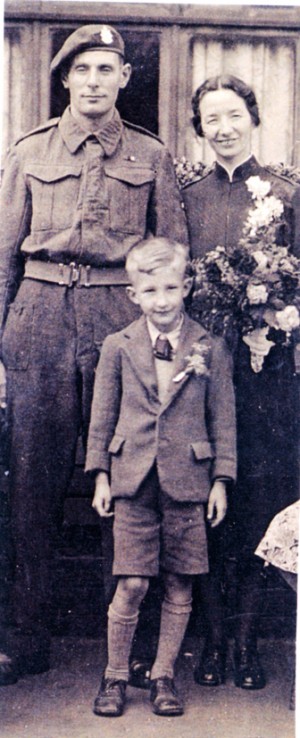
Planes like these had flown Uncle Bert Muir over the North Sea, months before, to drop him by parachute into Arnhem, and thence, due to the ineptitude of his commanders, to months in captivity.
But today’s migration was something else: something new and big was happening, something that not even Alvar Liddel had mentioned on the wireless. We were puzzled, and excited.
It was the sixth of June. The Longest Day was just beginning.
April 1945: I overheard Marcella say that she intended to stop the Daily Telegraph for a week. Sure, we could still have the Knockout comic on Wednesday as usual, with Sexton Blake and Stone-Age Kit the Ancient Brit (“Daft, I call it”).
Every week, Charles made a fuss of ‘getting first read’ of the Knockout. There would be a mock dispute that raised voices, and the threat of us being late for the school ‘chara’.
But why no Telegraph, for one particular week, with its small photographs and acres of grey print that seemed to occupy them both for ages? I continued to be mystified, but not for long.
On my way from school some days later, an almost complete spread of the Chronicle, adrift on the breeze, almost wrapped itself round my feet as I dawdled home past Fletcher’s Amusement Arcade. This was my moment.
I quickly stamped on the greasy sheet, a cast-off chip paper, and turned it over to find the most ghastly scenes of half-clothed men, women and boys clutching at the wire of some prison yard in Bergen Belsen.
There was more, and worse, of bodies piled askew, and earth pits being filled. My gut churned. I headed for home, wanting only the quiet dominion of Drachenfels, the smell of good food, the clink of tea-cups, and Elsie Marcella; quiet and constant in her care and love for all of us.
That same night I lay awake, mouth dry, unable to broach the topic of the pictures I had seen, and lost, quite lost, for any explanation as to why and how people could do these things.
It was a hateful world, a million miles from all I knew and loved; a hideous living dream to haunt me all my days.
Sometime in May 1945, we tumbled off the ‘chara’ as usual one afternoon, free from the overbearing gloom of Waseley Hills for another evening. Brother Dave and I went to climb and swing in the willow trees between the tramway terminus, and the gate to Cofton Park.
This was no ordinary day. A youth from Fletcher’s Fair came down, shouting wonderful news. “The War‘s over!’ he said. He’d heard it on the wireless that very hour. I was eight and a half years old, and I felt gloriously happy for weeks and months to come.
Victory in Europe! There was a huge bonfire in Parsonage Drive. Uncle Bert, our own family parachuting hero, newly released from the Stalag Luft prison, went missing for three whole days.
Mr York Jones, who owned, I think, the Lickey Tea Rooms, gave each child in the neighbourhood a free goody-bag with ice-cream.
Collecting mine with Dave and Betty Coley, I fell off my bike, and was taken, in great pain, by Elsie Marcella on the tram to Selly Oak Hospital and there was fitted with a fracture sling.
ALVECHURCH FOUND
Somehow, life was never quite as threatening again. A year went by, and in 1946, we made the great family migration to Alvechurch village, and to Gothic Cottages in Mill Lane.
For us four children, Mother Nature opened her doors to a time of peace, freedom, and if not exactly plenty, enough at least.
Our new home was lit by gas. Electricity was not available. Where once the wireless had reigned supreme, reading seemed to take hold of our lives as never before.
It began with the pages of Arthur Ransome’s Coot Club, Henry Williamson’s Tarka, and Richard Jeffries’ Bevis, whose doings we re-imagined as we haunted the wild green run of Rasmussen’s Dingle, and The Dumps, the old carp pools below Mynott’s farm.
In company with our namesakes, the Mynott brothers, Dave and I camped out and cooked, mapped and made dens, or rambled our summer days away; finding bird nests, stalking rabbits, keeping company with grass-snakes and kingfishers, fishing for perch, finding mushrooms, and drinking from clear springs. It was an idyll like no other.
Coming back home after spending a night or two under the stars always meant a special welcome. In fact, one of the single, greatest joys of being a ‘little brother’ was being ‘spoiled’.
I would creep into the quarry-floored kitchen at Gothic Cottage, and settle into the corner chair at the work-table, just when sweet cooking smells were at their most appetising, and there, sometimes, I was gifted – and surprised, always surprised – with some sublime delicacy from the casserole; maybe the rabbit’s head (tender tongue, cheek-meat and brain!) dripping with a delicious deep brown aromatic gravy of garden herbs and vegetables; or perhaps a simple chicken claw, golden, gluey, succulent and nourishing.
What grander tokens of a mother’s love were ever wished upon a child?
But there remained one singular and important lesson for me to learn about War. A strange experience lay waiting in these woodland ways as, gradually, Dave and I began to involve ourselves in the routines of life on Mill Farm.
Ernst Rasmussen’s magnificent dairy herd of 30 or so long-horned Ayrshires was managed by Celia Burman, Tony and John Small, and we were fascinated, brother Dave and I. It was our first introduction to Real Men’s Work. We shared in it, and we learned about life to the full.
From the war-prison camp in Tanyard Lane came German prisoners, helping to rebuild productivity; carrying forward the landwork until our own heroes would came marching home.
Dressed in dark brown fatigues and heavy boots, Hans, Max and Josef spoke only a few words of English. Helping them learn more was my first experience of teaching, and one which made me feel positive and somehow useful in the world.
As time went on these three became family friends. We came to see them as no more than ordinary men, with the same capacity for laughter, love and loneliness.
Their feelings about war mirrored our own feelings; that it was a massive and mindless cruelty, a waste of time and life, a curse upon the common people everywhere. In all my sixty years and more, I have not found much reason to think otherwise.
Occasionally, our ‘alien friends’ came to supper, listening in awe as Charles regaled us with the family saga: how only three generations previously, not quite a hundred years ago, his mother’s (my grandmother’s) people had migrated from Prussia to the Port of Cardiff; fugitives from the horrors of some other war.
Often these strange, convivial evenings ended with some singing, handclasps, and a few sentimental tears.
When the time came for their release and repatriation, one of our German friends made Elsie Marcella a willow basket; another made Charles a ‘German Village Scene’. It was a village, just like ours, in winter snow, set inside a half-size whisky bottle, bright-painted and magical.
Time for leave-taking; no more folk-songs, no more sad smiles or halting reminiscences. The war was finished with, for good and all; and in our innocence, we reassured ourselves that there could never be another.
* Mike Bannister’s collection of 25 poems, Greenstreet Fragments, was published in 2003 and is on sale at £4.50 at Alvechurch Post Office. Signed copies can be bought from Mike at £4.50, post-free, from 23 Station Road, Halesworth, Suffolk IP19 8BZ.
Pictured: Mike with his Uncle Bert and Aunty Josephine on their wedding day in 1945.
