
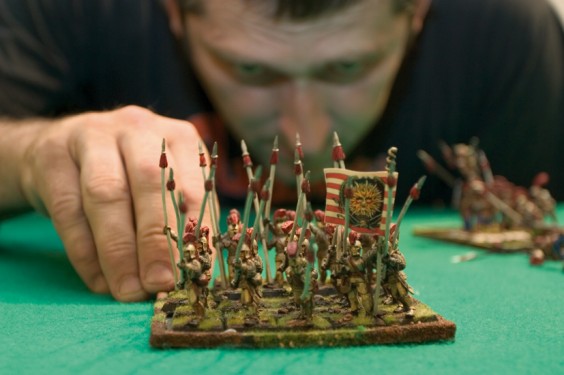
A new Alvechurch club offers the chance to play games of tactics, logic and skill, writes Karl Farrell.
Fancy yourself as a budding Caesar or Maximus (Russell Crowe in Gladiator)? Want to lead 300 Spartans against the Persians? Maybe you see yourself as a Pharaoh leading an ancient Egyptian army, or even a WWII tank general. Possibly you prefer a friendly game of chess or to shake the bones in a game of backgammon?
Well, you can do just that – and have a pint at the same time – at the recently inaugurated Chess, Backgammon & Wargaming Club, which meets every Monday evening at Alvechurch Sports & Social Club.
Backgammon is probably the oldest game in the world. It’s very easy to play, but takes a lifetime to master. It requires good tactics, an adaptable strategy and, with the advent of the doubling cube, good judgement and steely nerves.
Most people know how to play chess. It’s the most concise, precise and brain-hurting game I know. It’s 100 per cent skill; there’s no lucky dice or turn of the cards involved.
Originating in India around 450 AD, it was initially a wargame used in training army officers. The modern day Castle (or Rook) was initially an elephant model.
Elephants were widely used in ancient Indian armies as a major attack weapon; they caused terror to cavalry units and would make a right mess of infantry blocks.
Which brings me onto Wargaming (one of my armies being an ancient Indian).
A wargame is like a game of chess but using hundreds of pieces instead of 32, several types of dice, a rulebook and a playing surface usually about the size of a pool table.
You lay out some terrain such as hills and woods, organise your nicely painted model soldiers into units, line them up and beat your opponent with a cunning plan (well, you don’t always beat him, to be honest!).
Modern day wargaming was developed (like most decent sports and games) in Britain. The hobby exploded in the 1970s, mainly due to a Birmingham-based outfit called the Wargames Research Group who published the first widely adopted set of rules for the ancient period.
Ancients is my main period (thus the bias in this article) but if there’s been a conflict at any time in history, anywhere in the world, then you will find published rulesets for it.
Other major periods include Renaissance, Seven Years War, Napoleonic Wars, American Civil War, Colonial Wars, WWI and WWII.
Most youngsters will be familiar with Dungeons & Dragons and the Warhammer Fantasy battles. Well, Warhammer have a ruleset for ancients which I sometimes use, and (to my surprise) they aren’t too bad.
You’re welcome at the club whether you’re an expert or learner, male or female, young or old (under-17s need to be accompanied by an adult). Social Club membership is not necessary for joining, although becoming a member allows full use of all the Club’s facilities (snooker, pool, Sky football etc).
The club meets every Monday (except most Bank Holidays) from 7pm onwards. For more info please ring Karl Farrell on 0121 445 4616.
Above: Matt McVeigh sends in the troops.
