
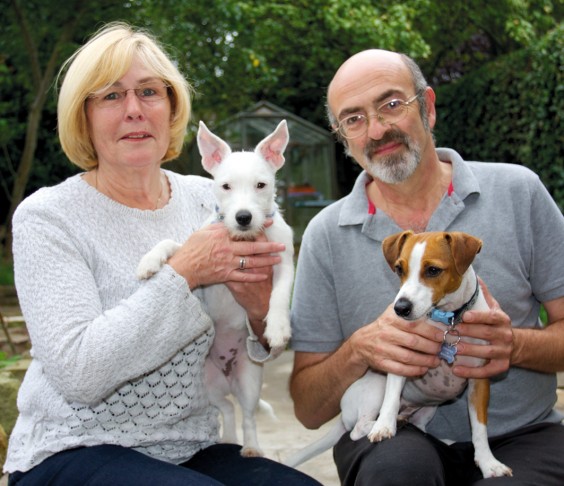
Val Farrell of Alvechurch tells us about the ups and downs of looking after her deaf Jack Russell.
Our first rescue dog was a Jack Russell named Penny, who my husband Karl and I got from Wythall Animal Sanctuary when she was nine months old. She settled well and soon got used to her new name – her only issue is getting vocal with other dogs; not all, but most!
Oh yes, and her recall is non-existent. Consequently she is never let off her lead. Once was enough, and we both nearly had heart attacks trying to get her to come back. I ended up doing a rugby dive to catch her.
Nearly three years after Penny joined us, I thought it was time to get another dog. We are firm believers in taking a rescue dog, but on the whole they are usually adult dogs, and this time I wanted a pup. I said to Karl that if we had a pup, we would be its “surrogate” mom and dad, and it would be easier to train. What did I know?
I saw Tess advertised online (not always the best medium to acquire a pet, I must admit) in the local area, so off I went to see the litter. Four of the pups were white and tan, the usual colour for Jack Russells, and the remaining two were mainly white. On my initial enquiry, I had implied my preference for one of the four bi-coloured pups.
On my arrival, I could see that it was a normal family home and the pups’ parents lived there, so there was no question as to the parentage. However, all the bi-coloured pups had been reserved, which left the choice between the two white pups.
I picked both up to see which would bond with me – very important, I think. Tess had a black dot on one of her ears, otherwise she was white. Whilst holding her, she started to get restless, and no sooner had I said, “I think she wants to get down to pee,” than she did exactly that.
At four weeks old, I thought, “That’s a good sign, she will be easy to house train,” and I plumped for Tess. What did I know?
Four weeks later, with great excitement and anticipation, off I went to collect her, having borrowed a pet carrier to transport her home.
The journey home was horrendous. She screamed and wailed non-stop, but this didn’t surprise me, as she had been separated from her parents and was in a strange environment. I turned the car radio up, sang to her, and poked my fingers through the carrier to assure her she was not alone. What did I know?
I arrived home and Karl came to the car to meet her. He hadn’t really been convinced that another dog was a good idea, but one look at this cute bundle of white fluff and he melted. Next, we had to introduce her to Penny. This went well, although Penny’s enthusiasm had to be quelled.
I had already bought a dog cage in which to put Tess – I had read that they are ideal for house training, and, of course, to separate her from Penny as and when needed. After all, they both need their own space.
Well, as you might expect, and we had anticipated this, whines and squeals were the order of the first night. We went to bed, and as soon as Tess realised she was alone she started. This went on for nearly two weeks – day and night.
We decided to stay downstairs with her, taking it in turns to sleep on the sofa. It would seem that this was the only way to quell her nightly tirades. Of course, it became clear that the only way for us to get some sleep was for Tess to join whoever was on sofa duty.
By this time, we thought, she might as well join us in bed, as had Penny for the last few weeks (I know, not ideal, but hey-ho), at least we would all get a good nights sleep.
The only time Tess was in the dog crate during the day was when she was gingerly put back once she had been nursed to sleep. I must admit though, on waking, she duly went to the newspaper end of the crate to do her toilet – we’ve cracked that, I thought.
Although adorable, Tess was so naughty. She took no notice whatsoever of our commands (or pleading, really) and I commented that she didn’t even know her own name. What did I know?
Karl came up with the idea that it was possible that she might be deaf, so we did our own hearing test. A couple of saucepans clashed together whilst Tess was asleep – not a flicker.
We turned to the internet to find out what we could. What an eye-opener. It would seem that if a dog (or cat) is white, it may have some hearing problems, if not total deafness.
It is hard to describe what I felt at the time. Sheer frustration, for this was the dog we hoped to train to near perfection. Sadness for Tess, and a quandary as to what to do for the best. I have to admit, at this point I did think “a trip to the vet for the final solution” – but it was a fleeting thought and quickly put out of my mind.
I searched online for any information, and there was plenty. We had no idea how prolific this problem is. A training book written by an expert was bought, which advocates using hand signs and body language. Oh yes, and a lot of patience.
Tess is seven months old now. Hand signs are coming very slowly. She knows the pointed finger means NO; she knows the palm of the hand means NO – well, that’s one word, and it’s a start! Obviously, our routine and habits are becoming known to her, and hers to us, so although she is hard work, it is not 24/7 as it was at first.
She does hate to be left alone, which can pose its own problems, but we read that for some reason deaf dogs do show what is called “separation anxiety”, which she surely does in no uncertain terms. It’s deafening, therefore she is never left alone and has to have a constant companion.
Tess loves her walks with Penny, although I am sure Penny would rather be on her own, and she loves the garden. She is a great tease, especially if she has retrieved something she shouldn’t have, like a sock or a slipper, and has great joy in seeing us chase her for it.
Apart from her deafness, she is just a normal, naughty, mischievous pup, and has made herself quite at home. I am hoping that, with time and even more patience, she will learn to ‘hear’ our signals.
Lucy Lowe of Townsend Veterinary Practice offers some expert advice:
Poor Tess! It is true that cats and dogs with a white coat can be predisposed to deafness, but not all of them by any means.
As Tess’s owners are discovering, deaf pets can be trained, they just require patience and a greater emphasis on body language and hand signals.
It does seem that Tess suffers from ‘separation anxiety’, which can affect all dogs – although some of the methods of overcoming it, such as leaving a ticking clock or the radio on, will not be of use in the case of deaf dogs.
There are some preparations which can help with separation anxiety. One is a diffuser which emits a synthetic copy of the “canine appeasing pheromone”, a natural product proven to comfort both puppies and adult dogs. The pheromone is the same as that naturally released by all lactating mammals to comfort their offspring.
This may be a useful thing to try; simply plug the diffuser into a normal plug, in a room where the dog spends the most time. It can take around a month before any improvement is seen but they can be very effective. These diffusers can be purchased from your local veterinary practice.
There are other natural products available from veterinary practice which can help with anxiety. Most practices will also be happy to offer training advice – at Townsend we have nurses who have undertaken courses on animal behaviour and training and are happy to help clients with training issues.
Townsend Veterinary Practice
168 Birmingham Road, Bromsgrove, B61 0HB Tel: 01527 831616
North Street Estate, Droitwich WR9 8JB Tel: 01905 772002
95 New Road, Rubery, B45 9JR Tel: 0121 453 5828
https://www.townsendveterinarypractice.co.uk Email: .(JavaScript must be enabled to view this email address)
Follow us on Facebook
