
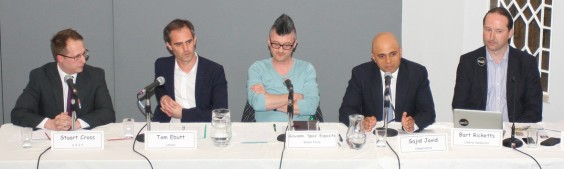
Alvechurch Baptist Church hosted all the candidates hoping to be your MP. Here’s what they had to say . . .
Around 110 people filled Alvechurch Baptist Church to hear the candidates for the Bromsgrove parliamentary seat answer questions from the public.
Chaired by Keith Williams, with Alyson Williams keeping an eye on times, the candidates took turns to answer seven questions submitted by villagers before the event.
Trying to cram a couple of hours into a couple of pages is unfeasible and so there isn’t always an answer from every candidate, but we’ve tried to be as balanced as possible.
1. The NHS and welfare state came out of the times of austerity after the Second World War, what will your party bring from this period of austerity?
Stuart Cross, UKIP: Our party would bring independence from Europe. What we would leave as a legacy would be a balanced budget and independence from European control.
Tom Ebbutt, Labour: I think the lesson people take from WW2 and the landslide election result was that we wanted a fairer and more secure society. I hope that time will come again that we will want a more fair society.
You can point to a whole range of things that I would like to see, such as non-dom tax. I would want to see us treat each other like human beings.
Giovanni ‘Spoz’ Esposito, Green Party: A legacy for the next generation is exactly what the Green Party is all about.
The Green Party is going to leave a safer, more caring planet, a cleaner planet with a future. We are part of a massive picture, folks.
Sajid Javid, Conservative: A strong economy, because that is the only way we can pay for the public services we really deserve and can lift people out of poverty.
We need to make sure that Britain is competitive and it also means we need to reform welfare to make sure that work pays.
Bart Ricketts, Liberal Democrat: It is about having a strong economy, but also a fairer society. It is to create opportunity for all and to increase everyone’s life chances.
2. Following the Health & Social Care Act 2012, designed to promote better integration of health and care services, why has Worcestershire County Council had to approve a £12 million cut to adult social care, and does this mean that the extra money for the NHS pledged by the political parties will just result in more patients being cared for in hospital when they could be at home?
Tom: Labour is the party of the NHS. The Health & Social Care Act is an Act that no one voted for. Health and social care are not two separate things.
Spoz: We will repeal the Act. It was outrageous how that came about. Health and social care are one and the same thing. We are committed to providing higher funding because it really makes sense.
Sajid: We created the £5bn Better Care Fund to deal with issues that fall within both areas. In an area like this where all the major parties agree, it would be better if we could find a way to take day-to-day politics out of it.
Stuart: At Worcestershire County Council the money literally was not there. It is a travesty that people’s care is going to suffer because of cuts. UKIP wants to stop that by funding it properly.
3. How do you personally view the issue of climate change, and how will your party prioritise it on an international agenda in order to stop it pushing disadvantaged communities, particularly those in developing countries, deeper into poverty?
Spoz: My personal view of climate change is that it is happening. We need to slow it down, we need to put it right. The only way is with sustainable energy and to stop burning fossil fuels.
We have the capacity to generate clean energy for the whole world, we just do not have the will. At the local level I would like to see wind turbines on the Waseley Hills.
Sajid: We take it seriously: we have the Climate Change Act, we have set up the Green Investment Bank and we introduced the Climate Change Levy.
But whatever the UK does, we are very small in terms of global emissions as countries like China, India and Brazil grow and want what we’ve got, which is perfectly understandable, so to deal with those issues will require a lot of co-operation at the international level.
Bart: It is a lot easier for European countries to put these things in place. The next government will have to tackle that with perhaps different levels of taxation and also looking locally at the environmental impact of what we are purchasing.
Stuart: There is no denying man is having an impact on the planet. We are a very small country; would it have a global impact if we were as green as possible? The answer is in technology and renewable sources and we need to invest in those sources.
Tom: I remember the time when David Cameron said this was going to be the greenest government, so I think it is really sad what has happened over the past five years.
4. Please bring back by law morning assembly with a religious theme, and religious education during which children of differing religions can attend their own religious classes.
Sajid: One of the good ways we govern ourselves is that we are not dominated by religion, but that doesn’t mean there is no role for religion in society. If people want to practise their religion, that’s fine; that’s nothing to do with the Government.
I don’t think that it is the place for politicians to dictate to people about religion and what should happen in schools or elsewhere.
Bart: It is important to have multiculturalism and to have all cultures working together. It should be down to each individual school.
Stuart: Religion and Government should be kept apart as much as possible. I don’t agree that it should be forced upon anybody.
Tom: I was brought up in the Christian tradition and remember doing Scout parade in Lickey. In terms of schools I don’t think politicians should be imposing that ‘x’ or ‘y’ should be done.
But people should be taught about different religions in schools and talk about the value of those religions and their similarities.
Spoz: Is the question, should we bring back religious assemblies? “No” is the answer. I think morning assemblies are brilliant, but I would like to see assemblies that don’t talk about a religion.
We should teach our children right from wrong. I am a disenfranchised Catholic, as you may be able to tell.
5. Why is it only English students who have to pay the extortionate fees for University, when the Welsh and Scottish students get it free? This also applies to prescription charges.
Bart: This has obviously been a difficult decision for the Liberal Democrats. Once fees were introduced by a Labour Government it has been really difficult to change that back.
We are hoping that one day there can be free fees in the UK as a whole.
Stuart: I think it’s grossly unfair that this exists. We are supposed to be a united kingdom, but this is basically bankrolled by the UK taxpayer.
UKIP would waive tuition fees for subjects such as science, mathematics and medicine.
Tom: I’m not going to rub more salt in the wounds of the Lib-Dems. A Labour Government would reduce tuition fees from £9,000 to £6,000. I’d like it to be reduced by more, but this reflects the climate.
Spoz: It is because Wales and Scotland care about their young people and prioritise it in that way. In England it divides a community and I would like to see tuition fees eradicated completely.
UKIP wants to divide you depending on whether you are an immigrant, now they want to divide you according to whether you want to be a scientist.
Sajid: The answer is that ten times more students go to university now than 20 years ago when I went. When we increased the fees we made sure it was free at the point of entry and there is no evidence that it put anyone off going to university.
When Labour says it will spend £3bn to bring them down to £6,000, it will only benefit our richest students.
6. What governmental reforms of Westminster are in your party’s manifesto? Do you agree with them and what others would you include to enable government to be fit for purpose in the 21st Century?
Stuart: The right to recall so that citizens can hold their MPs to account. A people’s referendum every two years . . . because what we are campaigning for is withdrawing from the EU and I do believe we should have a referendum on it.
Tom: Parliament is wrapped up in mystery and the more we can change that and make it more accessible, the better. We think an unelected second chamber is over-represented by London and the south east. We want an elected second chamber.
Personally, on a local level, to prevent the one-party states in local government, I would like to see proportional representation so that it would not just be red, yellow or blue.
Spoz: I would like to see the demystifying of the Houses of Parliament and I think it would be preferable to relocate them somewhere more central, like Birmingham . . . or Alvechurch!
A referendum on Europe might be good because it would get rid of UKIP forever when we vote to stay in.
Sajid: We would reduce the number of MPs from 650 to 600 because there are too many, and we would deal with the Midlothian Question. It is going to be English votes for English laws.
The third thing we would change is to bring in equal sizes of population in constituencies.
Bart: Decisions are still taken too far away from those they affect. We would let people vote at 16 and put a cap on how much money can be spent in elections. We would be supporting constitutional change of the House of Lords.
7. How do you yourself, and also your party, see our NHS functioning in 10 years?
Tom: It should stay free at the point of use and focus on patients and not be run for profit. If you look at what has happened over the past five years, there has been a private sector in the NHS.
Spoz: At the current rate there will be no NHS in ten years’ time. I would say there is no place for profit. There are only two factors that matter: the patients and the people supplying the care to the patients.
Sajid: I think we all agree on the challenges; a growing, ageing population and more treatments that can prolong lives. It requires more resources and we said at the time of the last election that we would protect spending on the NHS.
We did more than that and in real terms it receives £7bn more than it did five years ago. We are committed to the extra £8bn it requires until 2020.
Bart: The Lib Dems are looking to commit £8bn until 2020. We are looking at giving people more control of their healthcare budget and supporting people to care for their own health, perhaps through things like better diets.
Stuart: It worries me as a parent. I am going to spend all weekend in the maternity unit of the Alex. All I would ask is that whoever is in government they make the NHS a priority because my fear is that in ten years’ time the NHS will be the same as it is now.
Questions from the floor
After the pre-submitted questions, the chairman opened the panel to questions from the floor, including:
Would other candidates give more time to Bromsgrove than our current MP?
Sajid: Bromsgrove doesn’t get only a little of my time. My home is in Finstall and I work hard to reach out to all areas of Bromsgrove.
Judge me by my record and if you think my record reflects that I don’t give enough time to Bromsgrove, then that’s your right, but there will be plenty of people who disagree with you.
Do we need Trident/a nuclear deterrent?
Spoz: A nuclear deterrent is not a deterrent.
Tom: I’d love to live in an ideal world where we don’t need nuclear weapons, but we don’t live in an ideal world and you can’t take our security for granted.
Sajid: With the greatest respect to Spoz and the Green Party, they are utterly, totally deluded if they think we don’t need nuclear weapons.
Bart: It is a difficult subject. The Lib Dems will look at a deterrent and negotiate with our partner in government and look at whether we need two submarines rather than four.
Stuart: We live in a dangerous world and we have to have this defence in place.
Final Words from the Candidates
Bart: I would encourage everyone to get involved and vote with their hearts. We have had many MPs work very hard to give the Conservatives a heart.
Sajid: I am happy to be judged by my track record and on the Conservatives’ track record. I have worked hard for the past five years. I don’t get everything right; sometimes you just can’t help because it isn’t in your power.
Spoz: If you are looking for a fairer, caring society, then it has to be the Green Party. It is so obvious.
Tom: What do you want this country to look like? The Labour Party will produce a fairer Britain. There is a clear choice between Labour as a party of change and equality and a Tory Party with unfunded promises.
Stuart: All I would ask is: read the UKIP manifesto and if you don’t agree with it, vote for one of these people. It’s great that so many have come tonight.
