
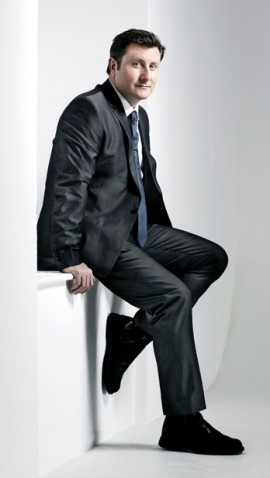
Sally Oldaker chats to Ben Cooper, the Controller of Radio 1 and Radio 1 Xtra, who grew up in Aston Fields and was back in his home town to give a talk at Artrix.
As children, most of us like to picture our future careers – actor, firefighter, astronaut – but it’s rare that we end up in the very job we once wished for.
So when young Ben Cooper sat in his Aston Fields bedroom listening to Radio 1 and dreaming of becoming a DJ, he surely could not have imagined that one day he would be running the whole station.
As the Controller of BBC Radio 1 and Radio 1 Xtra, as well as a member of the BBC’s Radio board and Chairman of the Radio Academy, Ben is proof that dreams can come true – with a bit of hard work, of course.
His love of radio – and Radio 1 in particular – began when his parents bought him a set for his eighth birthday: “I always listened to Radio 1 rather than anything else, and thought how great it would be to earn a living from playing music,” he recalls.
However, opportunities to get involved in broadcasting were fairly limited during his time at Finstall First School, Aston Fields Middle and South Bromsgrove High, which he left in 1988.
“Now the schools have brilliant facilities for media and technology, but not in my day!” he remarks.
The first time he was able to get involved with a radio station was when he did work experience at Radio Wyvern and then BBC Hereford & Worcester, when he was at Bristol University.
“I thought: wow, you really can get a job playing music!” says Ben – who, surprisingly, didn’t do Media Studies at Bristol, opting instead for Public Administration, a mix of economics and sociology.
“I then decided to go and work at BBC Hereford & Worcester. It was my first job: £30 per week, mainly answering the phone and making tea. . . but I was in love with radio and I knew I wanted this to be my career.”
He stayed with Hereford & Worcester and trained as a journalist, travelling all over both counties to report the local news. “Luckily for me, I had the advantage of the knowing the area really well, because my parents used to own Bromsgrove Books and I would do the deliveries for them in my school and uni holidays.
“I realised how important this local knowledge was when I later worked in Luton and hadn’t a clue where anything was!”
Ben then moved to Three Counties Radio, before finally realising his dream of working for Radio 1, as a producer.
He went on to spend two years as executive producer Capital Radio, worked with the likes of Chris Tarrant, Neil Fox and Cat Deeley, and even doing an outside broadcast for the Sydney Olympics – he says he loved every minute, but jumped at the chance to go back to Radio 1.
“I met the then Controller for pizza, and he offered me the position of Head of Mainstream – it was a great opportunity to be part of the management; getting to play with the train set, if you like.”
Did he have an eye on the top job from then on? “Good question! I wouldn’t say it was a conscious ambition, but I suppose I did sort of think, yeah, perhaps one day it might be me at the top,” he reflects.
“When I became Head of Programmes I knew I was getting quite high up, so I did realise it was a possibility.”
Ben was appointed Deputy Controller in 2009 and oversaw a major restructuring of programming. He became Acting Controller in July 2011 after the departure of Andy Parfitt, and duly moved into the top spot, where he’s in charge of editorial content, leadership and overall management of Radio 1 and Radio 1Xtra.
It’s been well-documented that his brief was to drastically reduce the average age of the station’s listeners, but did he have some of his own ideas on what needed changing?
“My main concern was changing the digital landscape,” he says. “Radio 1 is for young people, to represent their music and culture – if we are going to connect with them, we have to be across what they’re doing; the technology they use.”
“Relevance” seems to be his watchword: “We need to be relevant and to offer relevant content, and I really want to achieve this for the next generation – the “HD” generation as I call them.
“HD stands for “head down”, because they’re looking at their phones or tablets all the time.”
Ben was keen to make radio into a visual concept for these youngsters, but this posed an interesting question: what does radio look like on a screen?
“It’s pretty hard to achieve,” he admits. “It would be boring if you just filmed the DJ sitting in the studio – so we film things like interviews with guests, live performances, DJs mucking about.
“The idea is that people will view or download these moments, and hopefully they’ll share it with friends via social media.”
Having already launched a YouTube channel for this purpose, Ben also hopes to have radio content available on the BBC iPlayer later this year.
But despite embracing new technology – and despite implementing not-always-popular changes such as replacing Chris Moyles on the Breakfast Show – the average age of a Radio 1 listener still stands at a geriatric 32 (it should be between 15 and 29).
“That average still hasn’t flippin’ moved!” says Ben. “But we are doing the right things. The statistics make it into a mathematical issue, but we “feel” young and we are representing young people, even if older ones are still tuning in too!
“It’s a very difficult nut to crack, but we are certainly more focused on young people than ever before.”
This includes the Teen Awards, which Ben introduced, and the popular 1Xtra Live events. “My own first concert was at the age of 17 in Birmingham, and I’m very pleased that 1Xtra is coming back to the city this November,” he says.
“I think the Teen Awards are one of the best things we do – the noise from the audience is deafening, just a great atmosphere. Let me tell you, it’s quite an experience to hear a thousand teenage girls scream for One Direction…”
