
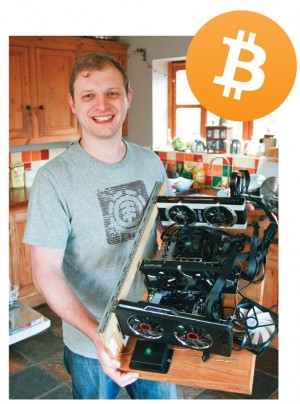
Cofton Hackett crypto-currency miner George Lloyd explains what the Bitcoin fuss is all about.
Bit-what? Bitcoin. It has made quite a few headlines in recent months, which for a nerdy topic is impressive.
It is a currency, designed for worldwide usage by anyone, with no limits, no registration, no credit checks and no application forms.
It has been around since 2009 and has been growing healthily since then. If you don’t know much (or anything) about it then this article should help . . .
Bitcoin is here to stay; it has long passed fad status and anyone who mentions tulips or Ponzi/pyramid schemes is just regurgitating badly-researched news articles.
So what is Bitcoin? Definitely a frequently asked question – and frequently resulting in a confusing answer. There is no easy explanation, but Bitcoin is a borderless currency (some might say commodity), it uses free “open source” software and is based entirely on proven mathematics.
People and businesses around the world dedicate computing power to provide the network required for this worldwide currency and, in return, are rewarded with the currency – for some this reward is their livelihood.
The fundamental property of Bitcoin is that it is decentralised, so no company, country or body of any form controls the currency.
It is all in the hands of its users and this is a new and very important concept – its value is not determined in a boardroom, nor by the amount of kilograms of gold in a government vault and it cannot be devalued by simply printing more of it (quantitative easing).
But why? Another frequent question. We have plastic cards, paper money and PayPal, so why do we need another method?
Well, not everywhere in the world has the luxury we enjoy in the UK or, say, the USA. Somalia, for instance, hasn’t had a functional banking system for years, while Iran’s banks are heavily monitored and excessively regulated, as are others, such as in China and Thailand.
For us “westerners” these aren’t issues for 99 per cent of adults, but it doesn’t mean we are happy with our banking fees or investment fund ethics. Our retailers have to forfeit profit margins to cover card fees and even enforce minimum purchase amounts.
Some retailers simply cannot accept card payments because of the fees, yet we are still steaming ahead towards a cashless society, so shouldn’t we have a cashless currency to match?
What do Bitcoins mean to me, personally? That is easy to answer. From the moment I first read a news story about Bitcoin I was hooked – I spent weeks researching it, following it, talking about it. I saw instantly the fundamental importance of such a currency/commodity.
It is not so much ground-breaking but rather world-shaking; it really is that big. I knew I was already too late to the game to join the ranks of the now millionaires but I could still see where it was going.
Bitcoin has made it to the mainstream earlier than any Bitcoiners imagined and I am immensely proud to be a part of it.
During 2014 I am determined to promote Bitcoin, not for financial gain but for the benefit of the UK and its residents: we and our government should be embracing this technology with everything we have.
I hope my efforts will help – this article is just the start.
To be continued . . .
George Lloyd is co-owner of DiGi-Masters.com Contact him at .(JavaScript must be enabled to view this email address) – he’d love to hear from you.
Pictured: Digital shovel and sieve: George Lloyd with one of the computer ‘rigs’ he has constructed capable of ‘mining’ digital currency 24 hours a day.
