
Mary Green takes stock of spring, from bluebells to buzzards.
February was an unusually dry and exceptionally sunny month (the sunniest February since records began) with warm and cold days and some extremely cold nights.
Plants, especially trees, have not been flowering very early (the cherryplum only just made it out in February and blackthorn not till March, a month later than last year).
March came in sunny but very cold, so it looks as if the late trend will continue.
Bluebells dominate April and May; beautiful and plentiful round here. They are best on a sunny day in woods with young beech leaves, where you can smell their scent among the blue and lime-green haze.
There is a wonderful display in Peck Wood near Rowney Green, though you have to keep alert for the open week at the end of April or early May (depending on how early they come out).
They are also good in the Old Orchard between Barnt Green and Blackwell, in Shortwood above the canal tunnel, in Pinfield Wood in the Lickeys and a delightful little wood called the Winsel near Lydiate Ash.
Usually they are accompanied by red campion and starry white stitchwort, and if you’re lucky yellow archangel, as the world becomes more colourful. Cowslips, too, can be found in undisturbed grassland – I know a beautiful patch near Tardebigge.
The wild cherry (also called mazzard or gean) with its loose white bunches of flowers is at its most beautiful in April and May – to my mind lovelier than the garden varieties – and surprisingly common round here, in hedges, fields and gateways.
Crab apples and “wilding apples” (left over from old plantings) will start flowering in April too, in all combinations of white and red.
In wet meadows you should find the lady’s smock or cuckoo flower, a pretty pale pink flower in the cress family (and therefore having edible leaves). Last year I found an unusual double variety in the fields near my home.
Lady’s smock is the food plant for one of my favourite butterflies, the orange tip. With its bright orange-tipped white wings, it is easy to identify. It is one of the first newly-hatched butterflies that appear in spring, usually April.
Other varieties over-winter as adults, including the brimstone, another sure sign of spring. This is pure primrose yellow, and may provide the origin of our word butterfly.
The oak is coming into leaf now, making a beautiful yellow-green start, usually followed by the less spectacular ash which will be in flower already. Most of us know the old lore about oak and ash: “Oak before ash, only a splash. Ash before oak, many a soak.”
In these warmer days, the oak nearly always wins. Apparently, oak reacts to warmth as well as light, whereas ash is prompted mostly by light. So the oak gets earlier, and the ash doesn’t. It didn’t stop the soaking last year!
The oak looks appropriately good around St George’s Day, April 23. This is also the peak time for dandelions, which are everywhere. It always seems wrong to me that our national flower is the rose, which doesn’t bloom near St George’s Day.
I wouldn’t go for the dandelion either, and I guess the cow-parsley that is abundant now is too ordinary, even if called by its prettier name of Queen Anne’s Lace. One of my friends suggested the forget-me-not, but I would go for the quintessentially English bluebell.
Last month I wrote about familiar garden birds. Bigger birds are around too: the trees I look out on are full of noisy rooks. If you can’t tell a rook from a crow, there is a good country saying: “If you see a group of crows, them’s rooks. If you see a rook, ’e’s a crow.”
Rooks are gregarious birds, and crows more solitary. Everyone knows their other common relative, the magpie. Warming climate means they have spread further north and become more common, so the old superstitions about greeting a solitary magpie to avoid bad luck are hardly ever called for now.
And in many copses round here you may hear the laughing call and see the pink, blue and white colours of the jay as it flashes by, always on the move.
We all see pheasants in the fields, and even gardens. The fact that they are bred not far from the area means that there are seed crops planted, which help other birds as well.
One thing that surprised me when I moved here was the resident buzzards, which I associated more with mountains and moorland. But they live at the top of the hill behind my house, and I see and hear others around Barnt Green and Rowney Green.
There’s nothing else that size round here, so you can’t mistake their magnificent soaring silhouettes and their distinctive mewing cry.
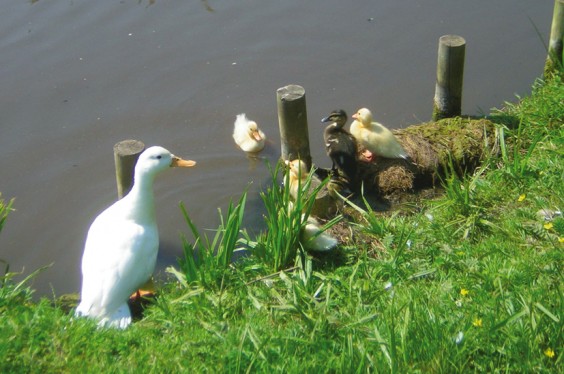
At this time of year, the water birds are a joy. Mallard ducks abound, the males with green heads and bright markings, the females with prettily marked brown feathers. They have broods of ducklings in April and May, little yellow-and-brown fluffy things that take to the water very quickly and are herded about by their parents.
Round here, we had a white farmyard duck join the flock a few years ago. Two years ago there was a brood of mixed yellow and mallard-coloured ducklings, and we now have four white ducks and some mallards with extra white patches.
I know we aren’t supposed to like “aliens”, but I also watch with interest a white goose that joined our resident Canada geese last year. Goslings are lovely ungainly yellow fluffy chicks, and I hope the white one takes part in producing some this year.
Moorhens are very common round here, though very shy. They scoot across to the other side of the canal or pond with their piercing cry when they see you. Their young are lovely, too, little black chicks skittering across the lily pads, unfortunately easy prey to herons and other predators.
On the bigger areas of water, like the Bittel reservoirs, you can also see coot and grebes. Seeing a heron is always a treat, despite its eating habits, as it sits motionless by the water or lifts off on its huge wings. We nearly always refer to it as seeing “the heron”, not “a heron”, just as we hear “the cuckoo” – as if there is only one!
As for the cuckoo, when I was first in the area more than 20 years ago I always heard it – and usually saw it – nearby in April and May, but haven’t done so for several years, having to be satisfied with hearing it on trips to the north where it still seems more common. I hope it comes back this year.
On the early May bank holiday, a group of people will be “beating the bounds” of Alvechurch parish. I hope we hear the cuckoo on the walk and see bluebells and all the other flowers described above – and of course May blossom – but more of that next month!
Beechwoods by Jenna Plewes
Spring sunshine brings the beech leaves
To a simmering mouthwatering greenness,
And the bluebells beneath are a long cool drink of blue.
I walk carefully, but leave a bruised path,
And so I stop, and let the blue-green day sift down around me.
Inside a voice says “Hold on to this, remember this,
Remember this when the busy world reclaims you,
See in your mind’s eye the blue and the green,
And the gentle sky.”
