
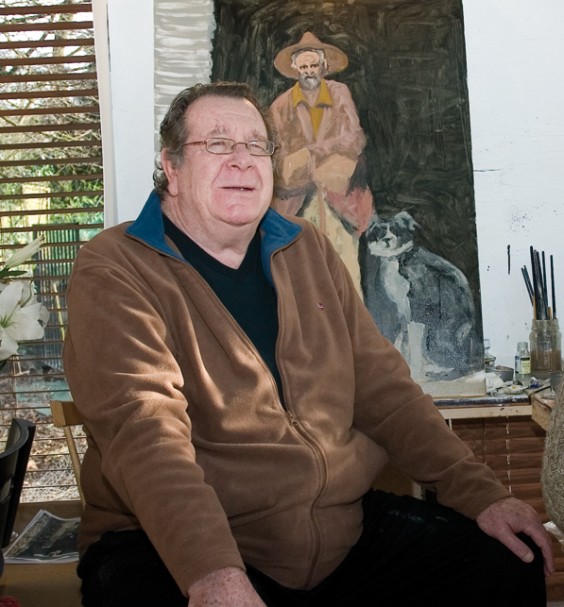
Sally Oldaker meets an art teacher who believes we all have an artistic talent if we have the passion to try.
“I don’t believe in talent,” Denzil Herring states firmly. An unusual remark, perhaps, for an artist; particularly one who is entirely self-taught – but Denzil claims that anyone can be taught to draw as long as they have passion for the subject.
Denzil, a native of South Africa who moved to this country at the end of October, aims to prove his theory further by offering art classes at his Marlbrook home.
A professional artist for 40 years, he is keen to pass on his skills to anyone who wants to learn, whether they are complete beginners or those who already have some artistic training.
“I taught A-Level and O-Level Art in South Africa, and a lot of the kids just didn’t want to learn; I felt sorry for them,” he comments.
“I do believe that anyone can learn, but they need to want to do it.”
He adds that some of the beginners he has taught have gone on to become professional artists, while his wife Irene – who says she had always wanted to study art but never really had the opportunity – has learned enough during their two-year marriage to become Denzil’s teaching assistant.
Denzil himself received no formal training, teaching himself to draw and then to paint by studying books about the Old Masters. His main influence was the Dutch school, in particular artists such as Rembrandt, whose use of light and shade is evident in Denzil’s own work.
“The most important factor is drawing – you have to start with the basics,” he says. “There is technique, which is all about shading and drawing what you see, and there is the technical aspect, which covers things like perspective and linear planes. Put the two together, and you should be able to draw anything.”
To demonstrate how he would teach a student, he hands me a printed grid of boxes with the left-hand side already shaded in pencil, getting progressively darker.
He asks me to shade in the right-hand column in exactly the same way, then to fill the entire centre panel with the colour in box number 5.
Once complete, the grid creates an optical illusion whereby the centre panel appears darker at the top and lighter at the bottom, despite being the same shade throughout. This demonstrates contrast and harmony, showing how colours look different depending on the colours next to them.
“If the subject matter is warm and the background is cool, the main colour will stand out,” Denzil explains, indicating his own study of a flame-haired woman in a vibrant green dress against a shadowy background.
The use of colour is one of the basic tutorials Denzil teaches, along with painting techniques like glaze and scumble (as used by the Old Masters), underpainting and overpainting (as used by the Impressionists), and the correct methods and materials to capture light in different settings.
He also stresses the importance of experimenting: “There are lots of laws in art, but they are not set in stone. You can transgress if you like – as long as you’re taught the correct way first!”
Denzil also gives me a sheet of pencil drawings of eyes, and asks me to choose one to copy. “No lines please, only shading.”
I wonder if it will come up to scratch (he knows that I studied Art to A-Level, so it would be embarrassing to mess it up!) and luckily it seems to meet with his approval.
Surprisingly, Denzil has only been a teacher for about 12 years – his varied career has also included fashion design and a stint in the Navy – and again it was his own experiences that taught him how to instruct others.
“Every time I did an exhibition of my work, people would ask me if I taught, but there didn’t seem to be enough time,” he recalls. “But eventually I decided to try it out, and with a friend I made a four-hour video tape showing people how to paint.”
A university in South Africa showed an interest, so Denzil hired a studio and made a professional video on how to paint still life. He asked artist friends who specialised in other genres to film similar tutorials, and the end result was a seven-part series.
“If the series had been a little longer, a TV company would have agreed to buy it, but unfortunately it was too expensive to make any more,” says Denzil.
However, plenty of people bought the videos and got in touch with questions, so Denzil invited some of them for a lesson – and that was the start of his teaching career.
His work has been displayed across South Africa in municipal buildings and embassies as well as private homes, and his homeland has certainly provided inspiration for many of his wildlife paintings – but the rising crime rate coupled with Irene’s desire to live closer to her son in England meant it was time for the couple to seek pastures new.
“It’s a great adventure to start afresh in a new country,” Denzil says. “I suppose it’s late in life, but what the hell!”
Class times: Tues–Fri 10am–12.30pm; Sat 9.30am–12pm;
Evenings 5.30–8pm
305 Old Birmingham Road
Marlbrook, Bromsgrove
Tel: 07925 465602
